


Description
AT-880 8-in-1 Integrated TSCM Platform | Portable TSCM Equipment
Nine detection technologies. One integrated TSCM inspection platform.
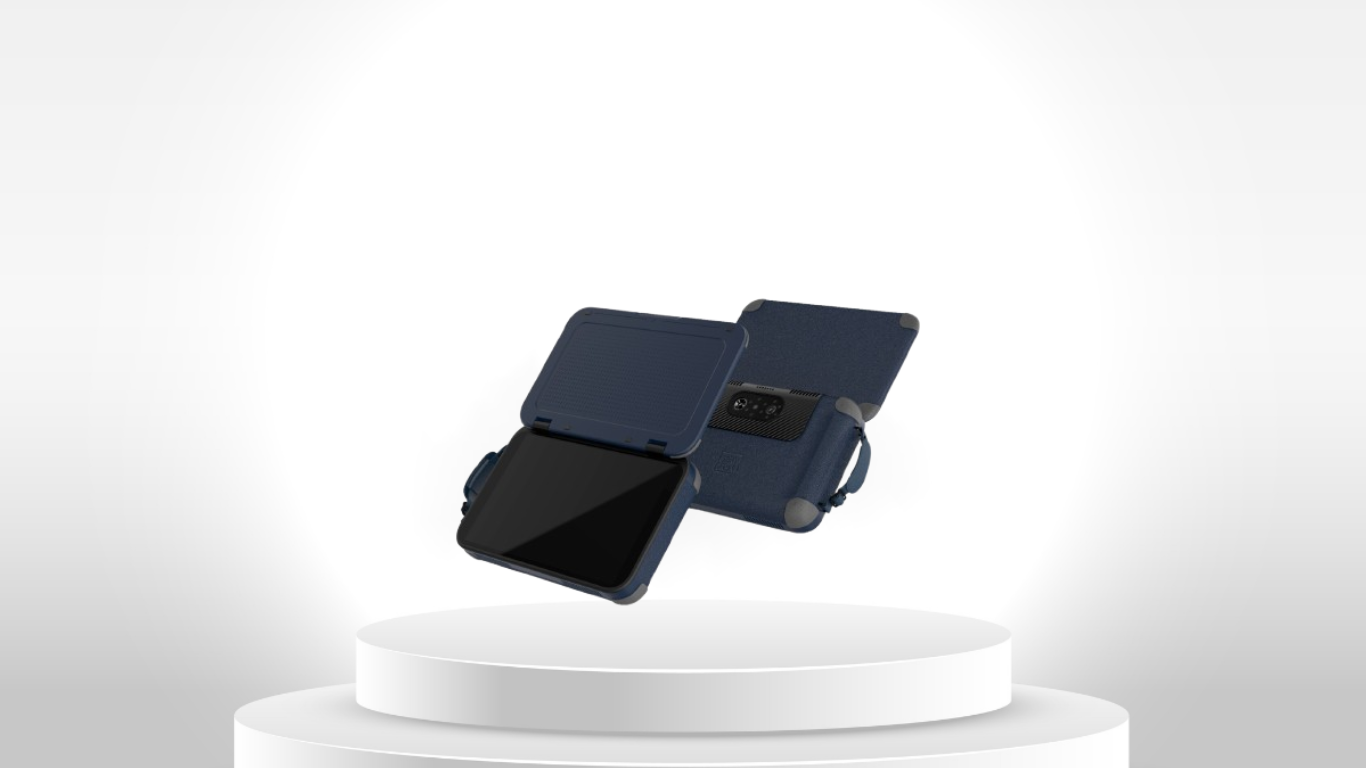
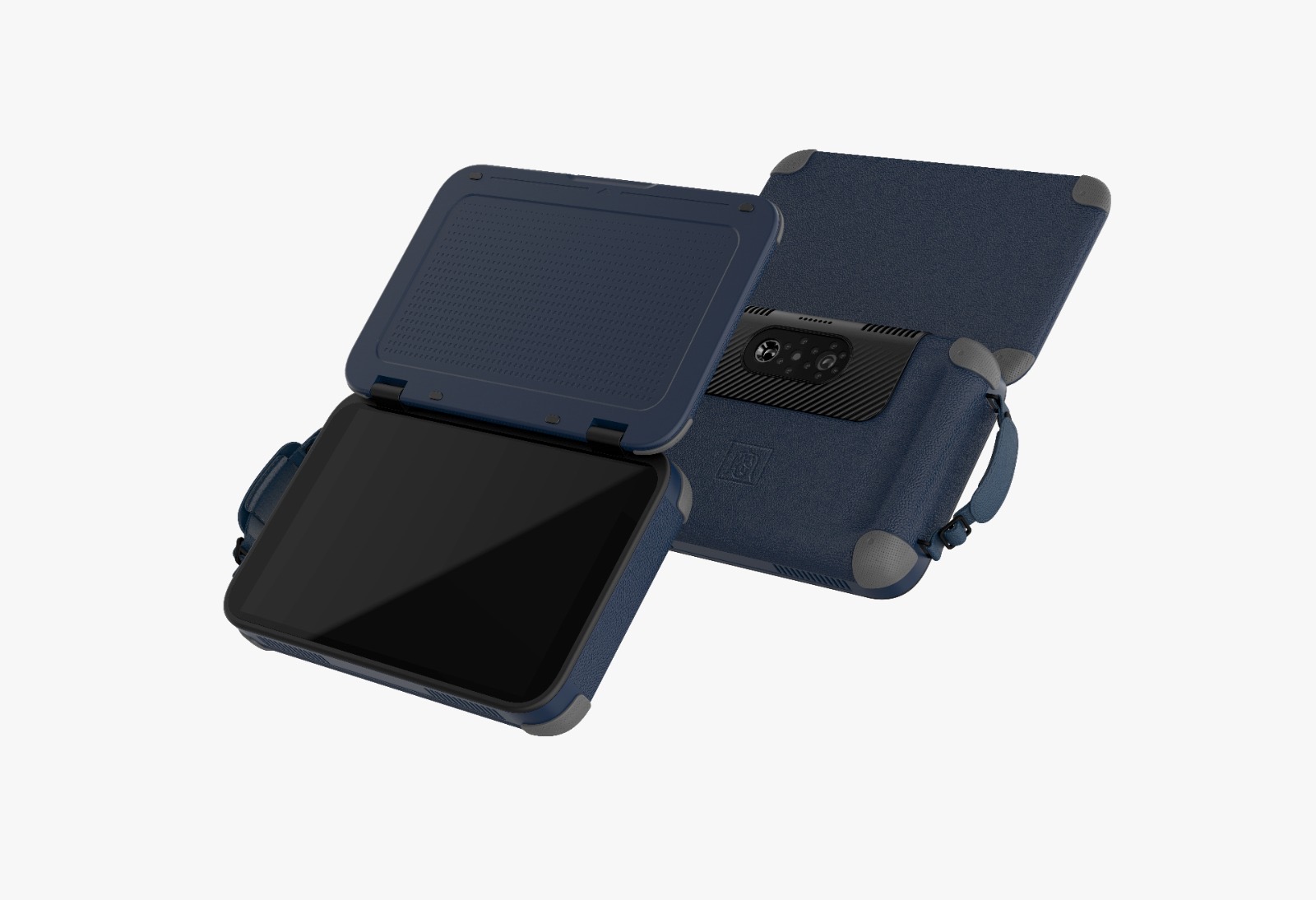
The AT-880 is a portable integrated TSCM platform designed to bring multiple technical surveillance detection methods into one inspection workflow.
Instead of relying on a single detection principle, the AT-880 combines spectrum detection, WiFi analysis, Bluetooth detection, mobile signal detection, hidden camera detection, infrared thermal imaging, endoscope inspection, audio-video restoration and nonlinear junction detection linkage.
The purpose is not simply to put more functions into one device.
It is to help security professionals detect, compare, locate, assess and document suspicious activity within the same inspection process.
The AT-880 also supports data comparison based on time and location, allowing operators to identify differences between inspections and use those changes as an additional input for risk assessment.
Designed for sensitive environments across government, military, enterprise and other security-critical organizations, the AT-880 combines multiple inspection capabilities with a portable form factor and integrated user interface.
Why the AT-880 Is More Than a Multi-Function Detector
TSCM inspections rarely involve only one type of threat.
A suspicious finding may involve:
- An active RF transmission
- A WiFi-connected device
- A Bluetooth device
- A cellular signal
- A concealed camera
- An electronic device hidden inside a structure
- An unusual thermal signature
- A device physically hidden inside a difficult-to-access space
Using separate equipment for every inspection layer can create a fragmented workflow.
The AT-880 brings these detection methods together so the operator can investigate different threat indicators from one platform.
The result is a more connected inspection sequence:
Detect → Identify → Locate → Compare → Assess → Verify → Document
All-in-One TSCM Detection
The AT-880 integrates numerous detection and investigation functions:
- Spectrum Detection
- WiFi Detection and Analysis
- Bluetooth Detection
- Mobile Signal Detection
- Hidden Camera Detection
- Infrared Thermal Imaging
- Endoscope Detection
- Audio-Video Restoration
- Nonlinear Junction Detection Linkage
Each function addresses a different part of the inspection problem.
The advantage is not simply having nine tools available.
The advantage is being able to move between different detection methods without rebuilding the entire inspection workflow around another device.
Spectrum Detection for Broad RF Awareness
The spectrum detection function provides real-time spectrum and waterfall displays across the specified frequency range.
It is designed to help operators:
- Observe RF activity
- Track signals
- Identify changes in the RF environment
- Investigate suspicious frequencies
- Support signal localization
The spectrum view provides a broader picture of the RF environment before the operator focuses on a specific signal.
This is particularly useful in environments where multiple legitimate wireless systems are operating simultaneously.
WiFi Detection for Network-Aware Inspection
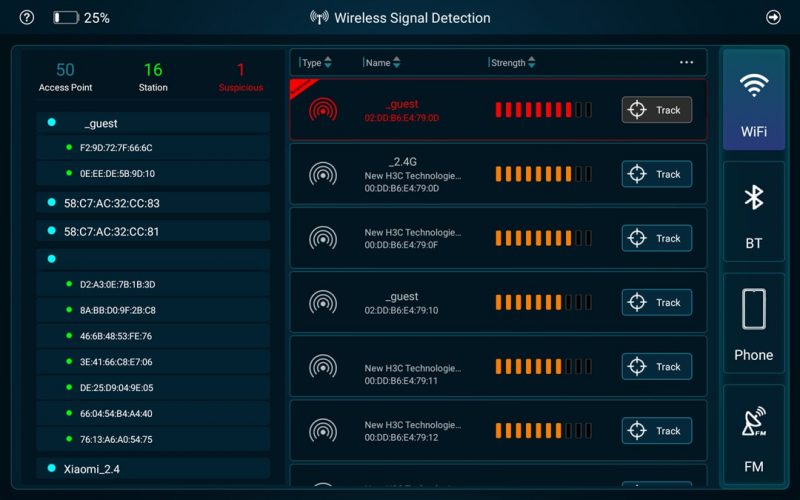
WiFi analysis goes beyond simply detecting the presence of WiFi.
The AT-880 supports 802.11 a/b/g/n/ac WiFi signal analysis and can display a WiFi topology map showing relationships between hotspots and connected terminals.
This provides an important operational advantage.
Instead of seeing only:
“WiFi is present.”
the operator can investigate:
“Which devices are connected, how are they related, and which devices require closer assessment?”
The system can also automatically identify and mark suspicious devices engaged in video-related activity over WiFi.
This creates a more useful inspection layer for modern connected environments.
Bluetooth Detection and Device Identification
Bluetooth environments can contain phones, tablets, watches, computer peripherals and other connected devices.
The AT-880 supports Bluetooth signal analysis across:
- Bluetooth 1.0
- Bluetooth 2.0
- Bluetooth 3.0
- Bluetooth 4.0
- Bluetooth 5.2
The system can provide information including:
- Device name
- MAC address
- Signal strength
- Other available terminal information
This helps the operator move beyond simply knowing that Bluetooth activity exists.
The objective is to identify the devices present in the environment and determine whether their presence is expected.
Apple Device Recognition
The AT-880 includes a dedicated Apple-device recognition capability.
It can support detection and localization of Apple devices including:
- iPhone
- iPad
- Mac computers
- AirPods
- Apple Watch
- Other supported Apple devices
The system can identify device models and provide signal-strength information.
This can be particularly useful in environments where a large number of personal Apple devices are present and the operator needs greater visibility into the wireless environment.
Mobile Signal Detection
The AT-880 can detect mobile communication signals associated with the major cellular network standards supported by the system.
It is designed to identify mobile activity including different communication states such as:
- Idle activity
- Calling
- Voice calls
- Video calls
- Data activity
This provides another layer of visibility into cellular activity within the inspection environment.
For a TSCM operator, the practical question is not simply whether a cellular signal exists.
It is whether the detected activity is consistent with the expected environment or warrants additional investigation.
Hidden Camera Detection
Hidden camera inspection provides a dedicated detection layer for covert visual surveillance.
The AT-880 integrates this capability into the broader TSCM workflow rather than treating camera inspection as a completely separate task.
This allows operators to investigate potential visual surveillance alongside:
- RF activity
- WiFi activity
- Bluetooth devices
- Cellular signals
- Thermal anomalies
- Physical concealment
That combination is particularly relevant in modern environments where a hidden camera may be connected to a wireless network rather than operating as an isolated device.
Infrared Thermal Imaging for Physical Assessment
The integrated infrared thermal imaging function adds another inspection dimension:
temperature.
The system supports a specified temperature range of −20°C to +150°C and allows customizable alarm thresholds.
Thermal imaging can help operators identify unusual temperature differences that may justify further physical inspection.
This does not mean that every thermal anomaly represents surveillance equipment.
The value is in providing another source of evidence when evaluating an area that already warrants attention.
Endoscope Detection for Difficult-to-Reach Spaces
Some surveillance threats cannot be adequately investigated from the outside.
They may be concealed:
- Inside narrow cavities
- Behind panels
- Inside furniture
- Within structural gaps
- Inside difficult-to-access spaces
The AT-880 incorporates endoscope inspection with a specified 1920 × 1080 image resolution.
This provides a direct visual inspection method for areas that cannot easily be examined by conventional visual inspection.
The practical workflow becomes:
Detect a suspicious area → Access the concealed space → Inspect visually → Identify the object → Verify
Audio-Video Restoration
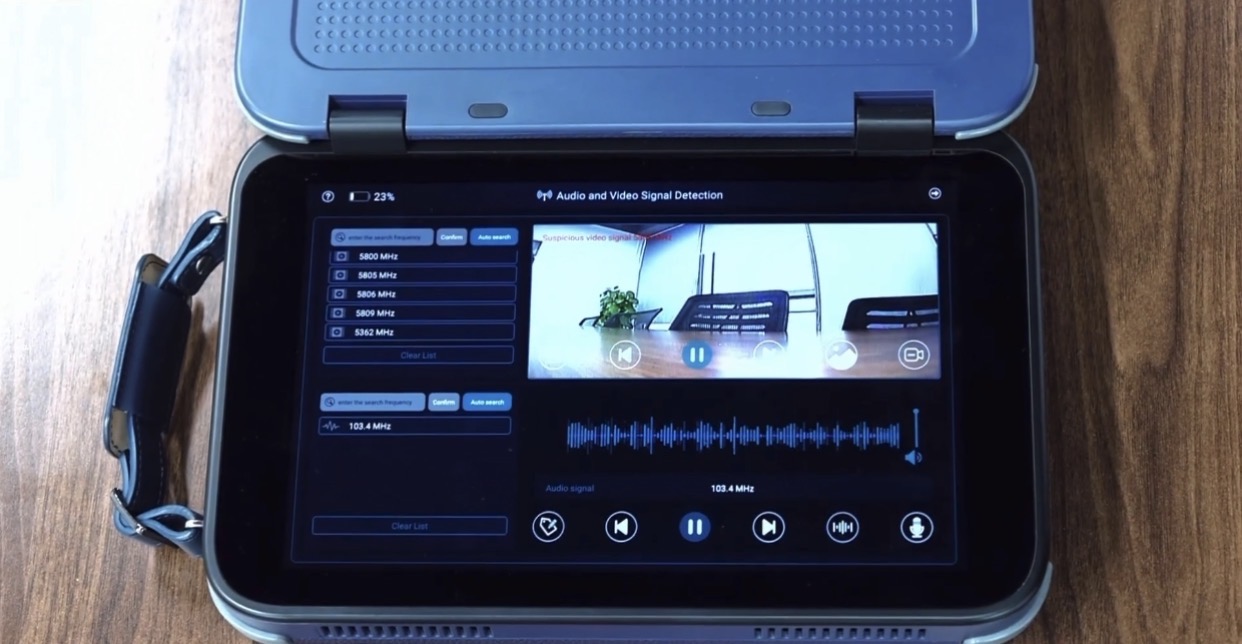
The AT-880 also includes audio-video restoration functionality.
This provides an additional investigation capability for searching and restoring analog audio and video signals.
Rather than limiting the platform to detection alone, this function extends the workflow toward recovering and examining potentially relevant signal information.
The capability is particularly relevant when an inspection requires investigation of analog audio or video sources in addition to modern wireless detection.
Nonlinear Junction Detection Linkage
The AT-880 includes linkage with nonlinear junction detection equipment.
NLJD technology provides a different detection principle from RF and wireless signal analysis.
It can help investigate concealed electronic components even when a device is not actively transmitting.
This gives the AT-880 a complementary detection layer:
Wireless detection finds active transmissions.
NLJD investigates concealed electronic circuitry.
Together, these methods address different operating states of electronic surveillance equipment.
Integrated TSCM Workflow
The AT-880 is designed to support a more connected inspection workflow rather than isolated testing.
A practical inspection can move through multiple layers:
Step 1 — Establish the RF Environment
Use spectrum detection to understand the surrounding RF activity.
Step 2 — Examine Connected Devices
Use WiFi and Bluetooth analysis to identify wireless devices and their relationships.
Step 3 — Investigate Cellular Activity
Examine mobile communication activity within the inspection environment.
Step 4 — Inspect for Visual Surveillance
Use hidden-camera detection to investigate potential covert visual surveillance.
Step 5 — Investigate Physical Anomalies
Use infrared imaging and endoscope inspection when the environment requires deeper physical examination.
Step 6 — Investigate Concealed Electronics
Use nonlinear junction detection linkage where concealed electronic components require investigation.
Step 7 — Compare and Assess
Use historical and location-based data comparison to identify changes and differences between inspections.
Step 8 — Document
Maintain inspection data and generate unified records for subsequent review.
This is where the integrated architecture becomes valuable.
Historical Data Comparison for Risk Assessment
One of the more distinctive capabilities of the AT-880 is its ability to compare testing data based on time and location.
This changes the inspection from a single snapshot into something that can be compared over time.
For example:
What was present during the previous inspection?
What is different today?
Which signals or devices appeared or disappeared?
Has the environment changed?
These comparisons can provide additional information for risk assessment.
A new signal does not automatically mean a threat.
But a change in the expected environment can be a reason for further investigation.
Data Backtracking and Unified Reporting
The AT-880 supports data archiving and backtracking across the inspection process, including data associated with nonlinear junction detection.
The objective is to preserve more of the inspection process instead of relying solely on an operator’s memory or isolated screenshots.
This can support:
- Historical review
- Comparison between inspections
- Location-based analysis
- Follow-up investigation
- Documentation
- Internal security records
For professional TSCM operations, this can be as important as the initial detection itself.
A finding that cannot be reviewed later is harder to compare, explain and defend.
Precise Positioning of Suspicious Signals
The AT-880 combines directional and omnidirectional antennas with an electronic compass and historical signal-strength information.
This supports a more systematic approach to signal localization.
Instead of simply detecting that a signal exists, the operator can use:
- Direction
- Signal strength
- Historical signal information
- Electronic compass information
to help narrow down the source.
The system also provides approaching-style directional indication and progressive sound alerts designed to guide the operator toward a detected target.
The operational principle is simple:
Detect → Direction → Approach → Signal Strength → Narrow → Verify
Designed for Real-World TSCM Operators
The AT-880 is designed around the reality that TSCM operators often work in environments where multiple technologies coexist.
A modern meeting room can contain:
- WiFi access points
- Smartphones
- Smartwatches
- Bluetooth peripherals
- Cellular devices
- Laptops
- Cameras
- Legitimate IoT equipment
The challenge is therefore not simply detecting signals.
The challenge is understanding what belongs in the environment, what has changed, what is unusual, and what deserves physical investigation.
AT-880 is designed to provide multiple information layers to support that decision.
Portable Integrated Design
Despite its broad detection architecture, the AT-880 is designed as a portable platform.
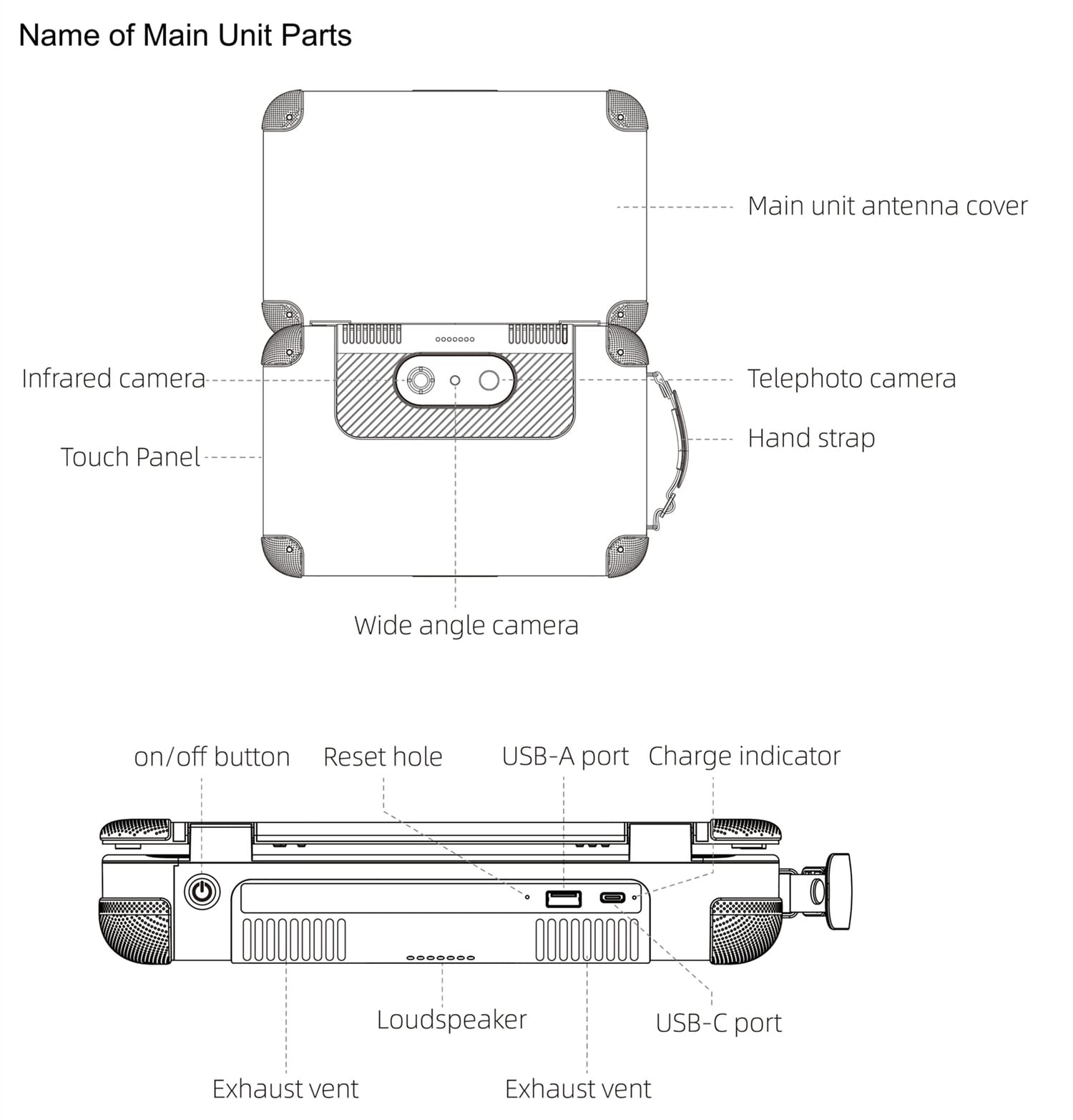
The host weighs less than 1.75 kg and incorporates built-in antennas and a 10.1-inch high-definition touchscreen.
The screen provides a 1920 × 1200 resolution.
The integrated design reduces the need to carry multiple independent interfaces during routine inspection work.
This is particularly useful when an operator needs to move between rooms, floors, vehicles or other inspection locations.
User Interface Designed for Fast Access
The AT-880 uses a simplified interface designed to make major detection functions accessible quickly.
The interface supports:
- One-click access to major functions
- Multiple detection modes
- Direct access to topology maps
- Spectrum and waterfall views
- Signal positioning
- Historical data review
The objective is not to make the technology less sophisticated.
It is to reduce unnecessary interaction between the operator and the equipment while the operator is conducting a physical sweep.
Applications
Executive and Boardroom TSCM
Sensitive meeting rooms can contain large amounts of legitimate wireless activity.
AT-880 allows operators to investigate RF, WiFi, Bluetooth, cellular, hidden-camera and physical concealment indicators within one inspection workflow.
Government and Sensitive Facilities
Government environments can require systematic inspection and documented security assessment.
The AT-880’s integrated detection and data-backtracking capabilities can support recurring inspection procedures.
Military and Defense Environments
Sensitive facilities may require multiple detection methodologies rather than reliance on one detector type.
The AT-880 provides multiple inspection layers in a portable platform.
Corporate Security
Organizations protecting confidential information, intellectual property and strategic discussions can use the platform to investigate changes in their electronic environment.
Hotels and Privacy-Sensitive Locations
Hotels, residences and other privacy-sensitive environments contain extensive legitimate wireless activity.
The ability to correlate WiFi, Bluetooth, cellular, RF and physical inspection information can help operators distinguish normal activity from areas requiring further investigation.
Recurring TSCM Inspections
The time-and-location comparison architecture is particularly relevant when the same facility is inspected repeatedly.
Rather than treating every inspection as a completely independent event, operators can compare the current environment against historical data.
What AT-880 Can Do
AT-880 can help security professionals:
- Monitor the RF environment
- Analyze WiFi activity
- Visualize WiFi topology
- Analyze Bluetooth devices
- Identify supported Apple devices
- Detect mobile communication activity
- Investigate hidden cameras
- Examine thermal anomalies
- Inspect difficult-to-access spaces with an endoscope
- Restore analog audio and video signals
- Link with nonlinear junction detection
- Locate suspicious wireless sources
- Compare detection data by time and location
- Archive inspection data
- Review previous inspection results
- Support unified reporting
- Conduct multiple TSCM detection functions from one portable platform
What AT-880 Does Not Automatically Determine
The AT-880 is a detection and investigation platform.
It does not automatically classify every detected signal, device or anomaly as a surveillance threat.
For example:
A WiFi device may be legitimate.
A Bluetooth device may belong to an employee.
A cellular signal may come from an ordinary smartphone.
A thermal anomaly may have a completely legitimate source.
An NLJD response may originate from ordinary electronics.
The purpose of the platform is to provide more information for professional assessment, not to replace that assessment.
The final determination should be based on the inspection methodology, environmental context and physical verification.
Why Integrated Detection Matters
The strongest feature of AT-880 is not any individual detector.
It is the ability to connect multiple forms of evidence.
A suspicious finding can be investigated through several independent perspectives:
RF
What signals are present?
WiFi
What devices are connected?
Bluetooth
What nearby devices are communicating?
Cellular
What mobile activity exists?
Camera Detection
Could covert visual surveillance be present?
Thermal
Is there an unusual heat signature?
Endoscope
What is physically hidden inside the space?
NLJD
Could concealed electronics exist even without active transmission?
Historical Data
What has changed since the previous inspection?
This is the difference between detecting an anomaly and building a stronger basis for assessing the anomaly.
Technical Specifications
| Parameter | Specification |
|---|---|
| Product Type | Portable Integrated TSCM Equipment |
| Detection Architecture | Nine integrated detection/investigation functions |
| Host Weight | <1.75 kg |
| Display | 10.1-inch HD touchscreen |
| Screen Resolution | 1920 × 1200 |
| Infrared Imaging Resolution | 384 × 288 |
| Endoscope Resolution | 1920 × 1080 |
| Spectrum Detection | Real-time spectrum and waterfall display |
| Spectrum Range | 1 MHz–90 GHz |
| WiFi | 802.11 a/b/g/n/ac analysis |
| Bluetooth | Bluetooth 1.0 / 2.0 / 3.0 / 4.0 / 5.2 |
| Bluetooth Information | Device name, MAC address, signal strength and available terminal information |
| Mobile Signal Detection | Major cellular communication standards supported by the system |
| Apple Device Detection | Supported Apple devices including phones, computers, headphones, watches and AirPods |
| Thermal Imaging Temperature Range | −20°C to +150°C |
| WiFi Analysis | WiFi topology and terminal relationship visualization |
| Endoscope | 1920 × 1080 |
| Audio-Video Restoration | Analog audio and video signal search and restoration |
| NLJD Linkage | Supports linkage with nonlinear junction detectors |
| Signal Positioning | Directional + omnidirectional antennas |
| Directional Assistance | Electronic compass |
| Signal Tracking | Historical signal-strength display |
| Wireless Alert | Progressive sound alarm |
| Storage | Built-in storage for inspection data and video |
| Operating Time | Approx. 2.5 hours; supports use while charging |
| USB | USB-A and USB-C |
| Working Temperature | −25°C to +55°C |
| Working Humidity | ≤93% RH, non-condensing |
Specifications are based on the supplied manufacturer product information. Certain source specifications contain formatting/OCR inconsistencies, so final technical configuration should be confirmed with the manufacturer before procurement.
Frequently Asked Questions About AT-880 Portable Integrated TSCM Equipment
What is the AT-880?
AT-880 is a portable integrated TSCM platform that combines nine detection and investigation functions into one device.
It is designed to help security professionals investigate RF, wireless, concealed electronic, visual surveillance and physical inspection threats within one workflow.
What are the nine functions in AT-880?
The platform integrates:
- Spectrum detection
- WiFi detection and analysis
- Bluetooth detection
- Mobile signal detection
- Hidden camera detection
- Infrared thermal imaging
- Endoscope detection
- Audio-video restoration
- Nonlinear junction detection linkage
Why would a TSCM operator need nine detection methods?
Because surveillance threats do not all behave the same way.
An active wireless transmitter, a powered-off electronic device, a concealed camera, a suspicious thermal anomaly and a device hidden inside a physical cavity require different inspection approaches.
AT-880 allows these different approaches to be performed from one integrated platform.
Is AT-880 an RF detector?
It includes spectrum detection, but it is more than an RF detector.
It also includes WiFi, Bluetooth, mobile signal, hidden camera, thermal, endoscope, audio-video restoration and NLJD linkage capabilities.
Can AT-880 detect WiFi devices?
Yes.
It supports 802.11 a/b/g/n/ac WiFi signal analysis and can display WiFi topology showing hotspots and terminal connections.
What is WiFi topology detection?
Instead of simply showing that WiFi exists, topology analysis can visualize relationships between WiFi hotspots and connected terminals.
This can help operators understand the structure of the wireless environment and identify devices that warrant closer investigation.
Can AT-880 identify suspicious WiFi devices?
The manufacturer states that the system can automatically identify and mark suspicious devices engaged in video activity via WiFi.
This should be treated as an investigative indicator rather than automatic proof that a device is malicious.
Can AT-880 detect Bluetooth devices?
Yes.
It supports Bluetooth 1.0, 2.0, 3.0, 4.0 and 5.2 signal analysis.
What information can Bluetooth detection provide?
The system can provide information such as device name, MAC address and signal strength, together with other available terminal information.
Can AT-880 recognize Apple devices?
Yes.
The system supports detection and localization of various Apple devices, including phones, computers, headphones, watches and AirPods, and can provide model and signal-strength information.
Why is Apple device recognition useful in TSCM?
Modern environments can contain many legitimate Apple devices.
Being able to identify and locate supported Apple devices can help operators establish what is normal in an environment before assessing whether another device or signal is unusual.
Can AT-880 detect cellular activity?
Yes.
The mobile signal detection function is designed to detect supported cellular communication signals and can identify different activity states including calling, voice, video and data-related activity.
Does detecting a mobile signal mean there is a hidden listening device?
No.
A detected cellular signal can come from an ordinary smartphone or another legitimate device.
Professional assessment and source identification are required.
What does the infrared thermal imaging function add?
It provides another physical inspection layer.
The system can identify temperature differences across the inspection area within its specified temperature range and supports customizable alarm thresholds.
A thermal anomaly should be investigated in context rather than automatically treated as surveillance equipment.
What is the infrared resolution?
The specified infrared thermal imaging resolution is 384 × 288.
What is the endoscope used for?
The endoscope provides visual inspection of difficult-to-access spaces where a conventional visual inspection cannot reach.
It can be useful for investigating cavities, narrow spaces, concealed compartments and other physically inaccessible areas.
What is the endoscope resolution?
The specified endoscope image resolution is 1920 × 1080.
Does AT-880 include NLJD?
Yes.
The platform supports nonlinear junction detection linkage.
This provides a complementary detection method for investigating concealed electronic components that may not be actively transmitting.
Why is NLJD linkage important?
Wireless detection is primarily concerned with active transmissions.
NLJD provides a different method for investigating concealed electronics.
Having both approaches available allows the operator to investigate different device states within a broader TSCM workflow.
Can AT-880 restore audio and video signals?
The manufacturer specifies support for searching and restoring analog audio and video signals.
This extends the platform beyond detection toward signal investigation and recovery.
Can AT-880 locate suspicious wireless signals?
Yes.
The platform uses directional and omnidirectional antennas, an electronic compass and historical signal-strength information to assist with signal positioning.
How does signal positioning work?
The system provides directional assistance and signal-strength information.
The operator can use the direction indicator and changing signal strength to move toward a detected source and progressively narrow the search area.
Does AT-880 identify the exact source of every wireless signal?
No.
Signal positioning helps locate a source, but source identity still requires professional investigation and verification.
Can AT-880 compare current and previous inspections?
Yes.
The platform supports data comparison based on time and location.
This can help operators identify differences between inspections and use those changes as part of a broader risk assessment.
Why is historical comparison important in TSCM?
A single inspection shows what is present at one point in time.
Repeated inspections can reveal what has changed.
A new signal, device or anomaly does not automatically indicate a threat, but changes in the environment can provide useful investigative leads.
Does AT-880 generate inspection records?
The platform supports data archiving and backtracking across the inspection process and can generate unified-format reporting.
This can support recurring TSCM programs where historical inspection records need to be reviewed.
How long can AT-880 operate?
The supplied specification indicates approximately 2.5 hours of operating time and supports operation while charging.
Actual operating time can vary depending on which detection functions are being used.
Is AT-880 suitable for C-Suite security decision-makers?
Yes.
The simplest way to understand its value is:
Instead of buying separate tools for every detection problem, AT-880 combines multiple TSCM inspection layers into one portable platform.
This can simplify equipment deployment, reduce workflow fragmentation and provide more information during a security inspection.
Is AT-880 suitable for professional TSCM operators?
Yes.
Its broad detection architecture, signal positioning, topology analysis, thermal imaging, endoscope inspection, NLJD linkage and historical data capabilities are designed around professional security inspection workflows.
What should a TSCM expert evaluate before purchasing AT-880?
An expert should evaluate:
- Spectrum coverage
- Waterfall performance
- WiFi standards supported
- WiFi topology capability
- Bluetooth versions
- Cellular technologies
- Apple-device recognition capability
- Hidden-camera detection methodology
- Thermal resolution and sensitivity
- Endoscope image quality
- NLJD linkage architecture
- Signal-positioning accuracy
- Historical data comparison
- Data export and reporting
- Battery performance
- Operating while charging
- Weight and portability
- Environmental operating range
- Manufacturer support
- Applicable certifications and testing documentation
The key question is not simply how many functions are listed.
It is whether those functions can be integrated into a practical inspection workflow that produces useful evidence and reduces unnecessary secondary investigation.


Reviews
There are no reviews yet.