


Description
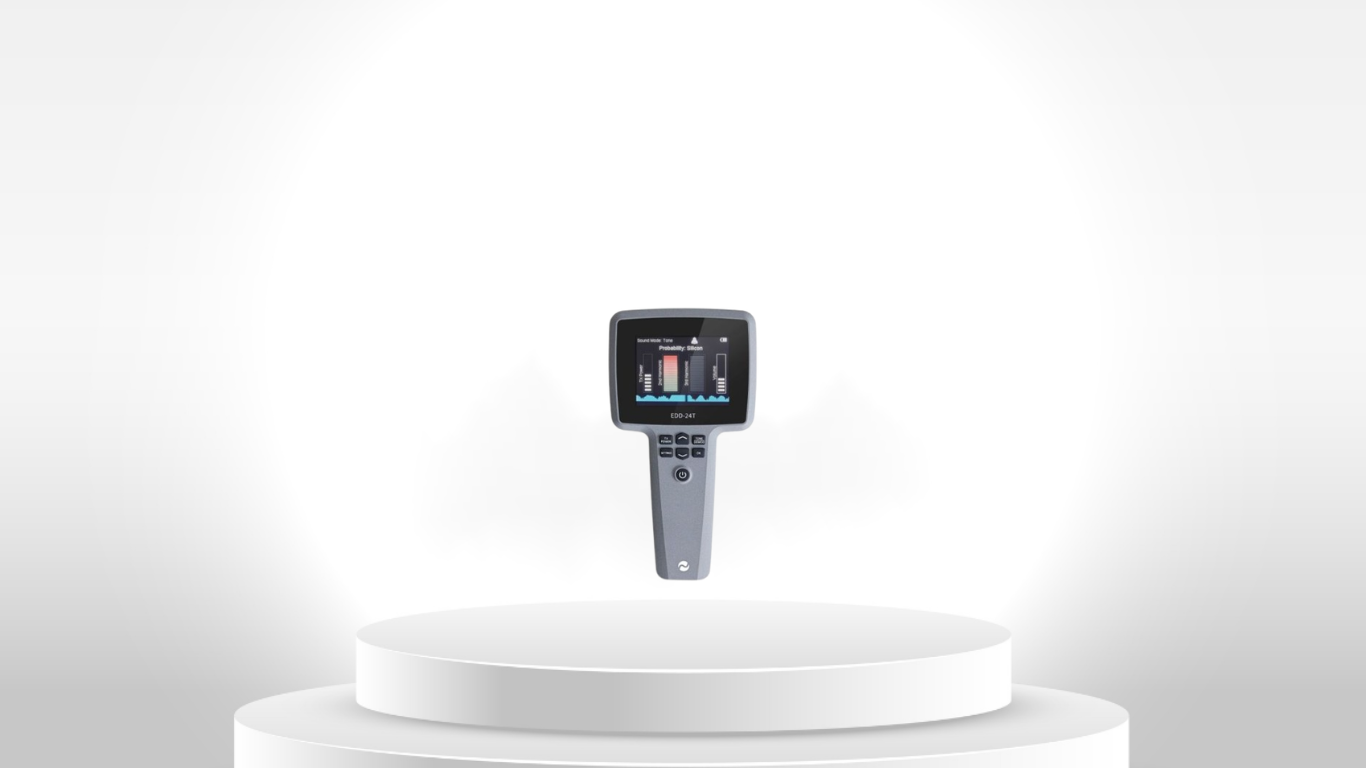
EDD-24T Handheld Non-Linear Junction Detector
Professional NLJD technology for detecting concealed electronic devices — including electronics that may be switched off, inactive or not transmitting.
The EDD-24T is a handheld Non-Linear Junction Detector (NLJD) designed to investigate semiconductor-based electronic components concealed within objects, structures and restricted-access areas.
Unlike an RF detector, which looks for wireless emissions, an NLJD works by transmitting a focused microwave signal and analysing harmonic responses produced by electronic junctions. This allows the EDD-24T to investigate electronic devices that may be active, in standby or switched off.
For professional TSCM work, this makes the EDD-24T a complementary detection technology to RF detection and spectrum analysis rather than a replacement for them.
What Is the EDD-24T Designed to Detect?
The EDD-24T is designed to detect semiconductor circuitry found in a wide range of modern electronic devices.
Manufacturer applications include the investigation of:
- Concealed listening devices
- Electronic voice recorders
- Covert cameras
- Mobile phones
- Tracking devices
- SIM cards
- Other electronic devices containing semiconductor components
Importantly, the manufacturer specifies that the device can investigate electronics that are in use, in standby or switched off.
This is the key distinction between NLJD detection and conventional RF detection.
An electronic device does not need to be actively transmitting a radio signal for its semiconductor components to produce a detectable nonlinear response.
How Does an NLJD Work?
The EDD-24T uses a focused directional probing signal at approximately 2.4 GHz.
When the signal interacts with semiconductor junctions, harmonic responses can be produced. The EDD-24T receives and analyses:
- 2nd harmonic: approximately 4.8 GHz
- 3rd harmonic: approximately 7.2 GHz
The manufacturer explains that semiconductor electronics typically produce a stronger 2nd-harmonic response, while materials such as oxidised metals and some bi-metal structures can produce 3rd-harmonic responses.
This two-harmonic architecture provides more information than simply detecting that “something” is responding.
2nd Harmonic and 3rd Harmonic Detection
2nd Harmonic — Electronic / Semiconductor Response
The 2nd-harmonic receiver is used to identify responses associated with semiconductor electronics.
This is particularly relevant when investigating concealed electronic devices such as:
- Listening devices
- Recorders
- Cameras
- Tracking devices
- Mobile phones
- SIM cards
The manufacturer specifies receiver sensitivity of better than −120 dBm on the 2nd and 3rd harmonics.
3rd Harmonic — Additional Response Information
The 3rd-harmonic receiver provides an additional source of information when interpreting a detected response.
The manufacturer notes that some oxidised metals, bi-metals and other non-electronic structures can generate 3rd-harmonic responses. The EDD-24T therefore uses both harmonic channels to help assess whether a response is more consistent with silicon-based electronics or metal.
The result should still be treated as a detection response requiring professional interpretation and, where appropriate, physical verification.
Silicon or Metal Probability Indicator
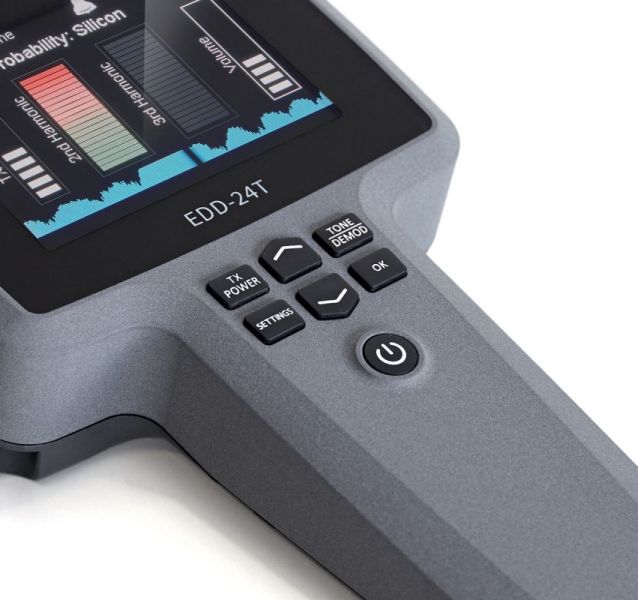
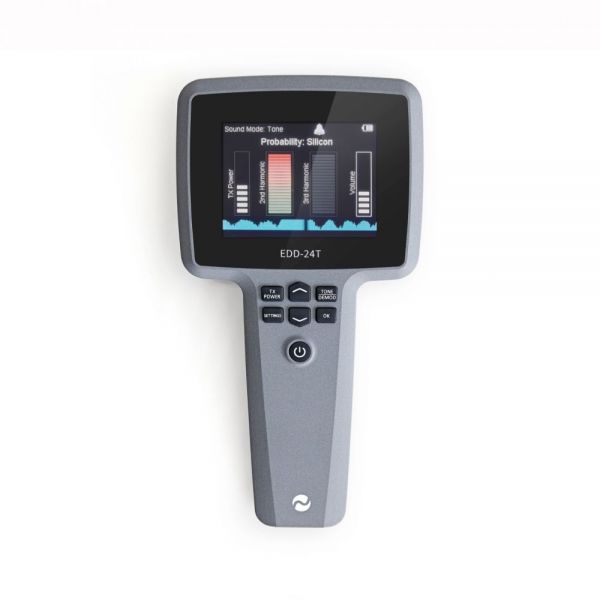
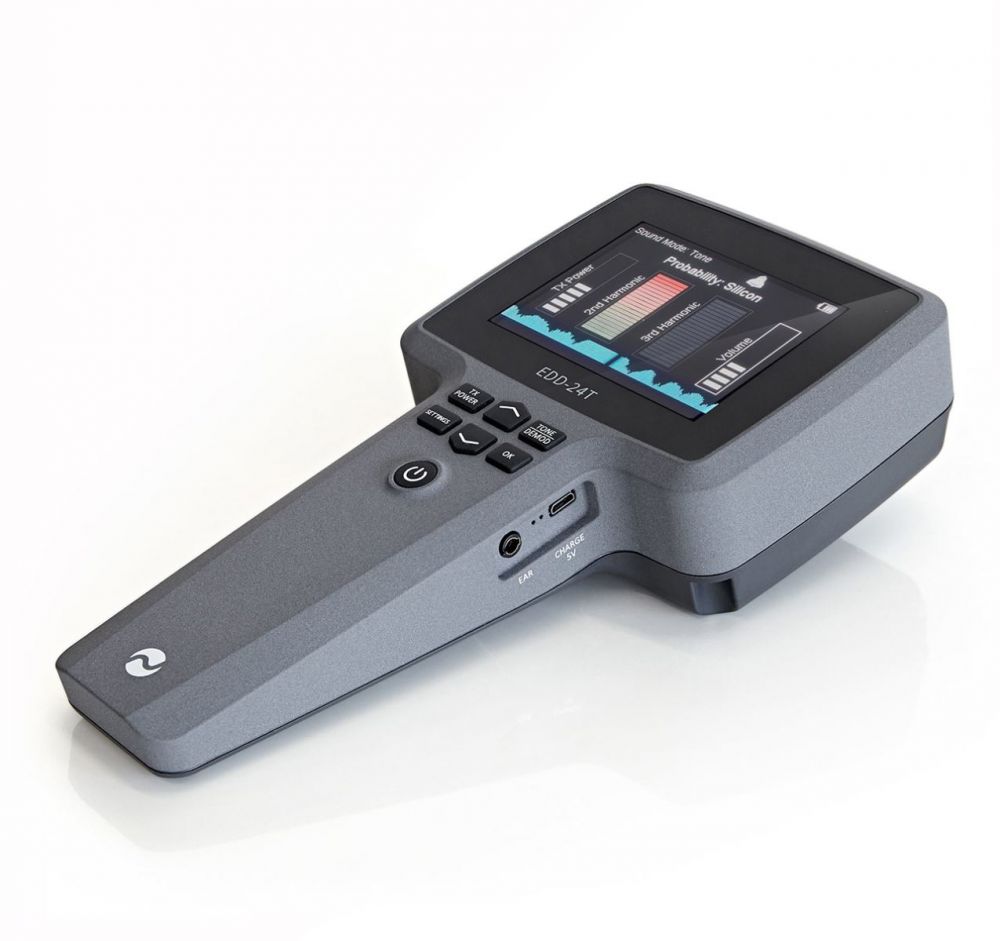
One of the EDD-24T’s distinctive features is its Silicon / Metal probability indicator.
The system analyses information from the 2nd- and 3rd-harmonic receivers and provides an indication of whether the detected material is more likely to correspond to silicon or metal.
This provides an additional interpretation layer during a sweep.
It does not automatically identify a surveillance device.
A silicon indication means that the response is consistent with semiconductor material; it does not by itself establish the identity, purpose or threat status of the object.
Audio Confirmation: TONE and DEMOD Modes
The EDD-24T provides two audio-based confirmation modes through its internal speaker or connected earphones.
TONE Mode
TONE Mode provides an audible indication of the detected 2nd-harmonic response.
The tone changes in pitch according to the detected signal strength, allowing an operator to monitor changes without continuously looking at the display.
DEMOD Mode
DEMOD Mode provides an audio representation of the demodulated 2nd-harmonic receiver signal.
The manufacturer describes this as an additional method for assessing detected responses.
Together, the visual indicator and audio functions give the operator multiple ways to interpret a detection response during an inspection.
Designed for Professional TSCM Inspection
The EDD-24T is positioned by its manufacturer for professional counter-surveillance and TSCM applications.
Selcom identifies applications including:
- Searching for active and passive electronic eavesdropping devices
- Detecting SIM cards and mobile phones
- Investigating bugging devices
- Investigating voice recorders
- Investigating covert cameras
- Searching for other semiconductor-based electronic devices
- Screening parcels or mail for electronic components
- Checking personnel for semiconductor-containing devices in restricted environments
The appropriate application depends on the inspection requirement, environment and applicable authorization.
Why Use NLJD Instead of Only RF Detection?
RF detection and NLJD detection answer different questions.
RF detection asks:
Is an active wireless transmission present?
NLJD detection asks:
Is there electronic circuitry producing a nonlinear response in this area?
A surveillance device may be switched off, inactive, disconnected from power or simply not transmitting at the time of inspection.
In those circumstances, an RF detector may have no wireless signal to identify.
An NLJD provides a complementary detection method by investigating the electronic circuitry itself.
For this reason, professional TSCM inspections often use multiple detection principles rather than relying on a single instrument.
EDD-24T vs. RF Detector
| Inspection Requirement | EDD-24T NLJD | Conventional RF Detector |
|---|---|---|
| Detect active RF transmission | Not its primary function | Yes |
| Investigate powered-off electronics | Yes, through NLJD principle | Generally no |
| Investigate non-transmitting electronics | Yes | Generally no |
| Detect semiconductor components | Yes | No |
| Detect wireless emissions | Not its primary function | Yes |
| Analyse 2nd / 3rd harmonic responses | Yes | No |
| Provide Silicon / Metal indication | Yes | No |
| Audio TONE / DEMOD functions | Yes | Model dependent |
| Complementary TSCM technology | Yes | Yes |
The EDD-24T should therefore be considered part of a layered TSCM capability, not as a universal replacement for RF analysis.
Directional Detection Architecture
The EDD-24T uses a focused directional probing signal at 2.4 GHz.
Its directional architecture allows the operator to investigate specific areas and objects rather than treating the entire inspection environment as one undifferentiated detection zone.
The manufacturer states that the EDD-24T can detect Nano SIM cards from up to 20 cm under its specified conditions.
This should be understood as a manufacturer-stated detection capability rather than a universal detection distance for every electronic target.
Actual performance can vary with:
- Target construction
- Target size
- Target orientation
- Concealment material
- Distance
- Environmental conditions
- Antenna positioning
- Operator technique
- Electronic and metallic structures surrounding the target
Built for Portable TSCM Work
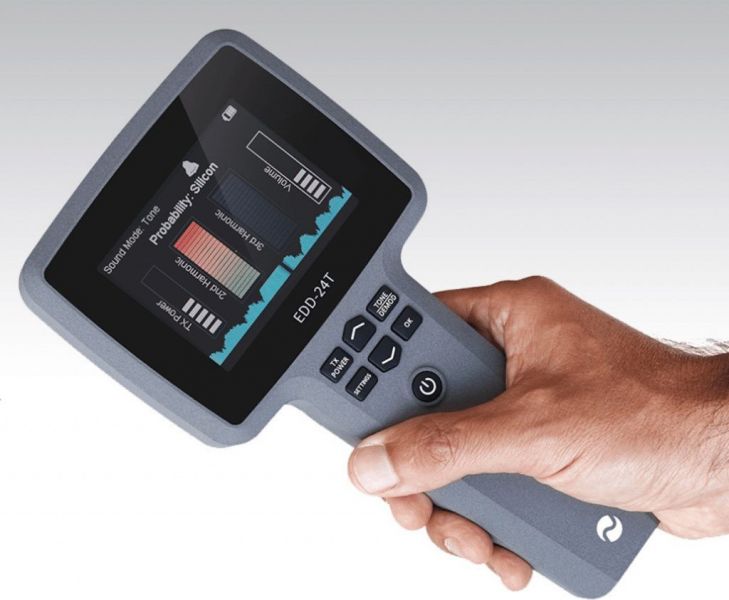
The EDD-24T is designed as a genuinely handheld inspection instrument.
The main unit weighs approximately 700–750 g, depending on the specification presentation, and uses a machined aluminium enclosure with a moulded plastic antenna cover.
The manufacturer specifies:
- 3.5-inch daylight-readable colour TFT display
- Internal rechargeable 3.7 V lithium-polymer battery
- Up to 4.5 hours operation at minimum transmit power
- Approximately 2 hours at maximum transmit power
- Internal loudspeaker
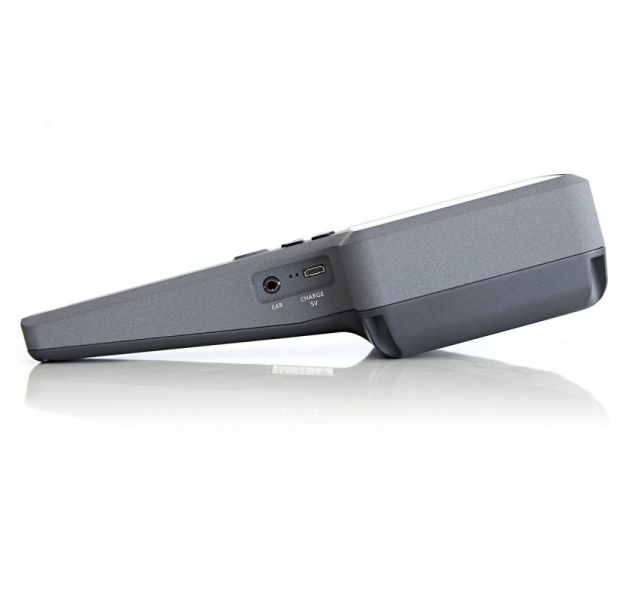
- 3.5 mm earphone connection
- Micro-USB charging
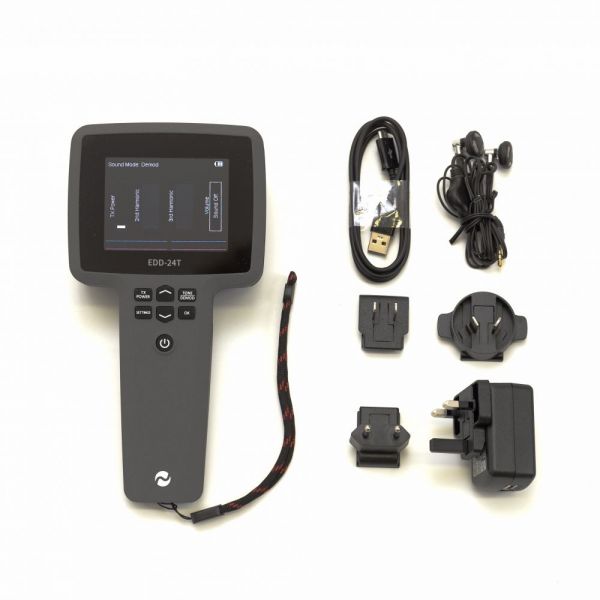
- 110/220 V-compatible international charger
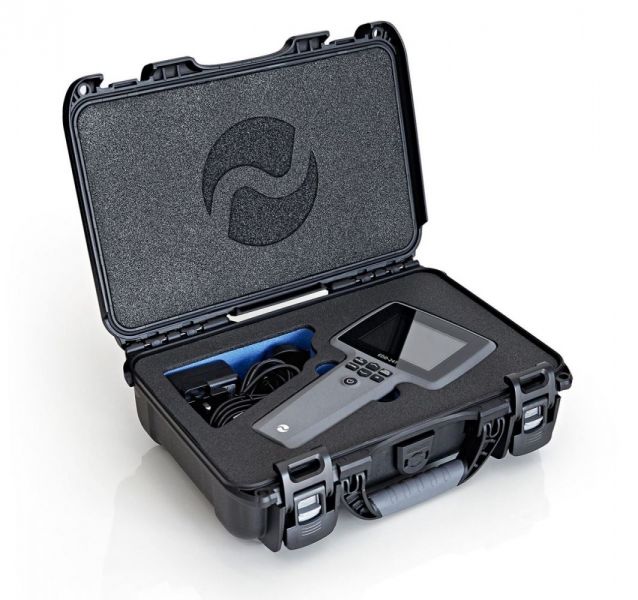
- Military-standard protective carry case
This makes the system suitable for mobile inspection teams that require a dedicated NLJD without carrying a larger platform.
EDD-24T Technical Specifications
| Parameter | Manufacturer Specification |
|---|---|
| Product Type | Handheld Non-Linear Junction Detector |
| Primary Detection Principle | Non-linear junction / harmonic detection |
| Transmit Frequency | 2.400–2.425 GHz |
| Transmit Power Level | Up to +30 dBm / 1 W |
| Radiated Antenna Power | Up to +36 dBm / 4 W |
| 2nd Harmonic | Approximately 4.8 GHz |
| 3rd Harmonic | Approximately 7.2 GHz |
| Receiver Sensitivity | Better than −120 dBm |
| Receiver Bandwidth | Approximately 10 kHz |
| Display | 3.5-inch daylight-readable colour TFT |
| Detection Indication | Silicon / Metal probability indicator |
| Audio Functions | TONE and DEMOD |
| Battery | Internal 3.7 V rechargeable Li-Po |
| Battery Life | Up to 4.5 h at minimum TX power; approx. 2 h at maximum TX power |
| Main Unit Weight | Approximately 700 g |
| Main Unit Dimensions | 225 × 118 × 51 mm |
| Operating Temperature | 0°C to +40°C |
| Enclosure | Machined aluminium with plastic antenna cover |
| Carry Case | Military-standard protective case |
Specifications are manufacturer-published values and should not be interpreted as guaranteed field performance under every inspection condition.
EDD-24T for Different TSCM Requirements
Detecting a Powered-Off Listening Device
The EDD-24T can investigate semiconductor electronics without requiring the suspected device to be actively transmitting.
This makes NLJD detection particularly relevant when RF detection produces no useful signal.
Investigating Concealed Recorders
Digital voice recorders contain semiconductor components that can produce nonlinear responses.
The EDD-24T is therefore suited to investigating areas where an electronic recorder may be concealed, subject to the limitations of NLJD detection and the surrounding environment.
Investigating Concealed Cameras
A covert camera may contain substantial semiconductor electronics even when its wireless transmission function is inactive.
NLJD detection can therefore provide a complementary method alongside optical and RF camera-detection technologies.
Checking for Electronic Devices in Restricted Areas
The manufacturer also identifies applications involving screening parcels, mail and personnel for semiconductor-containing electronics.
What the EDD-24T Does Not Tell You Automatically
An NLJD response is not automatically a surveillance-device identification.
The instrument can indicate a response associated with electronic or metallic material, but professional interpretation is still required.
The EDD-24T does not independently establish:
- Whether a detected electronic component is a surveillance device
- Who placed the device
- Whether the device is malicious
- Whether the device is legally authorized
- The purpose of the detected electronics
- Whether a finding represents a security threat
The appropriate workflow remains:
Detect → Assess → Locate → Identify → Verify
Manufacturer Specifications vs. Field Performance
The EDD-24T’s published specifications provide useful information about its technical architecture.
They should not be confused with independent validation of detection performance against every possible target.
For professional procurement, buyers should distinguish between:
Manufacturer Specification
The stated technical characteristics of the instrument.
Operator Observation
The response actually observed during a particular inspection.
Validated Field Performance
Repeatable results demonstrated under defined test conditions.
Confirmed Finding
The physical object or electronic component established through appropriate verification.
This distinction is particularly important when comparing NLJD equipment internationally.
International Professional Procurement
The EDD-24T is designed and manufactured in England according to the manufacturer, and JJN Digital currently publishes a Declaration of Conformity covering the model.
The unit is supplied with an international-input charger and protective case, supporting professional procurement across multiple markets.
Import, licensing, radio-frequency and operational requirements can vary by jurisdiction. Buyers should confirm applicable requirements before deployment.
Who Is the EDD-24T For?
The EDD-24T is particularly relevant for:
- Professional TSCM specialists
- Counter-surveillance teams
- Corporate security professionals
- Government and institutional security teams
- Investigative professionals
- Security consultants
- Professional sweep teams
- Organizations requiring a dedicated handheld NLJD
It is most useful where the inspection requirement extends beyond active RF transmissions and includes the investigation of concealed electronic circuitry.
Frequently Asked Questions About EDD-24T
What is the EDD-24T?
The EDD-24T is a handheld Non-Linear Junction Detector (NLJD) designed to detect semiconductor-based electronic components, including electronics that may be switched off or not actively transmitting.
What is the difference between an NLJD and an RF detector?
An RF detector looks for radio-frequency emissions. An NLJD transmits a probing signal and analyses harmonic responses associated with electronic junctions.
They therefore address different detection problems.
Can the EDD-24T detect switched-off electronics?
Yes. The manufacturer specifically states that the EDD-24T can detect electronics that are active, in standby or switched off.
What frequency does the EDD-24T transmit?
The specified transmit frequency is 2.400–2.425 GHz.
What are the 2nd and 3rd harmonics?
The EDD-24T receives the 2nd harmonic at approximately 4.8 GHz and the 3rd harmonic at approximately 7.2 GHz.
Why does the EDD-24T use both 2nd and 3rd harmonics?
The two harmonic channels provide additional information for interpreting detected responses. Semiconductor electronics are generally associated with stronger 2nd-harmonic responses, while some metals and oxidised structures can produce 3rd-harmonic responses.
Can the EDD-24T detect SIM cards?
Yes. The manufacturer states that the EDD-24T can detect Nano SIM cards from up to 20 cm under its specified conditions.
Does the EDD-24T identify whether a response is silicon or metal?
It provides a Silicon / Metal probability indicator based on analysis of the 2nd- and 3rd-harmonic responses. This is an interpretation aid, not automatic identification of a surveillance device.
Does the EDD-24T record or analyse RF transmissions?
No. Its primary function is nonlinear junction detection. RF transmission analysis requires appropriate RF detection or spectrum-analysis equipment.
Can the EDD-24T replace an RF detector?
No. NLJD and RF detection address different threat conditions and are complementary technologies.
Can the EDD-24T detect a hidden camera?
It can investigate the semiconductor electronics within a concealed camera, including when the camera is not actively transmitting. Optical and RF detection technologies may provide additional information depending on the camera and inspection environment.
How sensitive is the EDD-24T?
The manufacturer specifies receiver sensitivity of better than −120 dBm on the 2nd and 3rd harmonics.
How long does the battery last?
The manufacturer specifies up to 4.5 hours at minimum transmit power and approximately 2 hours at maximum transmit power.
Is the EDD-24T suitable for professional TSCM?
Yes. The manufacturer specifically positions the EDD-24T for professional countermeasures/TSCM use.
Is the EDD-24T portable?
Yes. The main unit weighs approximately 700 g and is supplied with a protective military-standard carry case.
Does the EDD-24T automatically identify a surveillance device?
No. A nonlinear response is an observation requiring professional assessment and, where appropriate, physical verification.
What should I use with an EDD-24T?
For a comprehensive TSCM capability, an NLJD can be combined with technologies such as RF detection, spectrum analysis, hidden-camera detection, physical inspection and other appropriate inspection methods.
EDD-24T: A Dedicated NLJD for Concealed Electronics
The EDD-24T is built around a specific TSCM requirement:
Detect electronic circuitry even when an active wireless transmission is not available.
Its 2.4 GHz directional probing signal, 2nd- and 3rd-harmonic receivers, Silicon/Metal probability indication and TONE/DEMOD audio functions provide multiple layers of information during an NLJD inspection.
For professional users, its value is not simply that it is a handheld NLJD.
It is a dedicated instrument designed to answer a specific inspection question:
“Could electronic circuitry be concealed here even if the device is not transmitting?”
The answer should then be followed by professional assessment, localization and physical verification.
EDD-24T — Handheld Non-Linear Junction Detector for Professional TSCM Inspection.


Reviews
There are no reviews yet.