


Description
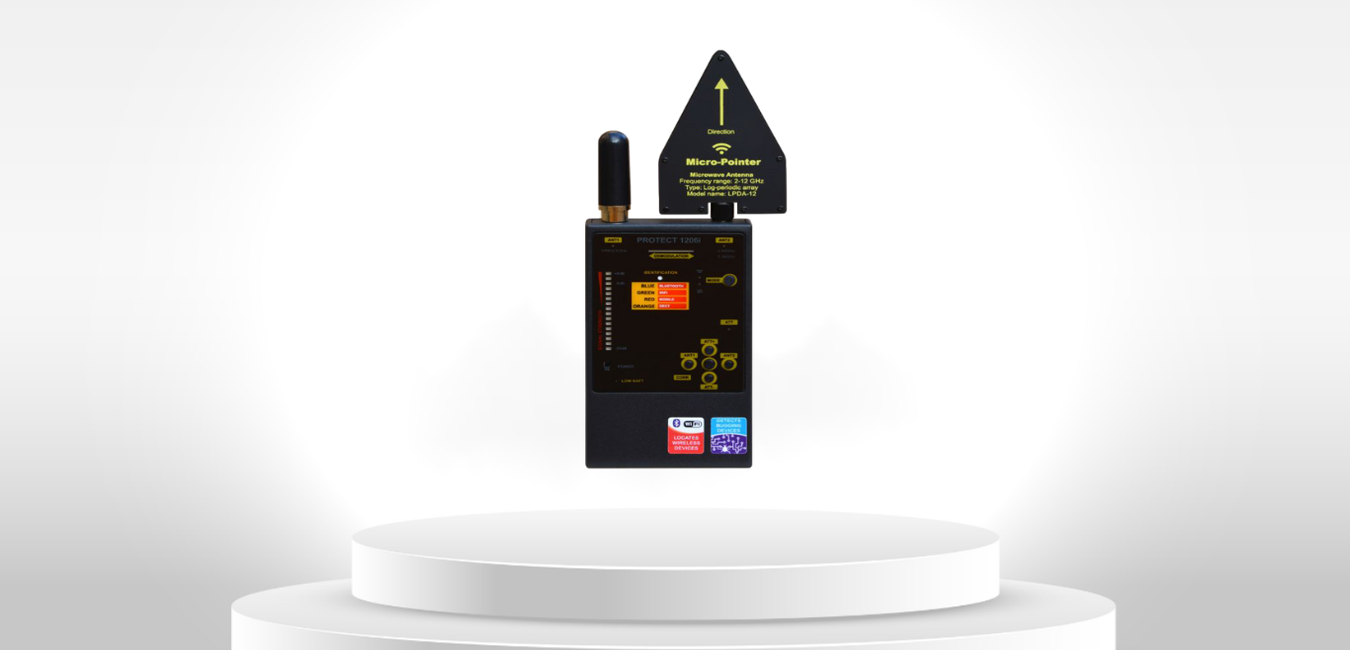
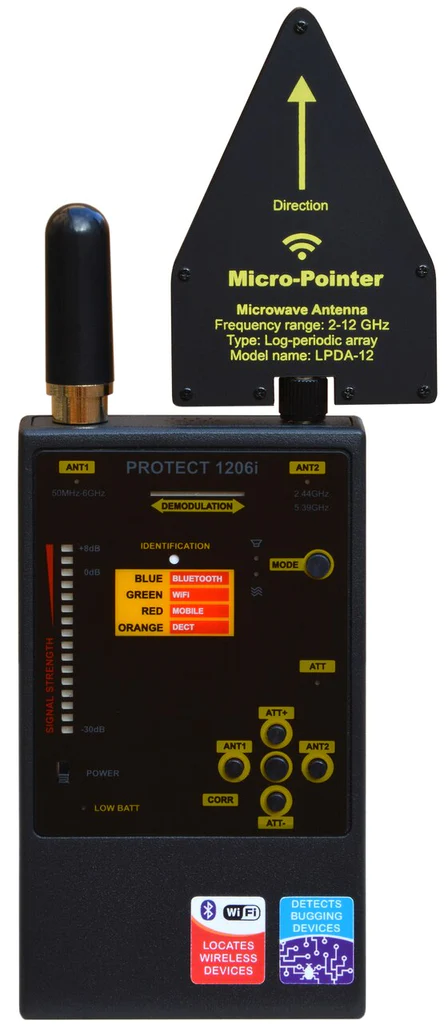
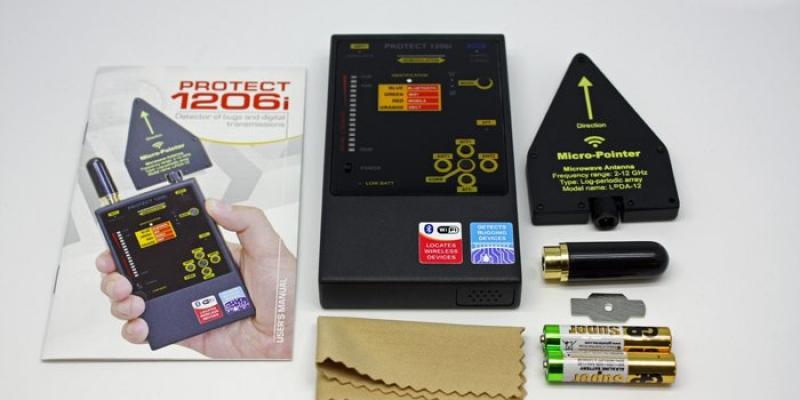
iProtect 1206i Digital RF Detector – TSCM Counter-Surveillance Device with 12 GHz Detection
Advanced RF Detection for Digital and Analog Wireless Threats
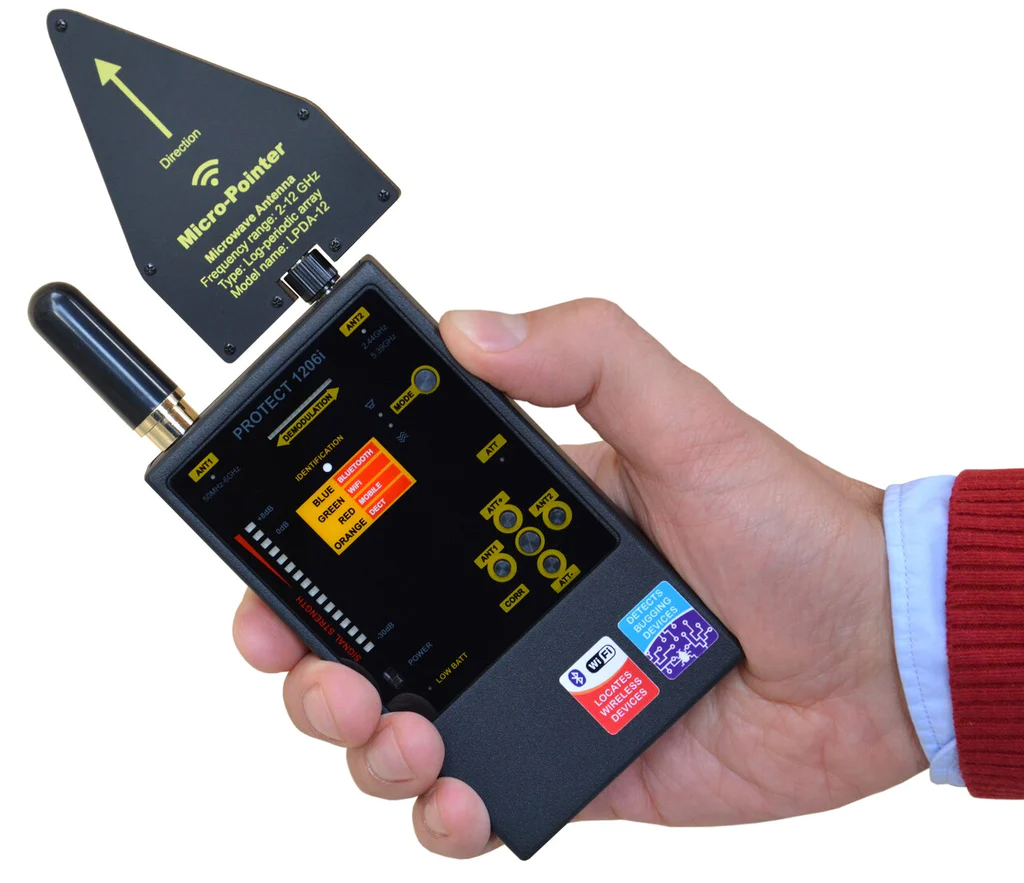
The iProtect 1206i Digital RF Detector is a professional handheld counter-surveillance device designed to detect, investigate and help locate analog and digital RF transmissions during TSCM inspections and privacy-security sweeps.
With detection coverage up to 12 GHz, a dedicated high-frequency antenna for 2.4 GHz and 5 GHz wireless activity, directional signal locating and demodulation-assisted analysis, the iProtect 1206i is designed for environments where conventional RF detection may not provide enough information to investigate modern wireless threats.
The device can be used to investigate RF activity associated with technologies such as Wi-Fi, Bluetooth, DECT, GSM, 3G, 4G/LTE and other supported wireless transmissions, while its directional antenna helps the operator move from simply detecting a signal to determining where that signal is coming from.
For TSCM professionals, security teams and privacy-conscious users, the objective is not simply to know that RF energy exists.
It is to detect → investigate → narrow → locate → verify.
Why the iProtect 1206i Is Different
Modern RF environments are increasingly difficult to inspect.
A conventional RF detector may alert an operator when RF activity is present, but a professional investigation often requires more information:
- Is the signal coming from a lower-frequency conventional transmitter?
- Is the activity associated with a 2.4 GHz or 5 GHz wireless source?
- Can the operator determine the direction of the source?
- Can the signal be investigated through demodulation?
- Is the detected activity consistent with a legitimate wireless device or something that requires further investigation?
The iProtect 1206i addresses these requirements through a combination of wideband RF detection, dedicated high-frequency detection, directional locating and demodulation-assisted analysis.
This makes it particularly useful when the operator needs to move beyond a simple “signal detected” indication.
Wideband RF Detection Up to 12 GHz
The iProtect 1206i’s main antenna provides a frequency range of:
50 MHz – 12 GHz
This broad coverage allows the detector to investigate RF activity across lower-frequency VHF/UHF ranges as well as higher-frequency wireless technologies.
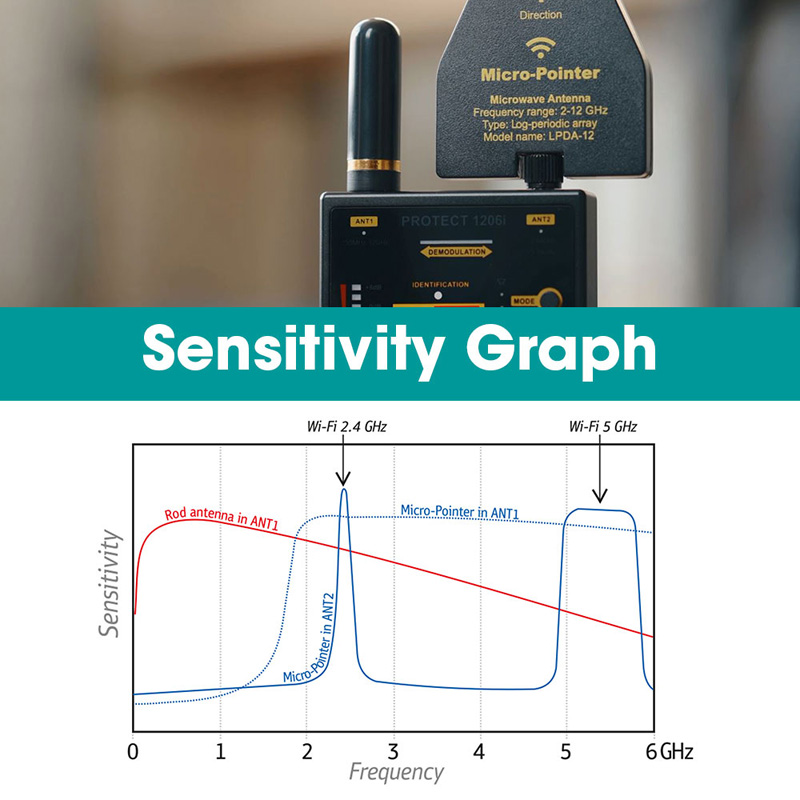
The manufacturer states that the wider lower-frequency coverage can improve detection distance for conventional VHF/UHF transmitters while maintaining sensitivity across higher-frequency areas such as GSM, Wi-Fi and Bluetooth.
For the operator, this means one handheld detector can cover a broad portion of the RF environment without limiting an inspection to a single wireless technology.
Dedicated Detection for 2.4 GHz and 5 GHz Wireless Activity
The iProtect 1206i includes a second antenna designed specifically for higher-frequency wireless signals:
Antenna 2: 1.4–2.48 GHz and 4.9–5.875 GHz
This range covers important wireless frequency areas including:
- Wi-Fi 2.4 GHz
- Wi-Fi 5 GHz
- Bluetooth
- Supported Wi-Max transmissions
- Higher-frequency LTE activity
- Other RF sources operating within the supported ranges
This dedicated antenna is especially useful when investigating modern wireless environments where multiple devices may be transmitting simultaneously.
Directional Antenna for Signal Locating
Detection is only the beginning of a TSCM investigation.
Once an RF signal has been detected, the next question is often:
Where is it coming from?
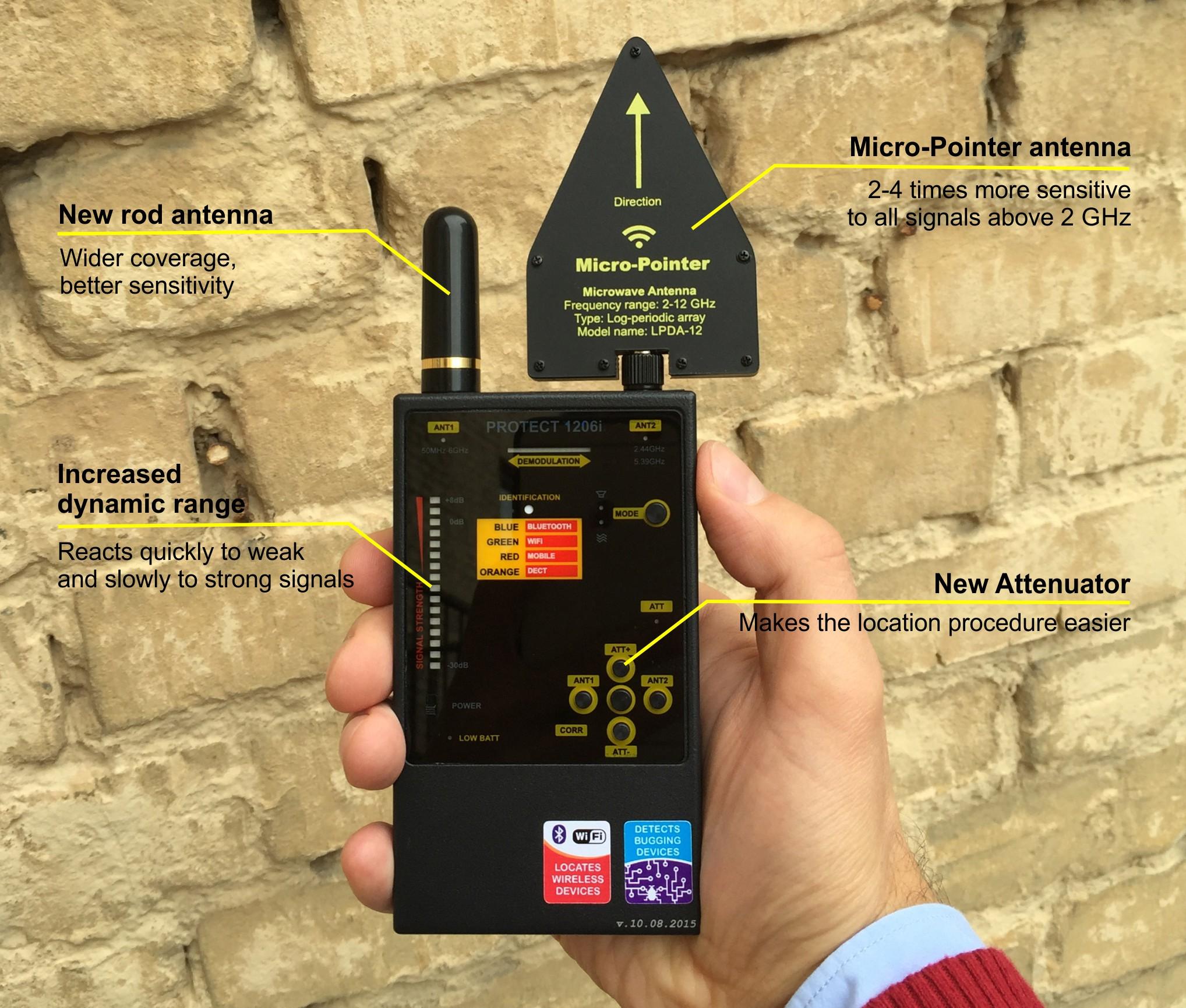
The iProtect 1206i’s secondary antenna has directional characteristics that help the operator investigate the direction and proximity of higher-frequency RF sources.
Instead of simply confirming that a Wi-Fi or Bluetooth signal exists, the operator can move around the inspection area and compare signal response to help narrow down the likely source.
This can make the transition from:
Signal Detection → Direction Finding → Source Investigation
much more practical.
Important: directional response and signal strength can help establish proximity, but they do not independently identify the physical device or prove that a transmission is unauthorized.
Digital and Analog RF Detection
The iProtect 1206i is designed to investigate both digital and analog RF transmissions.
This is important because RF environments contain a mixture of modern digital wireless systems and conventional analog transmitters.
Supported detection applications include RF activity associated with:
- GSM
- 3G
- 4G/LTE
- Bluetooth
- Wi-Fi
- DECT
- GPS-related RF activity
- Analog RF transmissions
- Digital RF transmissions
Actual detection depends on the transmission being within the detector’s supported frequency range and sufficiently detectable at the time of inspection.
Demodulation-Assisted Signal Investigation
One of the more distinctive capabilities of the iProtect 1206i is its demodulation function.
Rather than relying exclusively on a signal-strength indication, the device can process a detected transmission to provide additional information through its demodulation functionality.
For certain compatible transmissions, this can allow the operator to hear an associated audio component or observe changes in the demodulated signal.
This is particularly relevant when investigating conventional analog audio transmitters.
Why Demodulation Matters
Consider a room where an RF signal has been detected.
A basic detector might tell you:
“There is RF activity here.”
A detector with demodulation capabilities can provide additional information that may help answer:
“What kind of signal behavior am I observing?”
The iProtect 1206i therefore gives the operator another layer of investigation between initial RF detection and physical source verification.
Correlation Function for Audio Transmitter Investigation
The iProtect 1206i also incorporates a correlation function designed to assist with the investigation of compatible audio-transmitting devices.
The basic principle is straightforward.
An audio transmitter may pick up sound from the surrounding environment and retransmit it.
During an inspection, an operator can introduce an audible test signal and observe whether a corresponding response is detected through the RF/demodulation system.
This can provide an additional indication when investigating certain types of microphone transmitters.
The correlation function should be considered an investigative aid, not an automatic determination that a device is a surveillance bug.
Physical inspection and professional verification remain necessary.
Detecting Modern Wireless Activity
The iProtect 1206i is designed to investigate RF activity associated with several common wireless technologies.
Wi-Fi
The dedicated high-frequency detection path covers supported 2.4 GHz and 5 GHz Wi-Fi activity.
This can be useful when investigating wireless devices operating through local networks.
Bluetooth
Bluetooth operates in the 2.4 GHz range and can be particularly challenging to investigate in environments containing many legitimate wireless devices.
The iProtect 1206i provides dedicated high-frequency coverage and directional investigation capabilities for supported Bluetooth activity.
Cellular Networks
The device can detect RF activity associated with supported cellular technologies, including:
3G and 4G/LTE, together with other supported cellular transmissions within its frequency coverage.
DECT
The detector can also investigate supported DECT transmissions commonly associated with cordless communication systems.
Two-Antenna Architecture
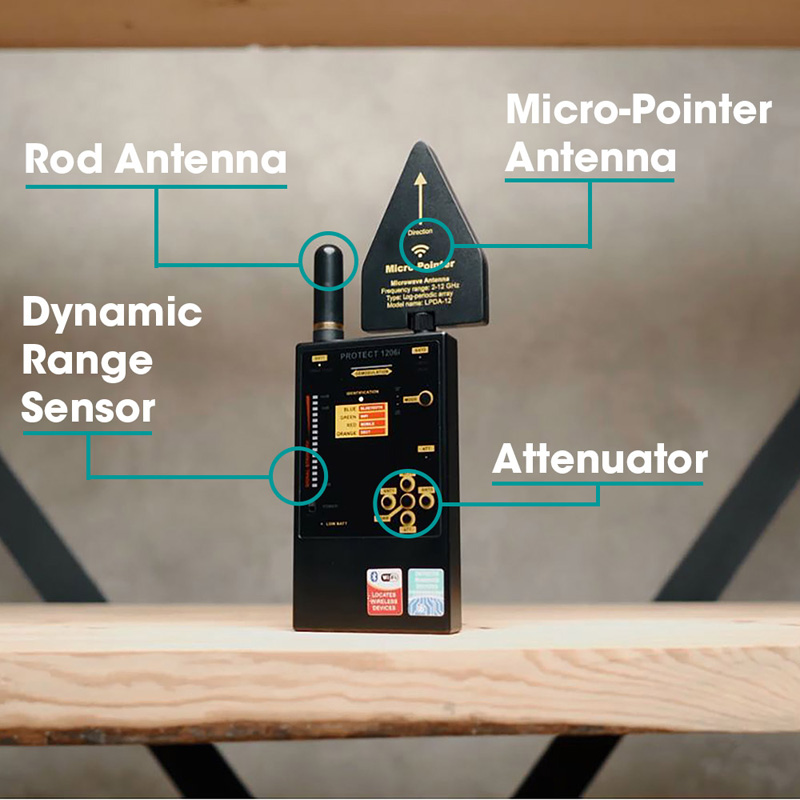
The iProtect 1206i uses two antennas for different inspection requirements.
Main Antenna
50 MHz – 12 GHz
Provides broad RF detection coverage across lower and higher frequency ranges.
Secondary Directional Antenna
1.4–2.48 GHz and 4.9–5.875 GHz
Provides dedicated coverage for important wireless frequency ranges and directional investigation of compatible RF sources.
The two-antenna architecture allows the operator to select the detection approach according to the signal and environment being investigated.
From Detection to Investigation
A practical iProtect 1206i inspection can follow a progressive workflow:
1. Detect
Perform a broad RF inspection using the main antenna.
2. Identify the frequency area
Determine whether detected activity falls within a relevant wireless or RF range.
3. Switch to the appropriate antenna
Use the secondary antenna when investigating supported 2.4 GHz or 5 GHz activity.
4. Narrow the source
Use directional response and changes in signal level while moving through the environment.
5. Investigate the signal
Use the detector’s demodulation and correlation capabilities where applicable.
6. Verify the source
Determine whether the detected transmission belongs to a legitimate device, an unknown source or a potential security concern.
This makes the iProtect 1206i more than a simple RF alarm.
It is a portable RF investigation instrument for the detection and examination of wireless activity during counter-surveillance work.
Designed for Professional TSCM and Privacy Inspections
The iProtect 1206i can support inspections in environments where unauthorized wireless transmission is a concern, including:
- Corporate offices
- Executive meeting rooms
- Private residences
- Hotels and temporary accommodations
- Vehicles
- Confidential meeting spaces
- Legal and professional environments
- Security-sensitive facilities
- TSCM inspection assignments
It can be particularly useful where the inspection requires both broad RF detection and closer investigation of wireless sources.
What Can the iProtect 1206i Detect?
The product specifications identify detection capabilities covering:
- RF signals
- Analog signals
- Digital signals
- Bluetooth
- Wi-Fi
- 3G
- 4G
- GPS-related RF activity
- DECT
- GSM and other supported cellular transmissions
The detector’s maximum specified frequency coverage is up to 12 GHz.
Detection should always be interpreted in context. A detected RF signal does not automatically mean that a surveillance device is present.
Built for Practical Field Use
The iProtect 1206i is designed as a compact handheld instrument for mobile inspection work.
Extended Operating Time
The device provides up to 20 hours of operation according to the supplied specifications.
Simple Battery Power
The detector operates from:
2 × AAA batteries
This makes battery replacement straightforward during field operations.
Compact Handheld Format
Dimensions: approximately 3 × 0.5 × 5 inches
Weight: approximately 0.6 lb
The compact form factor allows the device to be carried during room, vehicle and site inspections without the footprint of larger spectrum-analysis equipment.
Technical Specifications
Detection
- Frequency coverage: 50 MHz–12 GHz
- Main antenna: 50 MHz–12 GHz
- Secondary antenna: 1.4–2.48 GHz / 4.9–5.875 GHz
- Analog RF detection
- Digital RF detection
- Demodulation functionality
- Correlation function
- Directional RF investigation
Supported Signal Technologies
- GSM
- 3G
- 4G/LTE
- Bluetooth
- Wi-Fi
- DECT
- GPS-related RF activity
- Other supported RF transmissions
Power
- Battery powered
- 2 × AAA batteries
- Operating time: up to 20 hours
Physical Specifications
- Dimensions: approximately 3 × 0.5 × 5 inches
- Weight: approximately 0.6 lb
Who Is the iProtect 1206i For?
TSCM Professionals
For TSCM practitioners, the iProtect 1206i provides a portable combination of wideband detection, dedicated wireless-band coverage, directional investigation and demodulation-assisted analysis.
Corporate Security Teams
Security teams can use it to investigate unexpected wireless activity in sensitive meeting rooms, offices and executive environments.
Private Investigators
The compact design makes it practical for mobile counter-surveillance and privacy inspections.
Executive and High-Privacy Users
For individuals concerned about unauthorized wireless monitoring, the detector provides a professional RF investigation capability rather than relying solely on basic signal indicators.
Important Detection Limitation
The iProtect 1206i detects RF transmissions, not every possible surveillance device.
A device that is completely powered off, operating without an RF transmitter, recording locally without transmitting, or operating outside the detector’s supported frequency/detection architecture may not be detected through RF scanning alone.
For this reason, professional TSCM work normally combines RF detection with other inspection methods according to the environment and threat model.
Frequently Asked Questions About the iProtect 1206i Digital RF Detector
What is the iProtect 1206i used for?
The iProtect 1206i is a professional RF counter-surveillance detector used to detect and investigate analog and digital wireless transmissions during TSCM and privacy-security inspections.
Its combination of wide frequency coverage, dedicated 2.4/5 GHz detection, directional investigation and demodulation makes it useful when an operator needs more information than a simple RF signal alarm provides.
What makes the iProtect 1206i different from a conventional RF detector?
The iProtect 1206i combines wideband RF detection up to 12 GHz with a dedicated high-frequency antenna, directional source investigation, demodulation and correlation functionality.
This allows the operator to progress from detecting RF activity to investigating the characteristics and possible location of the source.
What frequency range does the iProtect 1206i cover?
The main antenna covers 50 MHz to 12 GHz.
The secondary antenna is designed for 1.4–2.48 GHz and 4.9–5.875 GHz, providing dedicated coverage for important 2.4 GHz and 5 GHz wireless ranges.
Can the iProtect 1206i detect Wi-Fi?
Yes. The detector’s secondary antenna covers 2.4 GHz and 5 GHz ranges used by supported Wi-Fi transmissions.
However, detecting Wi-Fi activity does not automatically mean that a hidden surveillance device is present because legitimate Wi-Fi networks and devices are common in modern environments.
Can it detect Bluetooth?
Yes. Bluetooth operates in the 2.4 GHz range, which is covered by the detector’s secondary antenna.
The directional characteristics can also assist the operator when investigating the location of a detected compatible source.
Can it detect cellular signals?
Yes. The supplied specifications identify GSM, 3G and 4G/LTE-related RF activity among the supported detection applications.
Actual detection depends on the frequency, transmission activity and signal conditions at the inspection location.
Can it detect a hidden wireless camera?
It can detect RF transmissions from wireless cameras when the camera transmits within the detector’s supported frequency range.
It does not identify the physical camera automatically. Once RF activity is detected, the operator should investigate and physically verify the source.
Can it detect a listening device?
It can detect RF-transmitting listening devices when they are actively transmitting within the supported frequency range.
The demodulation and correlation functions can provide additional investigative information for compatible transmitting devices.
What is the correlation function used for?
The correlation function can assist in investigating certain audio-transmitting devices.
An operator can introduce an audible test signal and observe whether a corresponding RF/demodulated response is produced, potentially providing an additional indication of an active microphone transmitter.
It should be treated as an investigative technique rather than automatic proof of a surveillance device.
What does demodulation do on the iProtect 1206i?
Demodulation extracts information from a compatible RF transmission so that the operator can investigate the signal beyond its strength alone.
For compatible analog transmissions, the resulting audio can help the operator recognize signal behavior and investigate potential audio transmitters.
Why is a directional antenna useful during a TSCM sweep?
A conventional omnidirectional antenna can indicate that RF activity is present, but it may provide less information about where that activity originates.
The iProtect 1206i’s directional secondary antenna can help the operator compare signal response from different directions and narrow down the probable location of a compatible RF source.
Can the iProtect 1206i identify exactly which device is transmitting?
No. RF detection and directional locating can help characterize and locate a signal, but they do not automatically identify the physical device responsible for it.
Source identification requires investigation and verification.
Can it detect a surveillance device that is turned off?
No RF detector can reliably detect a device that is completely powered off and emitting no detectable RF transmission.
Likewise, a device that records locally without transmitting may require other TSCM inspection methods.
Does detecting a Wi-Fi or Bluetooth signal mean there is a spy device?
No.
Modern offices, homes, hotels and vehicles can contain many legitimate Wi-Fi and Bluetooth transmitters.
The purpose of professional TSCM RF detection is to identify RF activity that warrants investigation, not to automatically classify every detected transmission as malicious.
Can the iProtect 1206i detect both analog and digital signals?
Yes. The supplied specifications identify both analog and digital RF signal detection.
This allows the detector to support investigations involving conventional analog transmitters as well as modern digital wireless systems.
How does the iProtect 1206i help locate an RF source?
The operator can detect the signal and then use the directional characteristics of the secondary antenna to compare signal response while moving through the inspection area.
Increasing signal response can indicate that the operator is moving closer to the transmitting source.
Is the iProtect 1206i a spectrum analyzer?
The iProtect 1206i is best described as a professional RF detection and counter-surveillance instrument with demodulation and directional investigation capabilities, rather than a full laboratory-grade spectrum analyzer.
Its purpose is focused on practical RF threat detection and source investigation during TSCM work.
What is the difference between the two antennas?
The main antenna provides broad 50 MHz–12 GHz coverage.
The secondary antenna focuses on 1.4–2.48 GHz and 4.9–5.875 GHz and provides directional characteristics useful for investigating higher-frequency wireless sources.
How long can the iProtect 1206i operate?
The supplied specifications state up to 20 hours of operating time, using two AAA batteries.
Actual operating time can vary depending on usage and operating conditions.
Is the iProtect 1206i suitable for vehicle TSCM inspections?
Yes. Its compact handheld design and ability to investigate cellular, Bluetooth, Wi-Fi and other supported RF activity make it suitable for mobile inspections, including vehicle environments.
However, vehicle TSCM should not rely exclusively on RF detection because a tracker or recording device may be inactive or non-transmitting.
Is the iProtect 1206i a complete TSCM system?
No.
It is a specialized RF detection and investigation component within a broader TSCM workflow.
Depending on the threat model, a comprehensive inspection may require physical examination, camera detection, NLJD, spectrum analysis, wired-line inspection and other specialized techniques.
What is the practical workflow for using the iProtect 1206i?
A useful approach is:
Detect → Identify Frequency Area → Select Antenna → Narrow the Source → Demodulate/Investigate → Physically Verify
This allows the operator to progressively move from broad RF awareness toward source investigation rather than treating every RF signal as an immediate threat.
iProtect 1206i — Professional RF Detection for Modern Counter-Surveillance
The iProtect 1206i Digital RF Detector brings together 50 MHz–12 GHz RF coverage, dedicated 2.4/5 GHz detection, directional wireless-source investigation, analog and digital signal detection, demodulation and correlation-assisted analysis in a compact handheld platform.
Its value is not simply the number 12 GHz printed on the specification sheet.
The real advantage is the ability to move through an RF investigation:
Detect → Narrow → Locate → Analyze → Verify
That makes the iProtect 1206i a practical RF detection tool for TSCM professionals, corporate security teams, investigators and privacy-focused security operations where understanding the RF environment matters as much as detecting it.
Product Classification
Category: TSCM & RF Detection Equipment
Product: iProtect 1206i Digital RF Detector
Primary Technology: Wideband Analog & Digital RF Detection
Core Capabilities: RF Detection, 12 GHz Coverage, 2.4/5 GHz Detection, Directional Source Investigation, Demodulation & Correlation
Primary Applications: TSCM Sweeps, Counter-Surveillance, Wireless Threat Investigation, Corporate Security, Privacy Protection & RF Source Locating
Detection Architecture: Main Wideband Antenna + Dedicated Directional High-Frequency Antenna
Video demonstration : Detect modern hidden bugs
We recommend you to turn off all transmitting devices such as smart devices, laptop & other smart home appliances.


Reviews
There are no reviews yet.