




Description
iProtect DD1207 – Multi-Channel Wireless Protocol Detector for TSCM & Counter-Surveillance
6-Channel Wireless Protocol Detection | Cellular, Wi-Fi & Bluetooth Detection | GPS Tracker Investigation | Up to 10 m Detection Range | Portable TSCM Design*
The iProtect DD1207 is a professional multi-channel wireless protocol detector designed to help TSCM practitioners, security teams and counter-surveillance professionals identify and investigate cellular, Wi-Fi, Bluetooth, WiMAX and other supported wireless transmissions.
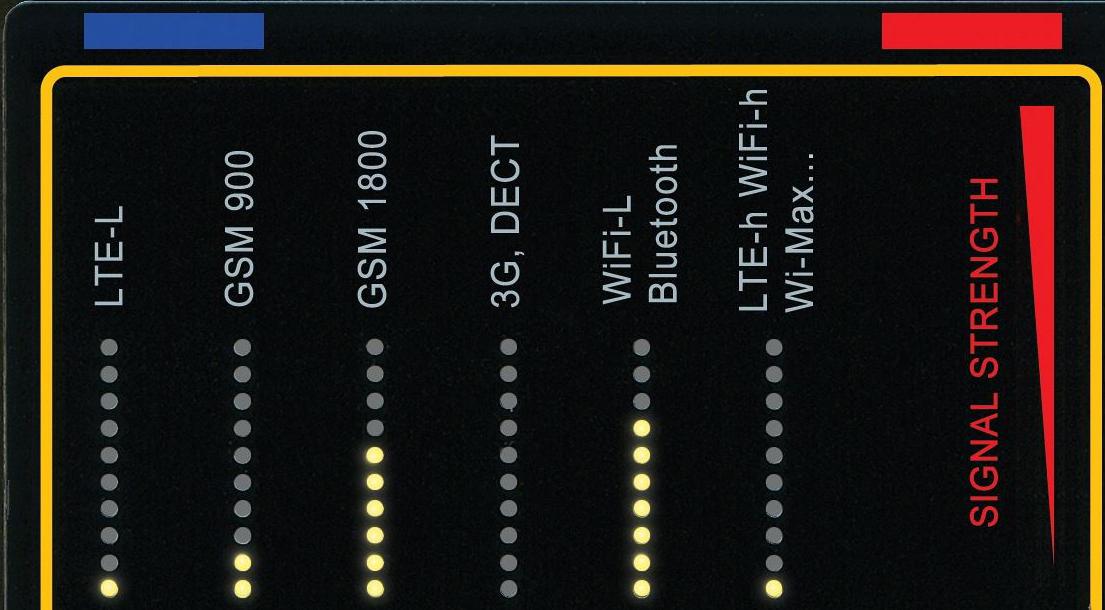
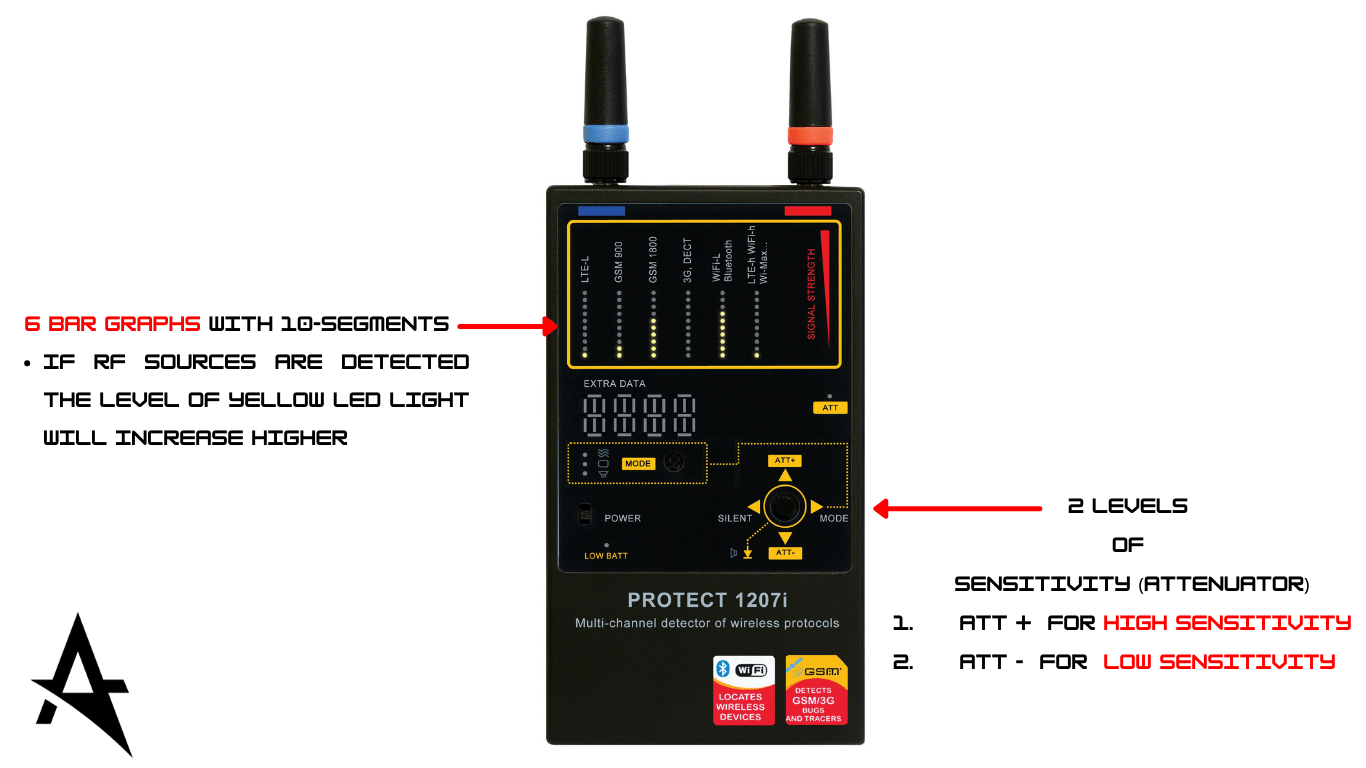
Instead of treating every RF signal as one undifferentiated source, DD1207 uses six dedicated detection channels with individual 10-segment bar graphs and signal-type indication to help the operator understand which supported wireless protocol is producing activity.
This makes DD1207 particularly useful when the concern is not simply that RF exists, but that a mobile phone, GPS tracker, wireless camera, Bluetooth device or other transmitting wireless equipment may be operating inside a sensitive environment.
Detect → Identify the Active Channel → Narrow the Investigation → Locate the Source → Verify
*Actual detection distance varies according to transmitter power, frequency, antenna orientation, environment, interference and other operating conditions.
Why DD1207 Is Different
Modern security environments are surrounded by wireless signals.
A meeting room may contain smartphones, Wi-Fi access points, Bluetooth devices and cellular activity before the TSCM inspection even begins.
The challenge is therefore not simply detecting RF energy.
The challenge is determining:
What type of wireless activity is present?
Which channel is active?
Is the activity expected?
Does the source require further investigation?
DD1207 is designed around this practical problem.
Its six-channel detection architecture allows the operator to inspect supported wireless protocols more selectively, while the individual bar graphs provide visual feedback about detected activity.
The result is a compact tool designed to help transform a general wireless alert into a more focused investigation.
Six-Channel Wireless Protocol Detection
DD1207 provides six detection channels covering supported cellular and wireless protocols.
Its documented detection capabilities include:
- CDMA
- GSM
- GSM/DCS
- WCDMA / 3G
- GSM/PCS
- DECT
- Bluetooth
- Wi-Fi
- WiMAX
- GPS-tracker-related transmissions
- Wireless audio/video transmitters operating within supported ranges
The exact frequency allocation depends on the supported protocol and the transmission being investigated.
Cellular Signal Detection
DD1207 is designed to detect supported cellular activity across several commonly used mobile communication ranges.
CDMA
824–849 MHz
GSM
880–920 MHz
GSM / DCS
1710–1790 MHz
WCDMA / 3G / GSM PCS / DECT
1920–2000 MHz
These ranges allow the operator to investigate cellular activity that may originate from mobile phones, GSM-based surveillance devices and other transmitting equipment using supported cellular protocols.
Detecting GSM Bugs & Cellular Spy Devices
Some covert surveillance devices use cellular networks rather than maintaining a short-range connection to a nearby receiver.
A GSM-based audio device, for example, may transmit through the mobile network when activated.
DD1207 can help identify supported cellular transmission activity associated with such devices.
However, detection of cellular RF activity does not automatically establish that the source is a surveillance device.
The operator must determine whether the detected transmission belongs to:
- An authorized mobile phone
- Cellular infrastructure
- A legitimate IoT device
- A wireless security system
- An unknown transmitter
- Potential surveillance equipment
This distinction is essential for professional TSCM work.
Wi-Fi & Bluetooth Detection
DD1207 also addresses two of the most common wireless technologies found in modern environments:
Wi-Fi
Bluetooth
These technologies are widely used by legitimate devices, but they can also be incorporated into covert surveillance equipment.
DD1207 can therefore help security personnel identify supported wireless activity that requires closer investigation.
Wi-Fi Detection
The documented specification includes:
2.4 GHz Wi-Fi: approximately 2400–2480 MHz
This can be relevant when investigating:
- Wi-Fi-enabled cameras
- Wireless devices
- Wi-Fi-enabled phones
- IoT equipment
- Other supported Wi-Fi transmitters
Bluetooth Detection
Bluetooth activity can be associated with ordinary personal devices as well as supported Bluetooth-based surveillance equipment.
Again, the presence of Bluetooth does not itself indicate malicious activity.
The value of the detector is helping the operator identify and investigate wireless activity within the inspection environment.
Wi-Fi Cameras & Wireless Video Transmission
Wireless cameras can transmit video over supported RF technologies such as Wi-Fi or other wireless links.
DD1207 is designed to detect supported wireless transmissions associated with devices such as:
- Wi-Fi cameras
- Wireless video transmitters
- GSM/GPRS/EDGE/3G/4G video devices
- Other supported RF video equipment
The detector identifies the wireless transmission, not the physical camera.
If RF activity is detected, the operator should continue with physical and visual investigation to determine the source.
GPS Tracker Detection
GPS tracking devices may use cellular or other wireless communication channels to transmit location data.
DD1207 can detect supported RF transmissions associated with GPS trackers when the tracker is actively transmitting within its supported detection architecture.
This makes it useful for:
- Vehicle security inspections
- Executive protection
- Personal counter-surveillance
- Asset protection
- Investigation of suspected tracking devices
Can DD1207 Detect a GPS Tracker That Is Not Transmitting?
No RF detector can reliably detect an electronic tracker that is completely inactive and producing no detectable RF transmission.
A tracker may be physically present but temporarily:
- Powered off
- In standby
- Outside its transmission cycle
- Operating outside the detector’s supported parameters
- Shielded from effective RF detection
Therefore, GPS tracker investigation should combine RF detection with appropriate physical inspection.
Six Bar Graphs for Signal Localization
One of DD1207’s most useful operator features is its six independent 10-segment bar graphs.
Each detection channel provides visual signal-level information.
This gives the operator more context than a single warning light.
As the operator moves through an environment, changes in the signal indication can help determine whether the operator is moving closer to or farther from a transmitting source.
A practical approach is:
Signal detected → Observe active channel → Move through the area → Compare signal level → Investigate the strongest area → Verify the source
Signal strength should be treated as an indication of RF activity and proximity, not as proof of the exact physical location of a device.
Four Alert Modes for Different Inspection Conditions
DD1207 provides four operating/alert modes:
Silent Mode
Designed for situations where the operator needs to conduct an inspection without audible notification.
Vibration Mode
Provides discreet tactile notification when configured detection conditions are met.
Visual Mode
Uses the detector’s visual indicators to communicate detected activity.
Listen Mode
Provides audible feedback during the inspection.
This allows the operator to choose an alert method appropriate to the environment.
For example:
Executive meeting → Silent/Vibration
Vehicle inspection → Visual/Vibration
Initial room sweep → Listen/Visual
The correct mode depends on the inspection environment and operational requirement.
Two Sensitivity Levels
DD1207 provides two sensitivity/attenuator levels.
This allows the operator to adjust the detector’s response according to the RF environment.
In a strong RF environment, reducing sensitivity can help prevent the detector from being overwhelmed by nearby high-level signals.
In a quieter environment, greater sensitivity may help the operator investigate weaker activity.
The purpose is not to eliminate every legitimate RF signal.
The purpose is to make the detector more usable during real-world inspection conditions.
Why Known Wireless Devices Matter During a TSCM Sweep
A modern room can contain many legitimate transmitters.
Before interpreting a detected signal as suspicious, professional operators should consider known RF sources such as:
- Smartphones
- Wi-Fi routers
- Bluetooth devices
- Laptops
- Wireless security systems
- IoT devices
- Cellular infrastructure
Where practical, authorized transmitters can be controlled, switched off or documented before and during the inspection.
This helps establish a more understandable RF environment.
What DD1207 Can Detect
Based on the documented specifications, DD1207 is designed to detect supported transmissions associated with:
- CDMA
- GSM
- GSM/DCS
- WCDMA / 3G
- GSM/PCS
- DECT
- Bluetooth
- Wi-Fi
- WiMAX
- GPS tracker transmissions
- GSM bugs
- GSM spy phones
- Bluetooth bugging devices
- Wi-Fi-enabled surveillance devices
- Wireless cameras
- Wireless video transmitters
- Other supported digital wireless transmitters
The device detects wireless transmission activity.
It does not automatically identify whether a detected signal is legitimate, unauthorized or malicious.
What DD1207 Does Not Do
Understanding the limitations is just as important as understanding the detection capabilities.
DD1207 should not be interpreted as a universal detector for every surveillance technology.
It may not detect a device when:
- The device is completely powered off
- The device is not transmitting
- The transmission occurs outside the supported detection parameters
- The signal is too weak for the prevailing environment
- RF shielding significantly reduces the detectable signal
- The device transmits only intermittently and is not active during the observation period
This is why DD1207 is best understood as a specialized wireless protocol detection tool within a professional TSCM workflow, rather than a standalone guarantee that an environment contains no surveillance equipment.
DD1207 vs. a Basic RF Detector
A basic RF detector may simply tell an operator that RF energy is present.
DD1207 is designed to provide more useful protocol-oriented information.
Basic RF Detection
RF detected → Alarm
DD1207
Wireless activity detected → Channel indication → Signal-level information → Protocol-focused investigation → Source verification
The six-channel architecture and individual bar graphs make DD1207 particularly useful when an operator wants to understand what type of supported wireless activity is being detected, rather than receiving only a generic RF warning.
Practical TSCM Workflow with DD1207
1. Establish the Environment
Identify known wireless equipment operating in the inspection area.
2. Start the Detection
Activate DD1207 and monitor the six detection channels.
3. Identify Active Channels
Observe which channel or protocol group is producing activity.
4. Adjust Sensitivity
Use the available sensitivity/attenuator setting according to the RF environment.
5. Investigate Signal Strength
Move through the environment and observe changes in the bar graphs.
6. Narrow the Source
Use changes in signal level and channel activity to determine the area requiring closer inspection.
7. Verify
Determine whether the source is:
Authorized → Unknown → Requires further investigation
8. Continue with Physical Inspection
If the RF source cannot be explained, continue with appropriate physical and technical TSCM procedures.
Detect → Identify → Narrow → Investigate → Verify
DD1207 for Corporate Security & Executive Protection
For corporate security teams, the value of DD1207 is not simply its ability to detect radio signals.
It provides a portable way to investigate wireless activity in environments where sensitive information may be discussed.
Typical applications include:
- Executive meeting rooms
- Boardrooms
- Hotel rooms
- Conference facilities
- Temporary offices
- Executive vehicles
- Private residences
- Sensitive corporate facilities
For a C-Suite or decision maker, the practical question is simple:
“Can our security team identify unexpected wireless activity before a sensitive environment is trusted?”
DD1207 provides a compact tool to help answer that question.
DD1207 for Professional TSCM Practitioners
For TSCM specialists, DD1207 is most useful when a rapid, portable method is needed to investigate common wireless protocols.
Its strengths are:
- Six-channel detection
- Protocol-focused inspection
- Six 10-segment bar graphs
- Two sensitivity levels
- Four alert modes
- Cellular detection
- Wi-Fi detection
- Bluetooth detection
- WiMAX detection
- GPS tracker-related RF investigation
- Compact handheld form factor
It can therefore function as a focused wireless protocol detector within a broader TSCM toolkit.
Technical Specifications
Detection Channels
- 6 dedicated detection channels
- 6 × 10-segment LED bar graphs
- Additional display for detected signal type
- Microprocessor-controlled detection
Supported Wireless Technologies
- CDMA
- GSM
- GSM/DCS
- WCDMA / 3G
- GSM/PCS
- DECT
- Bluetooth
- Wi-Fi
- WiMAX
- Supported GPS tracker transmissions
Documented Frequency Ranges
- CDMA: 824–849 MHz
- GSM: 880–920 MHz
- GSM/DCS: 1710–1790 MHz
- WCDMA 3G / GSM PCS / DECT: 1920–2000 MHz
- Wi-Fi: 2400–2480 MHz
- WiMAX: 3000–7000 MHz
Detection Features
- 6-channel protocol detection
- 6 × 10-segment signal indicators
- 2 sensitivity/attenuator levels
- Signal-type indication
- Adjustable detection threshold
- Detection distance up to approximately 1–10 m / 30 ft, depending on environmental and signal conditions
Alert Modes
- Silent
- Vibration
- Visual
- Listen
Power
- 2 × AAA batteries
- Portable handheld operation
Physical Design
- Durable metallic housing
- Compact handheld form factor
- Designed for portable counter-surveillance and wireless protocol detection
Frequently Asked Questions About iProtect DD1207
What is the iProtect DD1207?
The iProtect DD1207 is a professional multi-channel wireless protocol detector designed to identify supported cellular and wireless transmissions during TSCM and counter-surveillance inspections.
It is particularly focused on GSM, CDMA, 3G, 4G, Bluetooth, Wi-Fi, WiMAX and GPS tracker-related transmissions.
What is the main purpose of DD1207 in a TSCM inspection?
DD1207 is used to identify and investigate active wireless transmissions that may come from mobile phones, wireless devices, surveillance equipment, GPS trackers or other RF-emitting sources.
Its six-channel design helps the operator determine which supported signal category is active.
How is DD1207 different from a conventional RF detector?
A conventional RF detector may simply indicate that RF energy is present.
DD1207 provides six dedicated detection channels, individual bar graphs and signal-type indication, allowing the operator to focus the investigation on the detected wireless protocol category.
This can make the next step of the TSCM investigation more targeted.
How many detection channels does DD1207 have?
DD1207 has six detection channels designed for different supported wireless protocols.
Each channel is represented through a 10-segment bar graph, providing visual feedback on detected signal activity.
Can DD1207 detect 4G?
Yes.
The documented specifications include detection of 4G along with GSM/CDMA and WCDMA/3G cellular signals.
Actual detection depends on the operating frequency and transmission characteristics of the source.
Can DD1207 detect GSM bugs?
Yes.
DD1207 is designed to detect supported GSM transmission activity, including RF transmissions associated with GSM-based surveillance devices.
However, detecting GSM activity does not automatically prove that a GSM bug is present.
Can DD1207 detect a GSM spy phone?
It can detect supported cellular transmission activity from a transmitting phone or GSM-based surveillance device.
The detector identifies the RF activity; it does not automatically distinguish a normal authorized phone from a covert device.
Can DD1207 detect Wi-Fi cameras?
Yes, when the camera is transmitting over a supported Wi-Fi frequency.
The documented specification includes Wi-Fi detection around 2400–2480 MHz and identifies Wi-Fi cameras among the supported applications.
A camera that is not transmitting over RF may require another inspection method.
Can DD1207 detect Bluetooth bugs?
Yes.
DD1207 is designed to detect Bluetooth transmission activity within its supported detection architecture.
The presence of Bluetooth alone does not indicate a surveillance device because many legitimate consumer devices use Bluetooth.
Can DD1207 detect GPS trackers?
It can detect RF transmissions associated with GPS trackers when the tracker is actively transmitting within the supported detection parameters.
It should not be treated as a guaranteed detector for a tracker that is powered off or not transmitting.
Can DD1207 detect a GPS tracker when it is in standby?
Not reliably through RF detection alone.
If the tracker is not producing detectable RF transmission, DD1207 has no RF transmission to detect.
For suspected trackers, RF detection should be combined with appropriate physical vehicle or asset inspection.
Can DD1207 detect WiMAX?
Yes.
WiMAX is included in the documented detection capabilities, with a listed range of approximately 3000–7000 MHz.
What is the detection range of DD1207?
The documented product information specifies a detection distance of approximately 1–10 meters / up to about 30 feet.
This should not be interpreted as a guaranteed distance for every transmitter.
Actual performance depends on transmitter power, frequency, antenna orientation, environment, interference and other conditions.
Why can the detection distance change?
RF detection distance is affected by the characteristics of both the transmitter and the environment.
For example, a high-power transmitter in an open area may be detectable farther away than a low-power transmitter inside a shielded or RF-dense environment.
What are the six bar graphs used for?
The six bar graphs provide visual information about signal activity across the detector’s six detection channels.
They can help the operator identify which channel is active and observe changes in signal strength while moving through the inspection area.
Can the bar graph help locate a transmitting source?
Yes, it can assist with proximity investigation.
As the operator moves toward or away from a transmitter, changes in signal level may provide an indication of whether the operator is getting closer to the source.
However, signal strength alone does not establish the exact physical location or identity of the device.
What are the four DD1207 alert modes?
DD1207 provides:
Silent — discreet operation.
Vibration — tactile notification.
Visual — visual indication.
Listen — audible feedback.
The appropriate mode depends on the inspection environment.
Why would a TSCM operator use Silent or Vibration Mode?
These modes can be useful when conducting a discreet inspection in environments where an audible alarm could attract attention or interrupt a sensitive operation.
What are the two sensitivity levels used for?
The two sensitivity/attenuator levels allow the operator to adjust the detector’s response according to the surrounding RF environment.
This can be useful when strong nearby RF sources make the inspection difficult to interpret.
Can DD1207 eliminate false alarms?
No.
No RF detector can automatically determine that every detected signal is malicious.
DD1207 provides channel information, signal-level indication and sensitivity adjustment to help the operator interpret the environment more effectively.
Professional verification is still required.
Why should I turn off phones and other wireless devices before a sweep?
Known wireless devices can create legitimate RF activity that makes the environment harder to interpret.
Where practical, turning off or controlling authorized transmitters can reduce background activity and make unknown signals easier to investigate.
It is not always necessary or practical to eliminate every RF source, but known sources should ideally be documented or controlled.
Can DD1207 detect all RF signals?
No.
DD1207 is designed around specific supported cellular and wireless protocols and frequency ranges.
It should not be interpreted as a universal spectrum analyzer capable of detecting every possible RF transmission.
Can DD1207 detect an analog bug?
DD1207 is primarily designed around supported cellular and digital wireless protocols.
A surveillance device using an unsupported analog transmission may require a different RF detection or spectrum-analysis technology.
Can DD1207 detect a device that is completely powered off?
No.
An RF detector requires detectable RF transmission.
A completely powered-off electronic surveillance device does not normally provide an RF signal for the detector to identify.
Can DD1207 detect a wired listening device?
Not necessarily.
A purely wired device that does not transmit RF may not be detectable through DD1207.
A comprehensive TSCM inspection may therefore require physical inspection and other detection technologies.
Can DD1207 identify exactly what device is transmitting?
No.
DD1207 provides signal/channel information, not automatic physical-device identification.
For example, detecting GSM activity does not tell the operator whether the source is a smartphone, legitimate equipment or a GSM surveillance device.
Source verification remains part of the TSCM process.
Is DD1207 suitable for hotel room sweeps?
Yes.
Its compact handheld form factor and wireless protocol detection make it practical for hotel rooms and other temporary environments.
Is DD1207 suitable for vehicle TSCM?
Yes.
It can help investigate cellular and wireless RF activity during vehicle security inspections, including activity potentially associated with GPS trackers.
However, a complete vehicle TSCM inspection should not rely exclusively on RF detection.
Is DD1207 suitable for executive protection?
Yes.
Its compact size, discreet alert modes and ability to investigate common wireless protocols make it suitable for executive protection and close-protection environments where rapid RF checks may be required.
Is DD1207 a complete TSCM system?
No.
DD1207 is a specialized wireless protocol detection component within a broader TSCM workflow.
Depending on the threat model, a comprehensive inspection may require additional technologies for non-transmitting devices, hidden cameras, wired surveillance, spectrum analysis and physical inspection.
What is the recommended DD1207 workflow?
A practical workflow is:
1. Control or document known wireless devices
2. Activate DD1207
3. Observe the six detection channels
4. Identify the active signal category
5. Adjust sensitivity if necessary
6. Move through the environment and observe signal-level changes
7. Narrow down the suspected source
8. Physically investigate and verify the source
9. Determine whether the source is authorized, unknown or requires further action
What is the main benefit of DD1207 for a C-Suite or security decision maker?
The benefit is visibility and faster investigation of unexpected wireless activity.
Instead of relying on a simple “RF detected” warning, DD1207 gives security personnel a compact tool that can indicate which supported wireless channel is active and how signal strength changes during the inspection.
For decision makers, that means a more practical first layer of wireless threat visibility before a sensitive environment is considered secure.
iProtect DD1207 – Focused Wireless Detection for Real-World TSCM
The iProtect DD1207 is built for a specific security problem:
Identifying active cellular and wireless transmissions that deserve investigation.
With six detection channels, six 10-segment bar graphs, four alert modes and two sensitivity levels, it provides a practical way to move from a wireless alert toward a more focused investigation.
It is compact enough for field use, straightforward enough for security teams and sufficiently protocol-focused to be useful within a professional TSCM workflow.
Detect the signal. Identify the channel. Narrow the search. Investigate the source. Verify before you trust the environment.
Video demonstration : How to Detect spy bugs & cellular signals with iProtect DD1207
You can read our article about dangerous of illegal spying devices and threats from wireless networks.
You can also read another article about threats from wireless network.
If you have any questions about technical support & additional product’s specification, you can read our Tactical Detection FAQ, we have provided all useful information and technical support to assist your needs.


Reviews
There are no reviews yet.