



Description
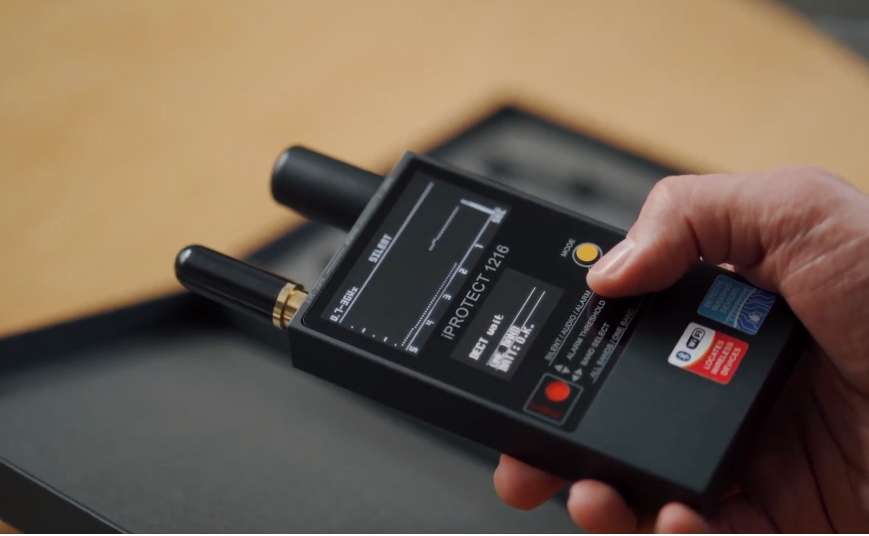
DD1216 3-Band RF Detector – Professional TSCM Bug Sweep & Wireless Signal Detection
50 MHz–12 GHz | 3-Band RF Detection | 48 Sensitivity Levels | Signal History | Professional TSCM Inspection
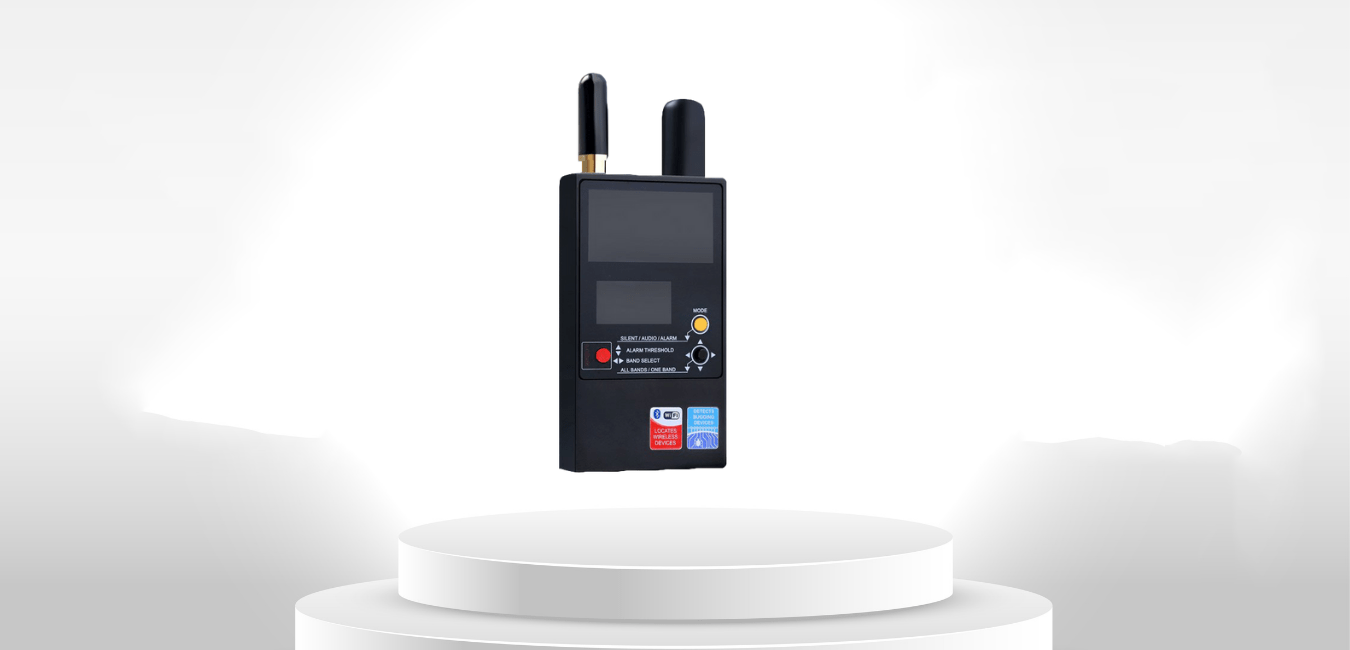
The DD1216 3-Band RF Detector, also known as the iProtect 1216, is a professional RF detection instrument designed to help security teams and TSCM practitioners identify and investigate wireless surveillance activity, cellular transmissions, Wi-Fi, Bluetooth, wireless cameras, audio transmitters and other RF-emitting devices.
Rather than treating the entire RF environment as one signal, DD1216 separates detection into three frequency bands, allowing the operator to see where RF activity is occurring and then focus the inspection on the relevant range.
Its combination of 50 MHz–12 GHz coverage, three-band detection, 48 adjustable threshold levels, signal history, signal signature indication and multiple alert modes makes it a practical instrument for moving from broad RF detection to more focused investigation.
Detect → Separate → Observe → Investigate → Verify
For security decision makers, the benefit is straightforward: DD1216 gives your team greater visibility into the wireless environment before an area is considered secure.
Why DD1216 Is More Than a Basic RF Detector
A modern office, hotel, vehicle or confidential meeting room can contain a large amount of legitimate RF activity.
Mobile phones, Wi-Fi, Bluetooth, IoT equipment, cellular networks and other wireless systems can all produce signals.
The challenge is therefore not simply:
“Is RF present?”
The more useful question is:
“Where is the RF activity occurring, how is it behaving, and does anything require investigation?”
DD1216 is designed around that second question.
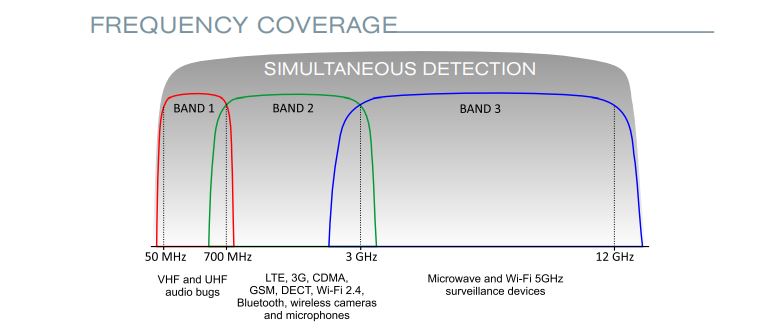
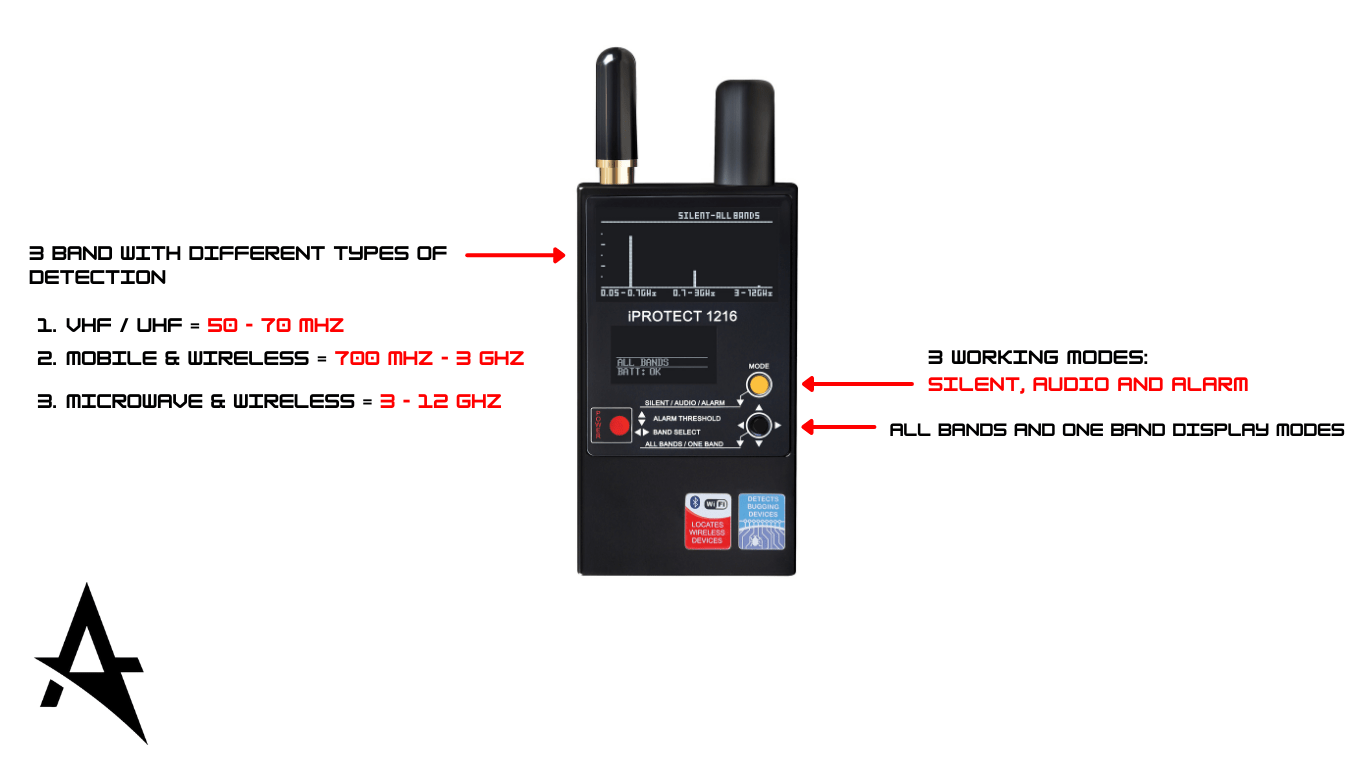
Its three-band architecture allows the operator to separate the RF environment into:
- 50–700 MHz
- 700 MHz–3 GHz
- 3–12 GHz
The operator can begin with a broad view and then narrow the investigation to the band requiring attention.
50 MHz–12 GHz Three-Band RF Detection
DD1216 provides coverage from 50 MHz to 12 GHz through three separately displayed detection ranges.
50–700 MHz – VHF/UHF Detection
The first band covers the lower-frequency VHF/UHF portion of the supported RF range.
This allows the operator to investigate RF activity occurring within this frequency region during a TSCM inspection.
700 MHz–3 GHz – Mobile & Wireless Environment
The second band covers a major portion of modern mobile and wireless communications.
Depending on the signal and operating frequency, this range can include activity associated with technologies such as:
- GSM
- CDMA
- 3G
- 4G/LTE
- Bluetooth
- Wi-Fi
- Other supported wireless transmissions
3–12 GHz – Microwave & Higher-Frequency Wireless
The third band extends detection into the microwave and higher-frequency wireless environment.
This provides additional coverage for supported wireless activity operating above 3 GHz, including portions of the 5 GHz Wi-Fi environment.
The three-band structure also makes it easier for an operator to determine which part of the RF environment deserves closer attention.
ALL BANDS Mode – Establish the RF Environment
ALL BANDS provides a broad view of activity across the three supported detection ranges.
This is useful as the first stage of an inspection when the operator does not yet know which frequency range may contain relevant activity.
A practical approach is:
ALL BANDS → Identify Active Band → ONE BAND → Investigate
Instead of immediately investigating individual frequencies, the operator can first establish where RF activity is concentrated.
ONE BAND Mode – Focus the Investigation
Once an active frequency region has been identified, ONE BAND mode allows the operator to concentrate on an individual band.
The display provides additional information including:
- Current signal level
- Signal history
- Bargraph information
- Five-second histogram
- Signal signature indication
This allows the operator to move from general RF detection toward more focused investigation.
Signal History for Intermittent RF Activity
Not every RF transmission is continuous.
A wireless device may transmit:
- Continuously
- Periodically
- In short bursts
- Only when communicating
- At specific intervals
A single instantaneous signal reading may therefore provide only part of the picture.
DD1216 provides a five-second signal histogram that allows the operator to observe recent changes in detected RF activity.
Practical Example
Imagine a suspected wireless device transmitting only periodically.
A momentary reading might show:
No signal → No signal → Transmission → No signal
The five-second history can provide additional context by showing that activity occurred during the observation period.
This does not automatically identify the source as a surveillance device.
It gives the operator another piece of evidence to investigate.
48 Adjustable Sensitivity Levels
RF environments vary significantly from one location to another.
A hotel in a major city may contain far more RF activity than an isolated office or private facility.
DD1216 provides 48 adjustable threshold levels, allowing the operator to configure the detector according to the surrounding RF environment.
This helps the operator manage unnecessary alerts and focus attention on signals exceeding the selected threshold.
The objective of a professional TSCM sweep is not to make the detector react to everything.
The objective is to make the detector useful within the environment being inspected.
Signal Signature Indication
DD1216 provides a signal signature indication intended to give the operator additional information about detected RF activity.
This can assist with investigation by providing context beyond signal strength alone.
However, a signal signature should be treated as an investigative aid, not as definitive identification of a particular surveillance device.
The final determination still requires appropriate investigation and verification.
Audio, Alarm & Silent Detection Modes
DD1216 provides different operating behaviors depending on how the inspection is being conducted.
Silent Mode
Useful when the operator needs to conduct an inspection without audible notification.
Audio Mode
Provides audible feedback during RF detection.
Alarm Mode
Provides an alert when detected RF activity exceeds the configured threshold.
This gives security teams flexibility when inspecting confidential environments where discretion or immediate notification may be important.
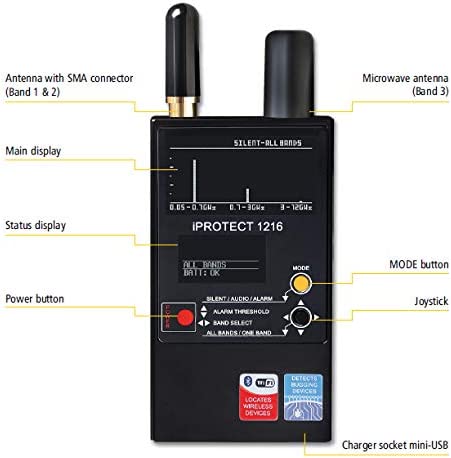
Built-In Microwave Antenna
DD1216 incorporates a built-in directional microwave antenna for Band 3.
This supports detection within the 3–12 GHz range without requiring an external microwave antenna for the standard Band 3 configuration.
The system also provides SMA RF connections for the relevant lower-frequency antenna inputs.
What Can DD1216 Detect?
DD1216 is designed to detect supported RF transmissions from wireless and RF-emitting equipment.
Depending on operating frequency and transmission characteristics, applications include detection of RF activity associated with:
- GSM
- CDMA
- 3G
- 4G/LTE
- Bluetooth
- Wi-Fi/WLAN
- IoT devices
- Wireless audio
- Wireless video
- Wireless cameras
- Other RF-emitting devices
The detector identifies RF transmission activity.
It does not automatically identify the physical device producing the signal.
Wi-Fi & Bluetooth RF Detection
Wi-Fi and Bluetooth are important considerations during modern TSCM inspections because they are present in almost every contemporary business and residential environment.
DD1216 provides coverage across the relevant supported frequency ranges.
However:
A detected Wi-Fi or Bluetooth signal does not automatically indicate surveillance.
The signal may belong to:
- Authorized infrastructure
- A mobile phone
- A laptop
- A smartwatch
- An IoT device
- A legitimate wireless system
- An unknown device requiring investigation
Professional TSCM work therefore requires interpretation rather than simply treating every detected transmission as a threat.
Understanding DD1216 Detection Limitations
A professional RF detector should never be presented as a device that automatically finds every surveillance device.
DD1216 detects RF transmission activity within its supported frequency range and detection architecture.
This means several real-world factors can affect what the operator sees.
Can a Powered-Off Device Be Detected?
Generally, an electronic device that is completely powered off and producing no detectable RF transmission cannot be detected through RF detection alone.
The same principle applies to a device that is present but currently not transmitting.
Can an Intermittent Transmitter Be Missed?
Yes.
If a device transmits only periodically, the operator may not observe activity during a short observation period.
The five-second histogram can help reveal recent intermittent activity, but it cannot display a transmission that never occurred during the observation period.
Can Strong RF Interference Affect Detection?
Yes.
Strong nearby RF sources can influence detection conditions.
This is one reason professional TSCM inspections should establish the RF environment before interpreting individual signals.
DD1216’s three-band architecture provides a more structured approach by separating the supported spectrum into three detection regions.
Strong activity in one band does not automatically mean that all three bands are affected in the same way.
Why Should Known Wireless Devices Be Controlled During a TSCM Sweep?
Known transmitters can make an RF environment significantly more complicated.
Where practical, professional inspection procedures may involve controlling or documenting known sources such as:
- Wi-Fi access points
- Mobile phones
- Bluetooth devices
- Cordless phones
- Other authorized wireless equipment
The purpose is not necessarily to eliminate every RF signal.
It is to establish a more understandable baseline so that unknown activity can be investigated more effectively.
Why Does Detection Distance Vary?
Detection distance is not a universal fixed specification.
The effective detection distance depends on factors including:
- Transmitter output power
- Frequency
- Antenna characteristics
- Orientation
- Distance
- Signal propagation
- Building materials
- RF interference
- Transmission pattern
- Whether the source is transmitting continuously or intermittently
A powerful transmitter may be detected from considerably farther away than a very low-power transmitter.
Therefore, a professional TSCM operator should interpret detection distance as an environment- and source-dependent measurement, not as a guaranteed distance for every device.
Can the Antenna Affect Detection Performance?
Yes.
Antenna characteristics influence the way RF energy is received.
The standard configuration uses the supplied antenna arrangement for the different detection bands, while optional antenna configurations may provide different sensitivity or directional characteristics for specific applications.
This is particularly relevant for expert users conducting more focused RF investigations.
Does a Strong RF Reading Mean a Bug Has Been Found?
No.
A strong RF reading means the detector is receiving significant RF energy within the relevant detection range.
The source could be:
- Cellular infrastructure
- Wi-Fi
- Bluetooth
- Authorized wireless equipment
- IoT devices
- Wireless cameras
- Wireless microphones
- Other legitimate transmitters
- An unknown source requiring investigation
The purpose of DD1216 is to help the operator identify and investigate RF activity.
It is not an automatic “bug confirmed” indicator.
Why DD1216 Can Be Useful in RF-Dense Environments
One of the practical advantages of separating the RF environment into three bands is that the operator can determine where activity is concentrated.
For example, an inspection may show:
50–700 MHz → Low activity
700 MHz–3 GHz → Strong activity
3–12 GHz → Moderate activity
The operator can then focus the investigation on the relevant portion of the RF environment instead of treating every detected signal identically.
This is particularly useful in:
- Hotels
- Urban offices
- Conference facilities
- Executive environments
- Vehicles
- Residential properties
- Sensitive corporate facilities
Practical DD1216 TSCM Sweep Workflow
1. Start with ALL BANDS
Establish the general RF environment.
2. Identify the Active Band
Determine whether activity is concentrated within:
50–700 MHz
700 MHz–3 GHz
or
3–12 GHz
3. Switch to ONE BAND
Focus the inspection on the relevant frequency region.
4. Observe Signal History
Use the five-second histogram to determine whether activity appears continuous, intermittent or periodic.
5. Adjust the Threshold
Configure the sensitivity threshold according to the RF environment.
6. Investigate the Area
Move through the inspection environment and observe changes in RF activity.
7. Verify the Source
Determine whether the detected signal belongs to an authorized device, unknown equipment or a source requiring further investigation.
8. Document the Finding
Record the relevant observations and determine whether additional TSCM investigation is required.
Detect → Separate → Observe → Investigate → Verify
DD1216 for Professional TSCM Inspections
DD1216 is particularly relevant for TSCM professionals who need a portable RF detection instrument that can move from an initial sweep into more focused RF investigation.
Its three-band architecture, adjustable thresholds and signal-history functions provide additional context compared with a basic detector that simply produces an alarm when RF energy is present.
For security teams, the benefit is practical:
Understand the RF environment before deciding that the environment is secure.
DD1216 for Corporate Security & Executive Protection
Sensitive meetings can take place in environments that security teams do not fully control.
Examples include:
- Hotels
- Conference centers
- Temporary offices
- Executive vehicles
- Client facilities
- Meeting rooms
- Private residences
DD1216 provides a portable way to investigate RF activity before and during sensitive operations.
For C-Suite and decision makers, the value is not the frequency range itself.
The value is greater visibility into wireless activity that could otherwise remain unnoticed.
Technical Specifications
RF Detection
- Frequency range: 50 MHz–12 GHz
- Band 1: 50–700 MHz
- Band 2: 700 MHz–3 GHz
- Band 3: 3–12 GHz
- Analog and digital RF detection
- Audio and video RF transmission detection
Detection & Analysis
- ALL BANDS mode
- ONE BAND mode
- Momentary signal-level bargraph
- Five-second signal histogram
- Signal signature indication
- 48 adjustable threshold levels
Alert Modes
- SILENT
- AUDIO
- ALARM
Antenna & RF Interface
- Built-in directional microwave antenna for Band 3
- SMA RF connections for supported external antenna inputs
- 50-ohm RF interface
Power
- Rechargeable Li-Ion battery
- 1150 mAh at 3.7 V
- Up to approximately 6 hours operating time
- Approximately 4 hours recharge time
- USB charging
Physical Design
- Shock-resistant CNC-milled duralumin housing
- Two OLED displays
- Approximate weight: 265 g
- Dimensions with antennas: 173 × 71 × 21 mm
- Operating temperature: -10°C to 45°C
Frequently Asked Questions About DD1216 / iProtect 1216
What is the DD1216 3-Band RF Detector?
DD1216, also known as iProtect 1216, is a professional RF detection instrument designed for TSCM sweeps and wireless signal investigation.
It covers 50 MHz–12 GHz and divides the range into three detection bands, helping operators identify where RF activity is concentrated.
Why is DD1216 called a 3-band RF detector?
Because the supported frequency range is divided into three sections:
50–700 MHz for VHF/UHF activity.
700 MHz–3 GHz for mobile and wireless activity.
3–12 GHz for microwave and higher-frequency wireless activity.
This separation provides more useful context during an RF inspection.
What is the difference between ALL BANDS and ONE BAND?
ALL BANDS provides a broad view of RF activity across the three detection ranges.
ONE BAND allows the operator to focus on one frequency region for closer observation.
A practical workflow is:
ALL BANDS → Identify → ONE BAND → Investigate
Can DD1216 detect intermittent RF signals?
Yes, it can help the operator observe intermittent or periodic RF activity through its five-second signal histogram.
However, an RF detector cannot display a transmission that does not occur during the observation period.
What is the five-second histogram used for?
The histogram provides a short history of RF signal levels.
It can help the operator determine whether detected activity appears:
- Continuous
- Intermittent
- Periodic
- Changing rapidly
This provides more information than relying on a single instantaneous signal reading.
Can DD1216 detect Wi-Fi?
Yes. DD1216 covers supported Wi-Fi activity within its 50 MHz–12 GHz detection architecture.
Detection does not automatically establish that a Wi-Fi signal belongs to surveillance equipment.
Can DD1216 detect Bluetooth?
Yes. Bluetooth is among the supported wireless applications within the relevant detection ranges.
As with Wi-Fi, the operator must investigate the source rather than assuming every Bluetooth transmission is suspicious.
Can DD1216 detect GSM, 3G and 4G/LTE?
Yes. The documented detection applications include GSM, CDMA, 3G and 4G/LTE, subject to the actual frequency and transmission characteristics.
Can DD1216 detect wireless cameras?
It can detect RF transmissions from wireless video devices when they operate within the supported detection range.
The detector identifies RF activity; it does not automatically identify the physical camera.
Can DD1216 detect wireless microphones?
It can detect RF transmissions associated with wireless audio equipment when the transmission falls within the supported frequency range.
Can DD1216 detect IoT devices?
It can detect RF activity from supported wireless IoT devices.
However, many IoT devices are legitimate, so detection should be treated as an indication requiring investigation.
Can DD1216 detect a GPS tracker?
DD1216 can detect RF transmissions from GPS tracking equipment when the tracker transmits within the supported frequency range.
It should not be interpreted as a guaranteed physical GPS tracker detector because a tracker that is inactive or not transmitting RF may not be detectable through RF detection.
Can DD1216 detect a GPS tracker that is not transmitting?
No.
An RF detector detects RF transmission, not simply the physical presence of an electronic device.
A powered-off tracker or a tracker that is not transmitting may therefore remain undetected by RF inspection alone.
What are the main limitations or constraints of DD1216?
The principal limitation is inherent to RF-based detection:
The target must produce detectable RF energy within the supported frequency range and under the prevailing detection conditions.
Other factors include:
- RF interference
- Transmitter power
- Antenna characteristics
- Distance
- Frequency
- Building materials
- Signal orientation
- Intermittent transmission
- Device operating state
Understanding these constraints is part of using the detector correctly in professional TSCM work.
Can strong RF interference affect DD1216?
Yes.
Strong nearby transmitters can influence detection conditions.
The three-band architecture helps the operator separate the RF environment and identify which frequency region contains the strongest activity.
A strong signal in one band does not automatically mean that all three detection bands are equally affected.
Why should known wireless equipment be controlled during a TSCM sweep?
Known RF transmitters can make an inspection environment difficult to interpret.
Where practical, security teams may control or document known sources such as Wi-Fi, Bluetooth, mobile phones and cordless communication systems.
The objective is to establish a more understandable baseline and make unknown activity easier to investigate.
Does DD1216 eliminate false alarms?
No RF detector can automatically eliminate every false positive.
DD1216 provides 48 threshold levels, three-band separation, signal history and signal-signature information to help the operator interpret RF activity and control unnecessary alerts.
Professional verification remains necessary.
Why does detection distance vary between RF devices?
There is no universal detection distance for every RF transmitter.
A high-power transmitter may be detectable from a greater distance than a low-power transmitter.
Detection can also change according to:
- Frequency
- Antenna
- Orientation
- Building construction
- RF interference
- Transmitter power
- Transmission pattern
- Distance
Therefore, detection distance should be understood as source- and environment-dependent.
Does the antenna affect detection performance?
Yes.
Antenna characteristics affect how RF energy is received.
DD1216 uses different antenna arrangements for its detection ranges, including a built-in directional microwave antenna for Band 3.
Optional antenna configurations can also be used for certain applications where additional sensitivity or directionality is required.
Does a strong RF reading mean a surveillance bug has been found?
No.
It means significant RF energy is being received in the relevant detection range.
The source could be legitimate infrastructure, a personal device, an IoT system, wireless equipment or an unknown transmitter.
The operator must investigate the source before determining whether it represents a security concern.
Can DD1216 miss a wireless surveillance device?
Yes, under certain conditions.
For example, detection may be difficult if a device:
- Is powered off
- Is not currently transmitting
- Operates outside the supported frequency range
- Produces a very weak signal
- Is shielded
- Transmits intermittently
- Is operating in a difficult RF environment
This is why professional TSCM inspections should use the appropriate detection technology according to the threat model.
Is DD1216 suitable for hotel room TSCM inspections?
Yes.
Its compact design and 50 MHz–12 GHz coverage make it suitable for portable RF inspection of hotel rooms and other temporary environments.
Is DD1216 suitable for vehicle inspections?
Yes, it can be used to investigate RF transmissions during vehicle security inspections.
However, vehicle TSCM should not rely exclusively on RF detection when the threat model requires inspection for non-transmitting or physically concealed devices.
Is DD1216 suitable for corporate boardrooms?
Yes.
It can support RF inspection of boardrooms, executive offices, conference rooms and other sensitive corporate environments.
Is DD1216 a complete TSCM system?
No.
DD1216 is a specialized RF detection component within a broader TSCM methodology.
Depending on the threat model, a comprehensive inspection may require additional technologies such as physical inspection, hidden-camera detection, NLJD, spectrum analysis, wireline inspection and other specialized TSCM equipment.
What is the main benefit of DD1216 for a C-Suite or security decision maker?
The primary benefit is greater visibility into the RF environment without requiring a large fixed analysis system.
DD1216 gives a security team a portable instrument capable of:
50 MHz–12 GHz detection
Three-band separation
48 threshold levels
Signal history
Signal signatures
Multiple alert modes
That allows the team to investigate unexpected wireless activity before treating a sensitive environment as secure.
What is the recommended DD1216 TSCM workflow?
A practical workflow is:
1. ALL BANDS → establish the RF environment.
2. Identify the active band → determine where activity is concentrated.
3. ONE BAND → focus the investigation.
4. Observe signal history → identify intermittent or periodic activity.
5. Adjust threshold → adapt detection to the environment.
6. Investigate proximity → examine the suspected area.
7. Verify the source → determine whether it is legitimate, unknown or requires further investigation.
8. Document the finding → retain the relevant inspection information.
Detect → Separate → Observe → Investigate → Verify
DD1216 – Structured RF Visibility for Professional TSCM
DD1216 is built around a practical principle:
RF detection becomes more useful when the operator can understand what the detector is seeing.
With 50 MHz–12 GHz coverage, three-band detection, 48 adjustable threshold levels, signal history and signal-signature indication, DD1216 provides a structured approach to investigating modern wireless environments.
For TSCM professionals, it provides a portable instrument for RF detection and investigation.
For security teams, it provides a practical layer of visibility before sensitive environments are considered secure.
For decision makers, the value is simple:
Know what wireless activity exists. Investigate what should not be there. Verify before you trust the environment.
Video demonstration
We recommend you to turn off all transmitting devices such as smart devices, laptop & other smart home appliances.
Detection Devices are great, they let you know what signals are being emitted.
This video is for the first time detector or the well seasoned professional, it will help you to get to know the iProtect 1216 3-band RF Bug Detector and perform a sweep.


Tomasz Wisniewski –
I am highly impressed with the Profinder 1216i. It covers a wide spectrum of frequencies, from VHF/UHF to 12 GHz, essential for detecting modern surveillance threats. Its clear signal displays and detailed histogram analysis are exceptionally useful for identifying and understanding multiple signals along with the adjustable alarm threshold effectively reduces background interference.