
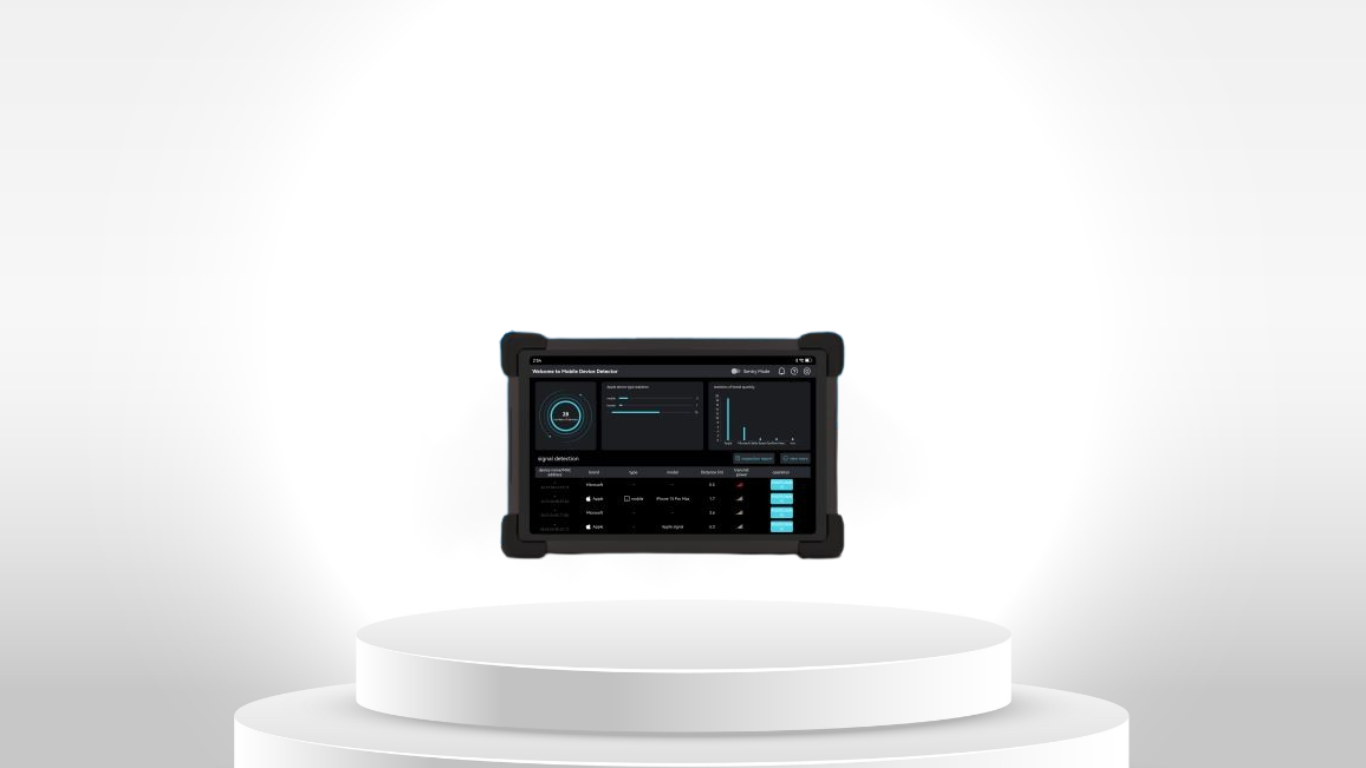
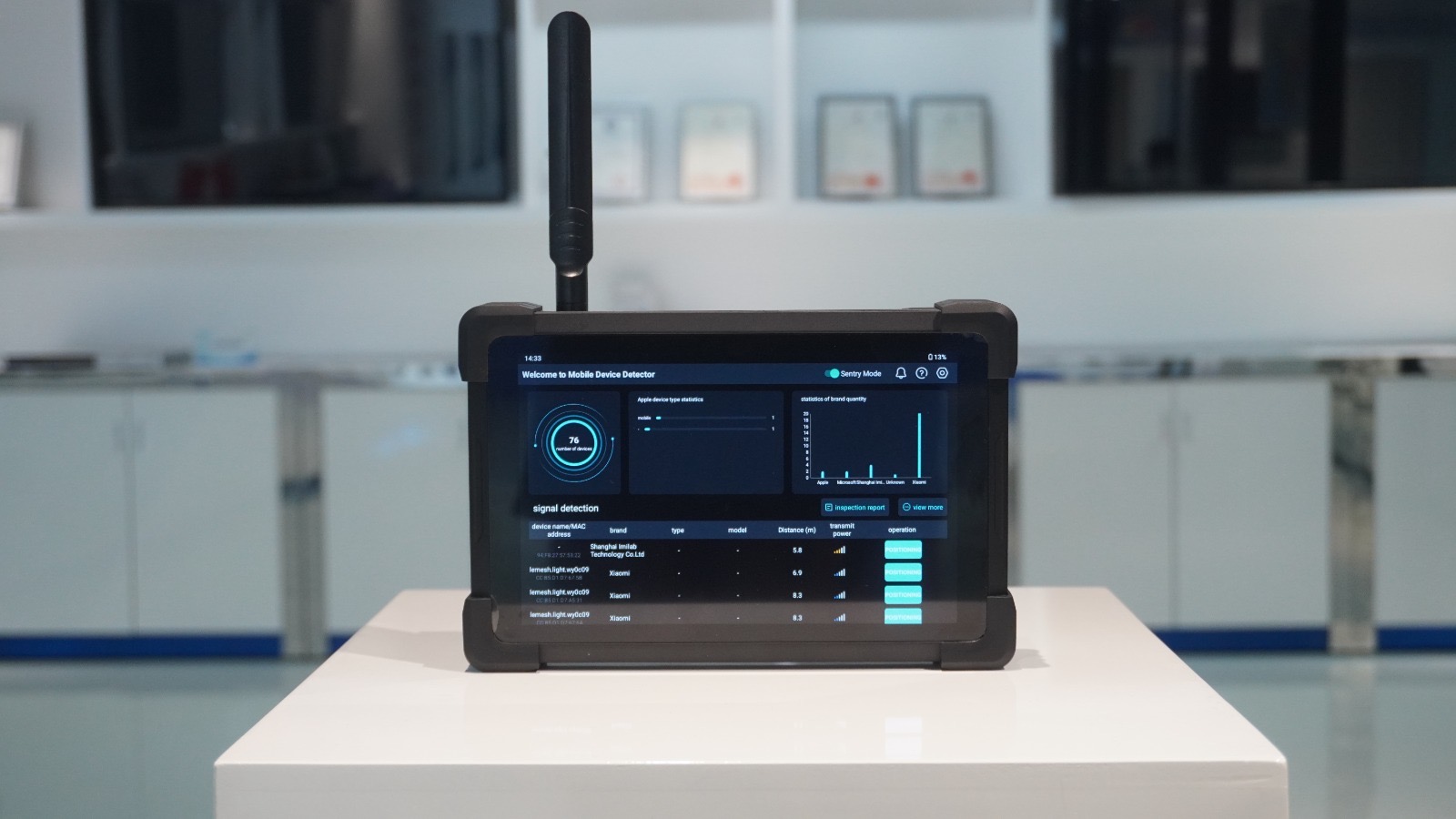
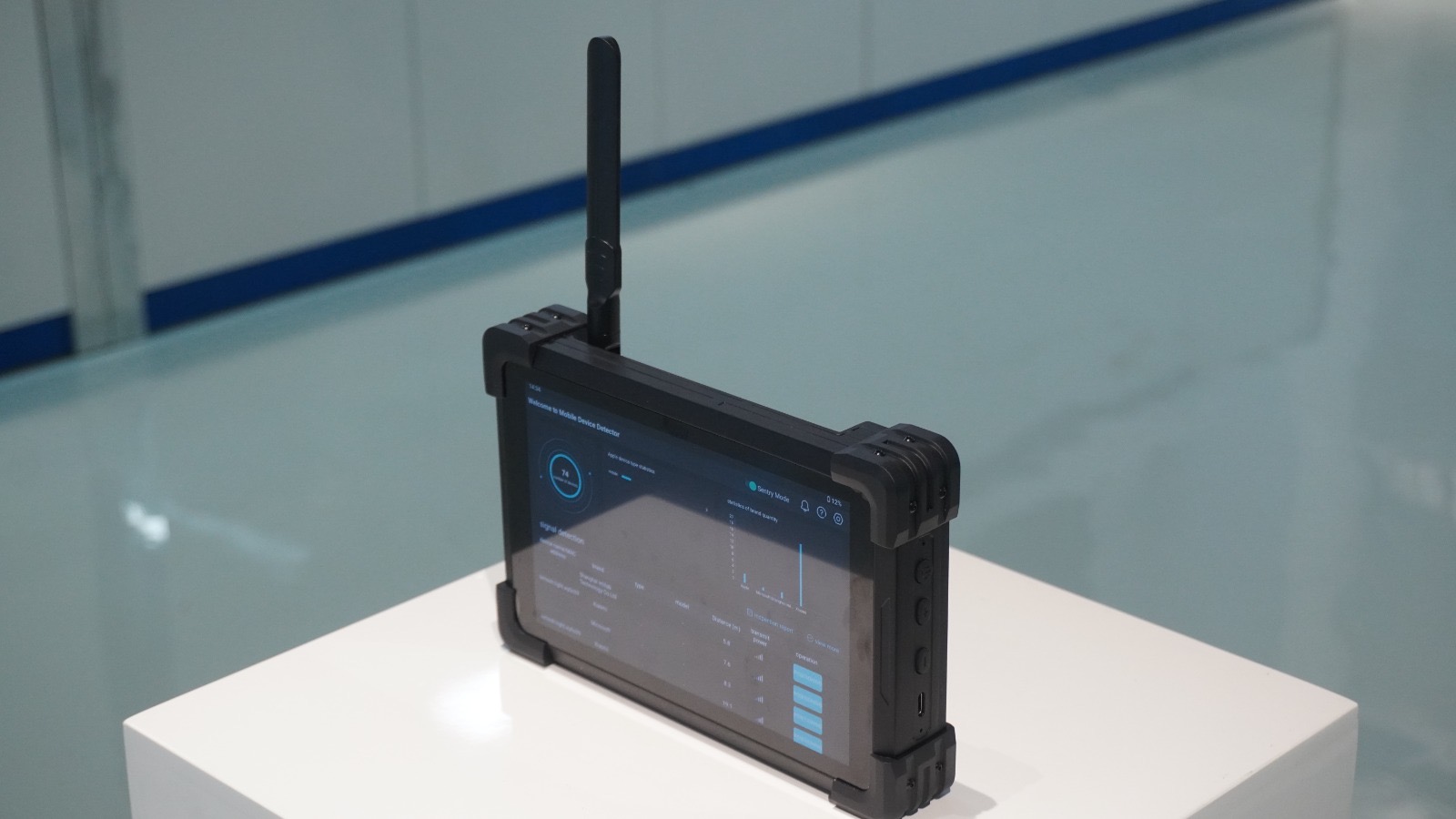
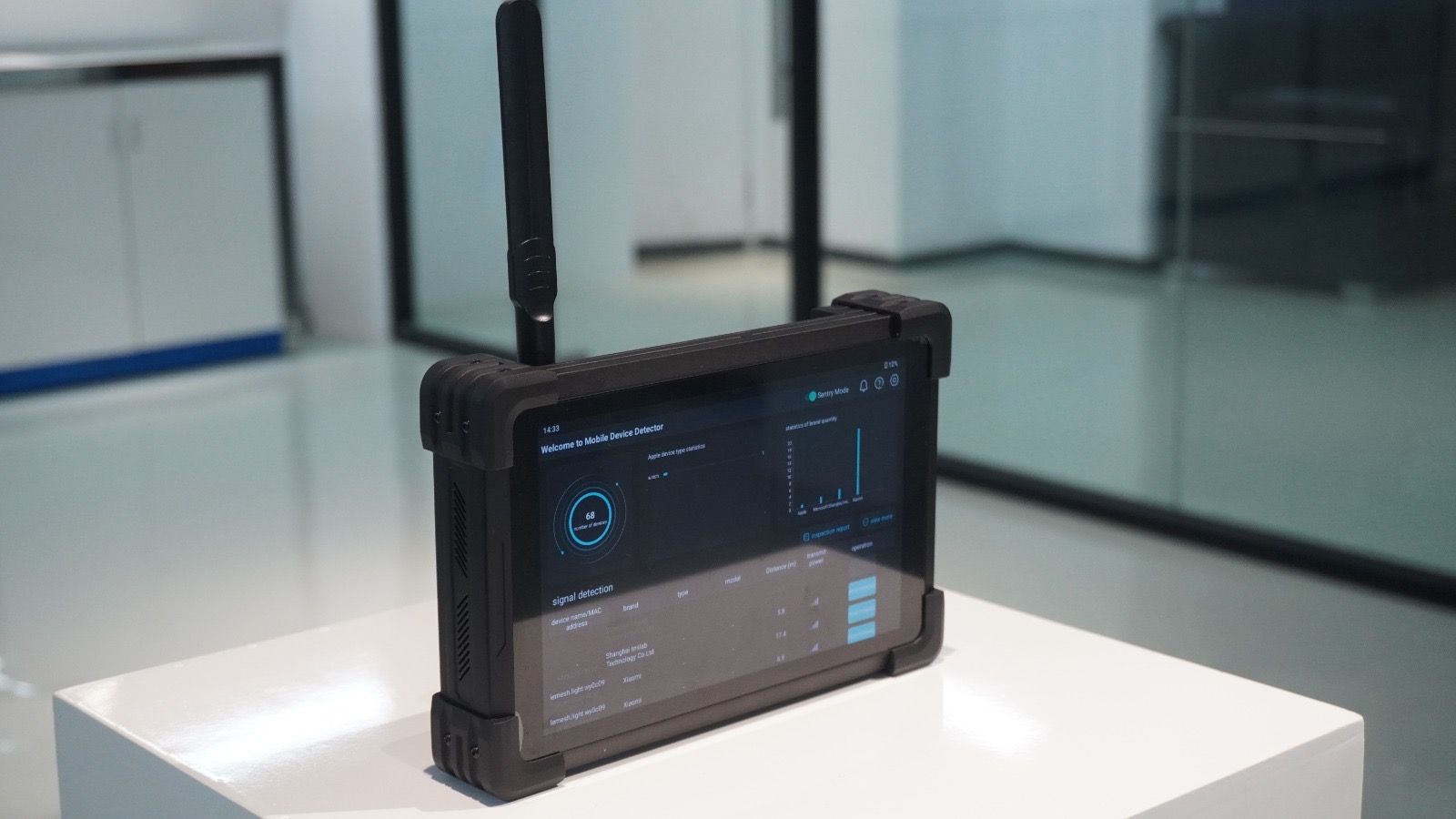



Description
Lisheng Digital Mobile Device & AirTag Detector
Bluetooth Device Detection, Identification & Proximity Positioning
The Lisheng Digital Mobile Device & AirTag Detector is a professional mobile device detection platform designed to identify supported wireless devices in sensitive environments and help operators determine where those devices are located.
It combines Bluetooth device detection, supported brand and model recognition, proximity positioning, Sentry Mode and long-duration monitoring in one portable platform.
Rather than simply indicating that RF activity exists, the system is designed around a more specific security question:
“What supported wireless device is present, and where should we look?”
What Is the Lisheng Digital Mobile Device & AirTag Detector?
The Lisheng Digital Mobile Device & AirTag Detector is a professional wireless device detection and proximity positioning system designed for environments where the presence of mobile or connected devices needs to be assessed.
The platform is particularly relevant to:
- Sensitive offices
- Security checkpoints
- Restricted facilities
- Government environments
- Corporate security
- Vehicle inspections
- Controlled-access areas
- Executive security operations
The manufacturer positions the system for important or confidential locations where security personnel need to scan surrounding areas for supported devices, identify suspicious device signals and use approaching-style positioning to locate them.
This makes it fundamentally different from a conventional RF detector.
A conventional RF detector primarily answers:
“Is there RF activity?”
The Lisheng platform is designed to answer:
“What supported wireless device may be present, and where should we investigate?”
Why Mobile Device Detection Matters
Modern security environments can contain large numbers of legitimate wireless devices.
Phones, watches, tablets, headphones, trackers and other connected devices may all coexist within the same area.
For sensitive environments, the challenge is therefore not simply detecting wireless energy.
It is distinguishing relevant device presence from background wireless activity.
A professional mobile device detection workflow may need to determine:
- Whether a supported device is present
- What type of device may be present
- Whether an Apple device is nearby
- Whether a Bluetooth tracking device is present
- Where the detected source is located
- Whether device presence changes over time
- Whether the device should be physically verified
The Lisheng platform is designed around this device-focused requirement.
Apple Device Detection
Apple device detection is one of the platform’s key capabilities.
The manufacturer describes detection and recognition of supported Apple devices including:
- iPhone
- Apple Watch
- iPad
- Wireless headphones
- Other supported Apple devices
Available device information may include brand, device type and model information depending on the device and its operating state.
However, recognition should not be interpreted as universal identification.
Detection behavior may vary according to:
- Device model
- Operating system
- Power state
- Screen state
- Bluetooth behavior
- Device configuration
- Environmental conditions
The manufacturer specifically documents limitations around certain Apple operating states.
The appropriate interpretation is therefore:
Supported Apple device detection and classification under applicable conditions — not guaranteed identification of every Apple device in every state.
AirTag & Bluetooth Tracker Detection
Bluetooth-based tracking devices create a specific security concern because they can be small, mobile and difficult to identify through visual inspection alone.
Apple states that AirTag uses Bluetooth to communicate with nearby devices as part of the Find My ecosystem.
The Lisheng platform’s Bluetooth detection architecture is therefore relevant to inspections involving supported Bluetooth tracking devices.
Potential inspection environments include:
- Vehicles
- Bags and personal belongings
- Executive environments
- Sensitive offices
- Security checkpoints
- Restricted facilities
- Equipment and assets
The purpose is to identify a detected wireless source that requires further assessment.
Detection does not independently establish:
- Ownership
- Intent
- Authorization
- Malicious activity
Those conclusions require physical verification and operational context.
Bluetooth Device Detection
The system uses Bluetooth as its primary wireless detection architecture.
Manufacturer specifications identify:
- Bluetooth 5.4
- BR / BLE
- 2400–2483.5 MHz
- Receiving sensitivity of < −100 dBm
- Stated detection coverage of approximately 200 m²
This makes the platform fundamentally different from a wideband RF spectrum analyzer.
It is designed around device-oriented Bluetooth detection and classification, rather than detailed spectrum analysis across a broad range of RF frequencies.
Supported Device & Brand Recognition
The system is designed to recognize supported device ecosystems and brands.
Manufacturer information identifies support for mainstream brands including:
- Apple
- Samsung
- Huawei
- OPPO
- Xiaomi
Depending on device conditions, available information may include:
- Brand
- Device type
- Model
- Signal presence
- Proximity information
This should be understood as supported-device recognition, not guaranteed physical-device identification.
For example, detecting an Apple-related wireless signal does not automatically establish who owns the device or whether its presence represents a security incident.
Proximity Positioning
Detection becomes considerably more useful when the operator can determine where the source is located.
The Lisheng platform provides approaching-style proximity positioning.
The operational process is:
Detect → Select → Approach → Narrow → Verify
The operator can move toward the detected source while using the system’s positioning feedback to determine whether the source is becoming closer.
This can support inspections involving:
- Vehicles
- Rooms
- Bags
- Checkpoints
- Furniture
- Controlled-access areas
The positioning function should be understood as local proximity positioning, not GPS.
Sentry Mode
The platform includes Sentry Mode for longer-duration monitoring.
This is particularly relevant where security personnel need to monitor a defined environment rather than perform only a single inspection.
Potential applications include:
- Security posts
- Gate checkpoints
- Restricted entrances
- Sensitive offices
- Government facilities
- Meeting environments
- Controlled areas
The operational model becomes:
Monitor → Detect → Alert → Investigate
rather than simply:
Scan → Finish
This makes Sentry Mode particularly relevant to environments where device presence itself is part of the security policy.
Detection Under Reduced-Visibility Conditions
The manufacturer describes detection of certain Apple devices under conditions where conventional visual inspection may not provide useful information, including specific shutdown, silent and locked conditions.
However, device behavior varies.
A device may not expose the same information when:
- Powered off
- Screen locked
- Configured differently
- Running different software
- Operating with different Bluetooth behavior
In some cases, the system may detect a signal without obtaining complete model information.
Therefore:
Detection capability should not be interpreted as guaranteed device identification in every operating state.
Real-Time Device Detection
The system is designed for real-time scanning around a defined area.
A typical operation is:
Scan → Detect → Classify → Position → Verify
The operator can assess detected sources through the integrated interface and determine which findings require additional attention.
This provides a more structured approach than treating every detected wireless signal as equivalent.
Long-Term Monitoring
The platform supports longer-duration monitoring for environments where repeated or continuous scanning is required.
This can help security teams observe whether supported devices appear within a controlled area over time.
Potential uses include:
- Security checkpoints
- Sensitive offices
- Restricted facilities
- Guard posts
- Meeting rooms
- Controlled entrances
The manufacturer describes the platform as suitable for real-time scanning and long-term detection around important locations.
Detection Coverage
The manufacturer-specified detection coverage is approximately 200 m².
This represents an area reference, not a guaranteed 200-metre detection distance.
Actual performance can vary according to:
- Device behavior
- Bluetooth activity
- Building construction
- RF interference
- Device orientation
- Antenna position
- Environmental conditions
- Deployment configuration
The coverage figure should therefore be treated as a manufacturer specification rather than universal field performance.
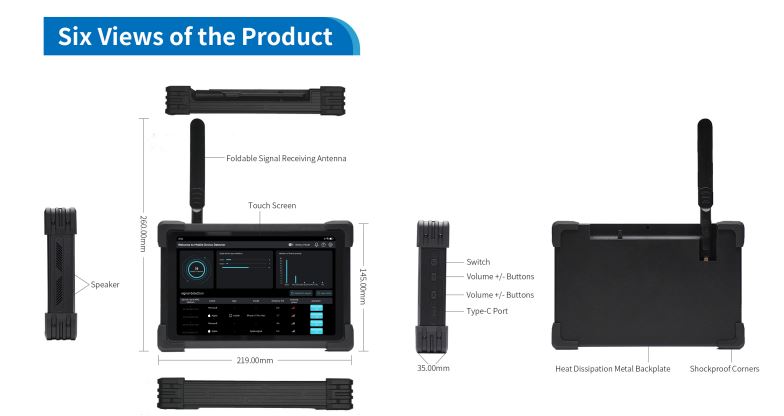
Portable Inspection Platform
The system integrates its detection hardware, processing platform, display and battery into a portable device.
Key specifications include:
- 8-inch capacitive touchscreen
- 1280 × 800 resolution
- Approximately 1000-nit display
- 8300 mAh battery
- USB-C connectivity
- Approximately 0.904 kg device weight
- Protective corners and metal rear construction
The portable architecture supports movement between:
- Offices
- Checkpoints
- Vehicles
- Meeting rooms
- Restricted facilities
- Security posts
Battery & Long-Duration Operation
The manufacturer specifies an 8300 mAh battery with approximately 12 hours of operation under specified conditions.
Actual operating time can vary according to:
- Screen brightness
- Scanning activity
- Sentry Mode usage
- Processing load
- Wireless environment
- Temperature
Organizations planning long-duration deployment should therefore evaluate battery requirements against their actual operating profile.
Security Inspection Workflow
1. Define the Area
Establish the room, vehicle, checkpoint or controlled zone being assessed.
2. Scan
Activate device detection and allow the system to identify supported wireless sources.
3. Classify
Review available device, brand or model information.
4. Prioritize
Determine whether a detected device requires further investigation according to the applicable security policy.
5. Locate
Use proximity positioning to narrow the source location.
6. Verify
Physically identify the device where appropriate.
7. Document
Record the detection, location, time and inspection outcome.
8. Escalate
Follow established procedures when an unauthorized or otherwise relevant device is identified.
Designed For & Common Applications
Security Checkpoints
Scan controlled areas for supported mobile and connected devices before entry into restricted environments.
Sensitive Offices
Assess meeting rooms, executive environments and other locations where unauthorized device presence may create security concerns.
Government & Restricted Facilities
Support device detection and longer-duration monitoring in controlled environments.
Corporate Security
Identify supported wireless devices in sensitive business areas and support follow-up verification.
Vehicle Inspections
Use proximity positioning to investigate vehicles for supported Bluetooth-based tracking devices.
Executive Security
Support security teams assessing device presence around protected environments.
Meeting & Conference Security
Monitor controlled meeting environments before or during sensitive activities.
Gate & Access Control
Deploy Sentry Mode where wireless device presence forms part of an access-control procedure.
What the Lisheng Detector Can and Cannot Do
What It Can Do
The platform can help operators:
- Detect supported mobile devices
- Detect supported Apple devices
- Detect supported Bluetooth devices
- Detect supported tracking devices
- Recognize supported brands
- Provide available device/model information
- Monitor device presence
- Provide proximity positioning
- Support Sentry Mode
- Generate detection alerts
- Support long-duration monitoring
- Assist security checkpoint and vehicle inspections
What It Cannot Automatically Do
The platform does not automatically:
- Identify the owner of a device
- Read messages
- Intercept calls
- Determine user identity
- Prove malicious intent
- Establish authorization
- Provide GPS coordinates
- Guarantee identification of every device
- Guarantee detection under every device state
- Replace wideband RF spectrum analysis
- Replace physical verification
The appropriate workflow remains:
Detect → Classify → Locate → Verify → Assess
Lisheng Mobile Device & AirTag Detector vs Conventional RF Detector
A conventional RF detector is primarily concerned with the presence and strength of radio-frequency activity.
The Lisheng platform is more specifically focused on supported wireless-device detection and proximity positioning.
| Capability | Conventional RF Detector | Lisheng |
|---|---|---|
| Detect RF activity | Yes | Yes |
| Device-oriented detection | Limited / model dependent | Yes |
| Apple device focus | Usually limited | Yes |
| Bluetooth device detection | Model dependent | Yes |
| AirTag-oriented detection | Model dependent | Yes |
| Brand recognition | Usually limited | Yes |
| Model information | Usually limited | Supported under applicable conditions |
| Proximity positioning | Model dependent | Yes |
| Sentry monitoring | Model dependent | Yes |
| Wideband spectrum analysis | Model dependent | Not its primary purpose |
The distinction is:
RF detector → “Is there RF activity?”
Lisheng → “What supported wireless device may be present, and where should we investigate?”
Lisheng Mobile Device & AirTag Detector vs Smartphone Bluetooth Scanning
Smartphones can scan Bluetooth devices, but a dedicated professional inspection platform provides a different operational architecture.
The Lisheng platform combines:
- Dedicated detection hardware
- Device classification
- Proximity positioning
- Sentry Mode
- Long-duration operation
- Integrated touchscreen
- Dedicated security workflow
The difference is therefore not simply whether Bluetooth scanning is possible.
It is the combination of:
Hardware + Detection + Classification + Positioning + Monitoring + Deployment
Professional Selection Considerations
Organizations evaluating a mobile device detection system should consider:
- Which device ecosystems need to be detected
- Whether Apple devices are a priority
- Whether Bluetooth trackers are relevant
- Required detection coverage
- Device classification requirements
- Proximity positioning
- Long-duration monitoring
- Checkpoint deployment
- Vehicle inspection
- Battery endurance
- Environmental conditions
- Operator training
- Verification procedures
- Privacy and legal requirements
The important question is not:
“Can it detect Bluetooth?”
It is:
“Does its detection architecture match the security problem we are trying to solve?”
Technical Specifications
| Parameter | Specification |
|---|---|
| Product Type | Mobile Device & Bluetooth Detection Platform |
| Primary Detection | Supported mobile and connected devices |
| Bluetooth | Bluetooth 5.4 |
| Bluetooth Modes | BR / BLE |
| Scan Frequency | 2400–2483.5 MHz |
| Receiving Sensitivity | < −100 dBm |
| Stated Detection Coverage | Approx. 200 m² |
| Device Recognition | Supported brand, device and model information |
| Apple Detection | Supported Apple devices under applicable conditions |
| Tracking Device Detection | Supported Bluetooth tracking devices |
| Positioning | Approaching-style proximity positioning |
| Feedback | Haptic / proximity feedback |
| Monitoring | Sentry Mode |
| Battery | 8300 mAh |
| Operating Time | Approx. 12 hours under specified conditions |
| Display | 8-inch capacitive touchscreen |
| Resolution | 1280 × 800 |
| Brightness | Approx. 1000 nits |
| Operating System | Android 14 |
| Processor | Quad-core / 6 TOPS |
| Memory | 8 GB LPDDR4 |
| Storage | 64 GB eMMC 5.1 |
| Charging | USB-C / PD up to 30 W |
| Dimensions | Approx. 220 × 145 × 35 mm |
| Weight | Approx. 0.904 kg |
| Operating Temperature | −20°C to +60°C |
| Primary Applications | Security checkpoints, sensitive areas, corporate security, restricted facilities and vehicle inspection |
Specifications may vary by product revision or configuration. Final specifications should be confirmed before procurement.
Included Equipment
Standard package contents include:
- Mobile device detection host
- USB-C data cable
- Charger
- Protective case
Final package contents should be confirmed before purchase.
Frequently Asked Questions
What is the Lisheng Digital Mobile Device & AirTag Detector?
It is a professional wireless device detection platform designed to identify supported mobile and Bluetooth devices and assist operators in locating detected sources through proximity positioning.
What devices can it detect?
The platform is designed to detect supported Apple devices, mobile devices, Bluetooth devices and supported tracking devices.
Can it detect iPhones?
Yes. The manufacturer specifically describes Apple device detection, including iPhones.
Can it detect Apple Watches?
Yes. Supported Apple wearable devices are included within the manufacturer’s described detection capabilities.
Can it detect AirTags?
The system is designed to detect supported Bluetooth-based tracking devices, including AirTag-type devices.
Can it detect a powered-off iPhone?
The manufacturer describes detection of certain Apple devices in shutdown conditions. However, detection and model recognition can vary by device and operating system.
Can it detect an iPhone in silent mode?
The manufacturer describes Apple device detection under silent conditions, subject to device behavior.
Can it detect a locked iPhone?
Detection may remain possible for supported devices, but the information available can vary according to device model and operating conditions.
Can it identify the exact model?
Model identification is supported under applicable conditions, but it is not guaranteed for every device or operating state.
Can it detect Samsung and Android devices?
The manufacturer describes support for mainstream brands including Samsung, Google, Huawei, OPPO and Xiaomi.
Is it an RF spectrum analyzer?
No.
The Lisheng platform is primarily a device-oriented Bluetooth detection system. It is not designed to replace a professional wideband spectrum analyzer.
Does it provide GPS location?
No.
Its positioning function is local proximity positioning based on detected wireless signals.
Can it identify the owner of a device?
No.
Device detection does not establish ownership or user identity.
Can it read messages or calls?
No.
The system is a detection and classification platform, not a communications interception system.
Can it prove that a detected device is malicious?
No.
A detected device may be legitimate. Security personnel must assess it according to the applicable operational context.
What is Sentry Mode?
Sentry Mode is a longer-duration monitoring function designed to observe a defined area and alert operators when supported devices are detected.
What is the detection range?
The manufacturer specifies approximately 200 m² of detection coverage. This is an area specification, not a guaranteed 200-metre detection distance.
How does proximity positioning work?
The system provides approaching-style feedback that helps operators move toward a detected wireless source and narrow the search area.
Can it detect Bluetooth trackers inside vehicles?
It may help identify supported Bluetooth tracking devices during vehicle inspections. Actual results depend on device state, vehicle construction and wireless conditions.
Can it replace CAM-GX5?
Not directly.
The two products address different security problems.
CAM-GX5 is primarily a cellular/RF activity detector covering 2G/3G/4G/5G and WiFi/Bluetooth activity.
Lisheng is more focused on supported mobile and connected-device presence, device recognition, Apple/AirTag-oriented detection and proximity positioning.
Can it replace a professional TSCM sweep?
No.
It is one detection layer within a broader security or TSCM methodology.
A professional inspection may also require RF spectrum analysis, NLJD, wireline analysis, optical camera detection, physical inspection and other methods.
| Attribute | Lisheng Digital Mobile Device & AirTag Detector | Cellular Detector — CAM-GX5 |
|---|---|---|
| Primary Concept | Mobile Device Detection | Cellular Signal Detection |
| Primary Focus | Device presence, recognition and classification | Cellular transmission detection and localization |
| Core Detection Architecture | Bluetooth / BR / BLE | Multiband Cellular RF |
| Device Recognition | Supported device / brand / model recognition | Signal/band-based device assessment |
| Apple Devices | Core use case | Not primary |
| AirTag / Bluetooth Trackers | Core use case | Not primary |
| Bluetooth Devices | Device-focused detection | Secondary wireless detection |
| Proximity Positioning | Yes | Signal-strength-based localization |
| Sentry / Long-Term Monitoring | Yes | Event logging / historical signal monitoring |
| 2G / 3G / 4G / 5G | Not the core architecture | Core detection capability |
| Detection Philosophy | “What supported device is present, and where is it?” | “What cellular transmission is active, and where is it?” |
| Archthetic Primary Category | Wireless & Protocol Detection | Cellular & Mobile Signal Detection |
Deployment & Procurement Considerations
Before deployment, organizations should establish:
What devices need to be detected?
Apple devices?
Bluetooth trackers?
Mobile terminals?
Where will detection occur?
Checkpoint?
Office?
Vehicle?
Restricted facility?
Is one-time inspection sufficient?
Or is continuous monitoring required?
Is proximity positioning important?
If the operator must physically locate the detected source, proximity positioning becomes particularly relevant.
How will findings be verified?
A detected wireless source should be assessed and physically verified where appropriate rather than automatically treated as a security threat.
Mobile Device Detection Within a Broader Security Architecture
The Lisheng platform is best understood as one layer within a broader security architecture.
A layered inspection program may combine:
Mobile Device Detection
→ Identify supported wireless devices
RF Detection
→ Assess broader wireless activity
NLJD
→ Investigate concealed electronic components
Optical Detection
→ Inspect potential hidden camera lenses
Physical Verification
→ Identify the actual device
This creates a layered methodology rather than relying on one detection principle.
Global Procurement Through Archthetic
Specialized security technologies are often developed within highly focused technology ecosystems.
Archthetic connects professional buyers with specialized manufacturers and technology partners through a global procurement infrastructure.
The Lisheng Digital Mobile Device & AirTag Detector can therefore be evaluated not simply as hardware, but as part of a professional security technology deployment.
The procurement journey is designed around:
Discover → Evaluate → Connect → Procure → Deploy
Product configuration, supported device coverage and deployment conditions should be confirmed before procurement.
Focused Conclusion
The Lisheng Digital Mobile Device & AirTag Detector occupies a specific position within professional security technology.
It is not simply another RF detector.
Its core value is the combination of:
Device Detection
Supported Device Recognition
Apple & Bluetooth Tracker Detection
Proximity Positioning
Sentry Mode
Long-Duration Monitoring
within one portable platform.
The operational workflow is:
Detect → Classify → Locate → Verify → Assess
For security checkpoints, restricted environments, corporate security, vehicle inspections and other controlled areas, the platform provides a device-focused approach to identifying supported wireless devices and determining where further investigation should take place.
Its capabilities should be evaluated against actual device behavior, wireless conditions, deployment requirements and manufacturer specifications.
The important question is therefore not:
“Can it detect wireless signals?”
It is:
“Can it identify the types of devices relevant to our security requirement and help our team determine where to investigate next?”


Reviews
There are no reviews yet.