
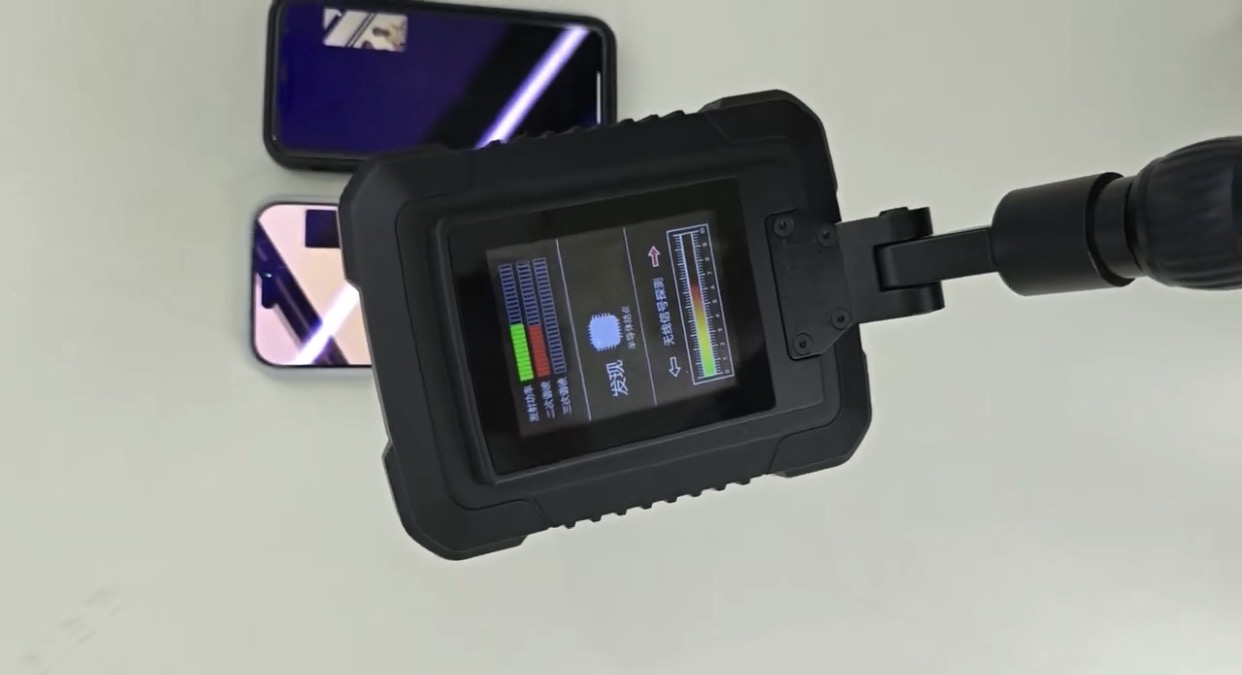
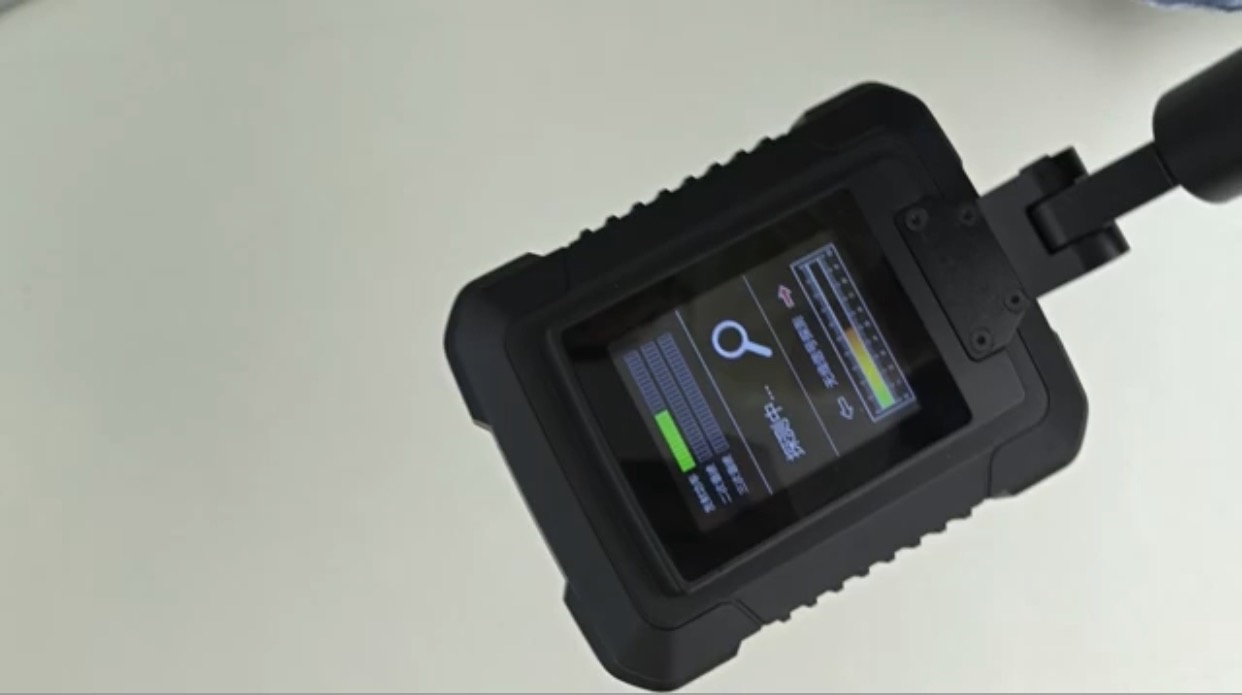


Description
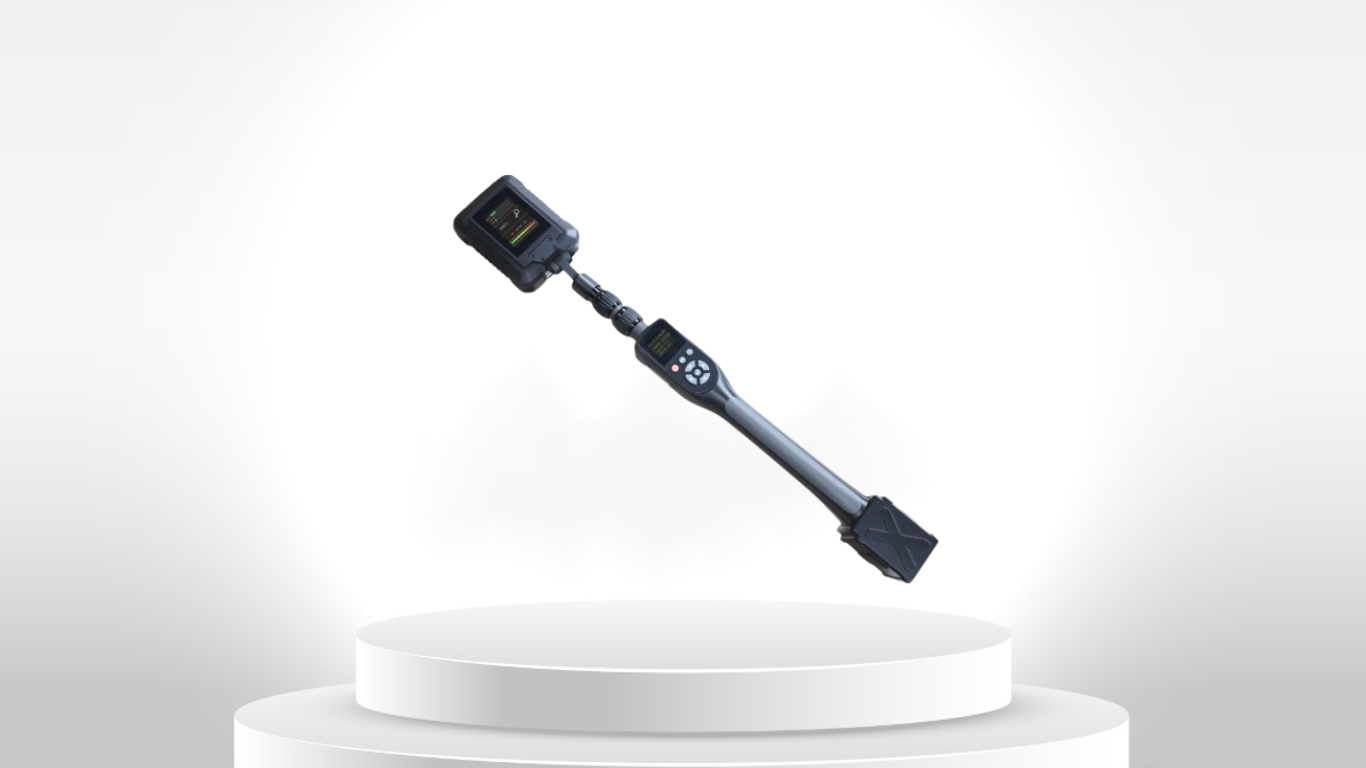
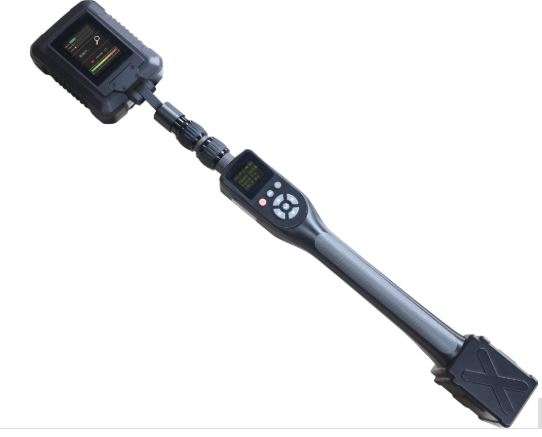
NLJD AT-811 Enhanced with WiFi & Wireless Signal Detection
One inspection. Two detection layers. A clearer path from suspicious electronics to the source.
The NLJD AT-811 combines nonlinear junction detection, wireless signal detection and directional positioning in one professional TSCM platform.
It is designed to address two different inspection questions:
- Could concealed electronic equipment be present, even if it is switched off or not transmitting?
- If a wireless signal is active, where is the source located?
A conventional Nonlinear Junction Detector AT-811 workflow may identify concealed electronics, while a separate RF or wireless signal detector may be needed to locate active transmissions. The AT-811 Enhanced brings these capabilities together, helping operators move from detection to directional localization with fewer equipment changes.
The platform can investigate semiconductor-based electronics concealed inside walls, floors, ceilings, furniture, lamps, packages and containers. Its wireless detection function supports cellular technologies, Bluetooth and WiFi across a specified range of 50 MHz–6000 MHz.
The AT-811 is not simply an enhanced NLJD. It is a combined detection and positioning platform for identifying concealed electronics, detecting active wireless signals and narrowing the search area.
AT-811 at a Glance
| Capability | What It Helps the Operator Do |
|---|---|
| Nonlinear junction detection | Investigate concealed semiconductor-based electronics |
| Powered-off electronics detection | Examine devices that may be switched off or inactive |
| Wireless signal detection | Identify active cellular, Bluetooth and WiFi transmissions |
| Directional positioning | Determine the likely direction of a wireless source |
| Signal-strength indication | Assess whether the operator is moving closer to the source |
| Differential detection | Improve target localization and reduce unnecessary re-checking |
| Structural penetration | Investigate targets through brick walls up to the specified limit |
| Professional TSCM use | Support counter-surveillance inspections in sensitive environments |
Why Combine NLJD with Wireless Signal Detection?
A conventional NLJD answers:
Could there be concealed electronics here?
A wireless signal detector answers:
Is something transmitting from here, and where is that transmission coming from?
These are different detection problems.
A concealed device may be switched off, inactive or not transmitting during an inspection. In that situation, active RF detection alone may not identify it. Conversely, a device that is actively communicating through cellular, Bluetooth or WiFi may be easier to investigate through wireless signal detection and directional positioning.
The AT-811 combines both approaches in one workflow:
Concealed Electronics → Active Signal → Direction → Localization → Physical Verification
This can help reduce inspection time and limit the need to switch between separate instruments.
Two Detection Layers in One Platform
Layer 1: NLJD Detection
The nonlinear junction detection function investigates electronic components and semiconductor-based circuitry that may be concealed inside:
- Walls
- Floors
- Ceilings
- Furniture
- Lamps
- Packages
- Containers
- Concealed compartments
- Other structural or enclosed locations
NLJD detection does not depend solely on the target actively transmitting. This makes it relevant when investigating electronics that may be:
- Switched on
- Switched off
- Inactive
- Not actively transmitting
- Concealed behind structural materials
The AT-811 uses nonlinear harmonic detection to identify responses associated with electronic components that may be difficult to locate through active wireless detection alone.
Layer 2: Wireless Signal Detection
The wireless signal detection function is designed for active transmissions.
The AT-811 supports detection of:
- GSM
- WCDMA
- CDMA2000
- TD-SCDMA
- LTE
- LTE-A
- 5G
- Bluetooth
- WiFi
The specified wireless detection range is 50 MHz–6000 MHz, allowing the device to investigate a broad range of active wireless sources rather than focusing on one communication standard.
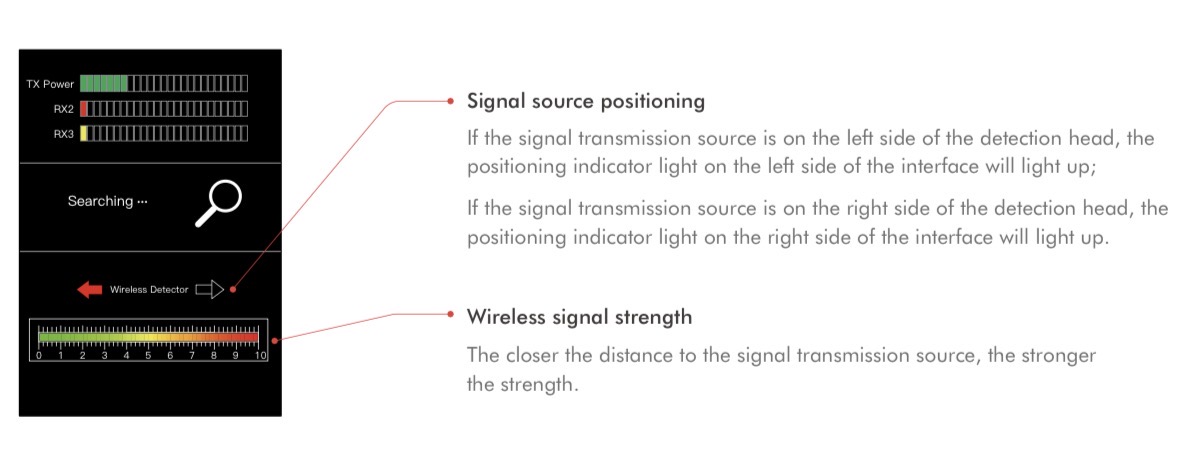
Directional Wireless Signal Positioning
Detecting a wireless signal is useful. Determining where it is coming from is more useful.
The AT-811 provides directional positioning to help indicate the origin of a detected wireless signal. Directional indicators show whether the source is positioned toward one side or the other of the detection head.
As the operator moves closer to the source, the detected signal strength may increase. This creates a practical field process:
Detect → Determine Direction → Move Toward Source → Monitor Strength → Confirm
The objective is to reduce the amount of time spent searching an entire room, vehicle, furniture item or structural area after an active wireless source has been detected.
How the AT-811 Supports a TSCM Inspection
| Inspection Stage | AT-811 Function | Operational Objective |
|---|---|---|
| Initial sweep | NLJD detection | Identify possible concealed electronics |
| Wireless assessment | Wireless signal detection | Identify active transmissions |
| Direction finding | Directional positioning | Establish the likely source direction |
| Search refinement | Signal-strength indication | Move toward the strongest signal area |
| Target localization | Differential and directional detection | Narrow the physical search area |
| Final assessment | Physical verification | Identify and assess the actual device |
The equipment supports the inspection process, but it does not replace professional judgment. Every detection should be assessed in context and physically verified where appropriate.
Why This Matters for Modern TSCM
Modern surveillance and electronic environments are more complex than the traditional model of a continuously transmitting “bug.”
A device may:
- Remain inactive during part of an inspection
- Store information locally
- Transmit only at intervals
- Communicate through cellular networks
- Use Bluetooth or WiFi
- Combine multiple functions in a compact electronic package
For this reason, a professional inspection should not rely on a single detection principle.
The AT-811 addresses two complementary requirements:
Is there concealed electronic circuitry?
and
Is there an active wireless source, and where is it located?
This combined approach is particularly relevant in environments where inactive electronics and legitimate wireless activity exist at the same time.
Differential Detection and Target Localization
Detection and localization are not the same task.
A detector may indicate that a response exists, but the operator still needs to determine where the target is physically located. The AT-811 uses differential detection principles, together with directional positioning, to help refine the target location.
This can support:
- Smaller search areas
- Fewer repeated inspections
- Faster physical verification
- More efficient secondary review
The practical objective is:
Less area to search. Less unnecessary re-checking. Faster target localization.
High Sensitivity for Concealed Electronics
The AT-811 specifies NLJD receive sensitivity of ≤−140 dBm and uses a high-gain antenna.
This supports the investigation of semiconductor-based electronics concealed within walls, furniture and other structures. However, sensitivity should not be considered in isolation.
Actual detection performance depends on factors such as:
- Target construction
- Target orientation
- Distance
- Structural material
- Environmental conditions
- Operator technique
- Target electronic characteristics
The specification represents an important capability, but it does not guarantee identical results for every target or inspection environment.
Structural Penetration Through Brick Walls
The AT-811 is specified to detect through brick walls up to 370 mm thick. The manufacturer also states that the product meets the C-level product standard specified in GA1236-2015.
This capability may be relevant when direct access to a suspected location is difficult.
Potential inspection areas include:
- Structural walls
- Floors
- Ceilings
- Furniture
- Lamps
- Containers
- Concealed compartments
Actual performance depends on the wall construction, target characteristics, distance, orientation and surrounding conditions.
Wireless Signal Strength Detection
The wireless detection function provides relative signal-strength information.
As the operator moves closer to an active transmission source, the detected signal strength may increase. This helps answer two practical questions:
- Which direction should I investigate?
- Am I getting closer to the source?
The operator is therefore not limited to knowing that a wireless signal exists. Directional positioning and signal-strength changes can help narrow the search area.
Supported Wireless Technologies
| Wireless Technology | Supported |
|---|---|
| GSM | Yes |
| WCDMA | Yes |
| CDMA2000 | Yes |
| TD-SCDMA | Yes |
| LTE | Yes |
| LTE-A | Yes |
| 5G | Yes |
| Bluetooth | Yes |
| WiFi | Yes |
The manufacturer specifies a wireless detection range of 50 MHz–6000 MHz and wireless signal reception sensitivity of −50 dBm.
This makes the wireless detection layer relevant to connected environments where cellular, Bluetooth and WiFi-enabled electronics may coexist.
Reducing Secondary Review
Secondary inspection takes time.
When an operator identifies a suspicious area, additional equipment or repeated inspection may be required to determine whether the source is concealed electronics, an active wireless device or legitimate equipment.
By combining NLJD and wireless signal detection, the AT-811 can provide more information during the initial inspection. This may help reduce unnecessary secondary review and improve the efficiency of professional security sweeps.
The value is not simply the number of functions included in the device. It is the ability to obtain more relevant information before deciding what to investigate next.
What Happens When a Wireless Source Is Found?
The AT-811 provides directional indication through its interface.
If the wireless source is positioned toward one side of the detection head, the corresponding positioning indicator illuminates. If the source is toward the opposite side, the relevant indicator changes accordingly.
As the operator approaches the source, wireless signal strength may increase.
A typical field workflow is:
Signal Detected → Direction Identified → Operator Moves → Signal Strength Increases → Target Area Narrowed
This can be useful when searching rooms, furniture, vehicles or other areas containing multiple potential wireless sources.
Professional TSCM Applications
Confidential Meeting Rooms
Sensitive meeting rooms may contain both concealed electronics and active wireless devices. The AT-811 can investigate potential concealed electronics while also identifying active wireless transmissions.
Executive Offices
Executive offices often contain substantial legitimate wireless activity. Directional positioning can help operators narrow down suspicious sources without treating the entire room as one undifferentiated search area.
Government and Sensitive Facilities
Sensitive facilities may require inspection methods capable of addressing inactive concealed electronics and active wireless communications. The AT-811 provides both detection layers in one platform.
Corporate Security
Organizations protecting confidential information, intellectual property and sensitive discussions can use combined detection methodologies as part of broader TSCM procedures.
Hotels and Privacy-Sensitive Environments
Hotels and similar environments may contain concealed electronics inside furniture, walls, lamps and other objects, while also containing extensive legitimate WiFi and cellular activity. Operators must therefore be able to investigate both concealed electronics and active wireless sources.
Using AT-811 in Areas With Heavy Wireless Activity
Modern environments contain many wireless devices, including:
- Phones
- Laptops
- WiFi routers and access points
- Bluetooth devices
- Connected appliances
- IoT equipment
- Other wireless electronics
The presence of a wireless signal does not automatically mean that a surveillance device is present.
The AT-811 should be used as an investigation and localization tool, not as an automatic spy-device classifier. Operators should identify, assess and verify detected sources.
A legitimate phone, WiFi access point or Bluetooth device may produce a detectable signal. Similarly, legitimate electronic equipment may produce an NLJD response.
What AT-811 Can and Cannot Tell You
What It Can Do
The AT-811 can help operators:
- Investigate concealed semiconductor-based electronics
- Investigate devices that are switched off
- Investigate devices that are not actively transmitting
- Detect nonlinear harmonic responses
- Detect active wireless signals
- Identify supported cellular technologies
- Detect Bluetooth and WiFi activity
- Determine the direction of a wireless source
- Monitor relative wireless signal strength
- Narrow the physical search area
- Reduce unnecessary secondary review
What It Cannot Automatically Do
The AT-811 does not automatically prove that every detection is a surveillance device.
A wireless signal may originate from legitimate equipment. An NLJD response may originate from ordinary semiconductor electronics.
Professional interpretation and physical verification remain necessary.
The correct methodology is:
Detect → Assess → Locate → Identify → Verify
AT-811 Compared With Other Detection Equipment
AT-811 vs. a Conventional NLJD
| Capability | Conventional NLJD | AT-811 Enhanced |
|---|---|---|
| Investigates concealed electronics | Yes | Yes |
| Detects powered-off electronics | Depending on model | Yes, through NLJD function |
| Detects active wireless signals | Usually limited or unavailable | Yes |
| Supports cellular signal detection | Usually unavailable | Yes |
| Supports Bluetooth and WiFi detection | Usually unavailable | Yes |
| Provides wireless direction finding | Usually unavailable | Yes |
| Provides relative wireless signal strength | Usually unavailable | Yes |
| Combines detection layers | No | Yes |
A conventional NLJD primarily asks:
Is there concealed electronic circuitry here?
The AT-811 adds:
Is there also an active wireless transmission, and where is it coming from?
AT-811 vs. a Conventional RF Detector
| Capability | Conventional RF Detector | AT-811 Enhanced |
|---|---|---|
| Detects active RF or wireless transmissions | Yes | Yes |
| Investigates non-transmitting electronics | Usually no | Yes, through NLJD |
| Detects powered-off electronics | Usually no | Yes, through NLJD |
| Supports nonlinear harmonic detection | Usually no | Yes |
| Provides wireless direction finding | Model-dependent | Yes |
| Supports cellular, Bluetooth and WiFi detection | Model-dependent | Yes |
| Provides combined NLJD and wireless detection | No | Yes |
A conventional RF detector focuses on active transmissions. The AT-811 adds nonlinear junction detection, allowing operators to investigate concealed electronics that may not be transmitting.
AT-811 vs. a Spectrum Analyzer
| Requirement | Spectrum Analyzer | AT-811 Enhanced |
|---|---|---|
| Detailed RF signal analysis | Yes | Not its primary purpose |
| Frequency-domain investigation | Yes | Limited compared with a spectrum analyzer |
| Rapid field detection | Model-dependent | Yes |
| Wireless source direction finding | Model-dependent | Yes |
| NLJD detection | No | Yes |
| Concealed powered-off electronics investigation | No | Yes |
| Physical source localization | Model-dependent | Yes |
The AT-811 does not replace a spectrum analyzer. Spectrum analysis provides detailed information about RF signals and their characteristics. The AT-811 is designed for rapid field detection and localization of supported wireless sources while also providing NLJD capability.
Technical Specifications
| Parameter | Specification |
|---|---|
| Product Type | Enhanced Nonlinear Junction Detector with Wireless Signal Detection |
| Working Band | 2400 MHz |
| Transmit Frequency | 2.4–2.5 GHz |
| Received Harmonics | 4.8–5.0 GHz / 7.2–7.5 GHz |
| Harmonic Detection | 2nd and 3rd harmonics |
| Transmit Power | 0–4 W EIRP, maximum pulse mode |
| NLJD Receive Sensitivity | ≤−140 dBm |
| Detection Distance | ≥6 m |
| Structural Penetration | Up to 370 mm brick wall |
| Wireless Detection Range | 50 MHz–6000 MHz |
| Wireless Detection Types | GSM, WCDMA, CDMA2000, TD-SCDMA, LTE, LTE-A, 5G, Bluetooth, WiFi |
| Wireless Signal Reception Sensitivity | −50 dBm |
| Wireless Positioning | Directional positioning of wireless signal sources |
| Wireless Strength Detection | Yes |
| Battery | Replaceable lithium battery |
| Operating Time | >4 hours in maximum pulse mode |
| Dimensions | 760 × 114 × 108 mm |
| Weight | 1.6 kg |
| Working Temperature | −10°C to +55°C |
| Working Humidity | ≤93% RH, non-condensing |
| Standard | C-level product standard specified in GA1236-2015 |
Specifications are based on current manufacturer product information. AWP notes that product configurations and displayed parameters may change during product updates, so the final configuration should be confirmed before procurement. (AWP Tech)
Frequently Asked Questions About NLJD AT-811
What is the NLJD AT-811 Enhanced?
The AT-811 is an enhanced Nonlinear Junction Detector that combines nonlinear junction detection with wireless signal detection and directional positioning.
It is designed to investigate concealed electronic devices and active wireless sources.
What is the main advantage of AT-811?
Its main advantage is the combination of two detection layers in one platform.
NLJD investigates concealed electronics, including devices that may be switched off or not transmitting. Wireless detection identifies active signals from supported cellular, Bluetooth and WiFi technologies and helps indicate their direction.
Why combine NLJD and wireless signal detection?
Concealed electronics and active wireless transmitters present different detection problems.
NLJD can investigate electronics without requiring active transmission. Wireless detection can identify devices that are currently transmitting. Combining both reduces the need to treat these as completely separate inspection tasks.
Can AT-811 detect devices that are switched off?
Yes. The NLJD component is designed to investigate electronic devices regardless of whether they are turned on or off.
Can AT-811 detect devices that are not transmitting?
Yes. The NLJD function does not require the target to be actively transmitting a wireless signal.
Can AT-811 detect active wireless devices?
Yes. The wireless detection unit is designed to detect supported active wireless signals.
What wireless signals can AT-811 detect?
The manufacturer specifies support for:
- GSM
- WCDMA
- CDMA2000
- TD-SCDMA
- LTE
- LTE-A
- 5G
- Bluetooth
- WiFi
The specified wireless detection range is 50 MHz–6000 MHz.
Can AT-811 locate the direction of a wireless signal?
Yes. The wireless detection system provides directional positioning to indicate the origin and location of detected wireless signals.
How does wireless signal positioning work?
The operator uses directional indicators to determine which side of the detection head the signal is coming from. As the operator moves closer to the source, the detected wireless signal strength may increase, allowing the search area to be progressively narrowed.
Does AT-811 identify the exact device transmitting the signal?
Not automatically.
The wireless detection function identifies and helps locate a wireless signal source. It does not automatically establish whether the source is a legitimate phone, WiFi device, Bluetooth device or surveillance device.
Physical identification and verification remain necessary.
Can legitimate WiFi devices trigger AT-811?
Yes. WiFi routers, access points, computers, phones and other legitimate wireless equipment can produce detectable signals.
Signal detection should therefore be followed by source identification and professional assessment.
Can legitimate electronic devices trigger the NLJD?
Yes. NLJD technology responds to nonlinear characteristics associated with electronic components, not exclusively surveillance equipment.
Professional operators must distinguish legitimate electronics from suspicious targets.
What is the difference between the NLJD and wireless detection functions?
The NLJD function investigates concealed electronic circuitry through nonlinear harmonic responses.
The wireless detection function investigates active wireless transmissions.
They answer different questions and complement one another.
What are the 2nd and 3rd harmonic frequencies of AT-811?
The manufacturer specifies:
- 2nd harmonic: 4.8–5.0 GHz
- 3rd harmonic: 7.2–7.5 GHz
These frequencies are part of the nonlinear junction detection process.
What is the NLJD receive sensitivity?
The specified NLJD receive sensitivity is ≤−140 dBm. This supports the investigation of semiconductor-based electronics concealed within structures and objects.
How far can AT-811 detect?
The specified detection distance is ≥6 metres, with the manufacturer stating compliance with the C-level product standard specified in GA1236-2015. (AWP Tech)
Can AT-811 detect through walls?
Yes. The manufacturer specifies detection through up to 370 mm of brick wall and identifies the product as meeting the C-level standard specified in GA1236-2015.
Does 370 mm penetration mean it can detect every device behind a 370 mm wall?
No.
Penetration specifications should not be interpreted as a universal guarantee. Actual performance depends on wall construction, target characteristics, distance, orientation and environmental conditions.
What does differential detection do?
Differential detection helps locate a suspicious device more precisely. Identifying that a response exists is different from determining where the source is physically located.
Why is directional positioning useful to a TSCM operator?
It reduces the search area. Instead of knowing only that a wireless signal exists somewhere in a room, the operator can use directional information and signal-strength changes to move toward the likely source.
Can AT-811 replace a spectrum analyzer?
No.
Spectrum analysis provides detailed information about RF signals and their characteristics. AT-811 is designed for rapid field detection and localization of supported wireless sources while also providing NLJD capability.
The technologies can complement one another.
Can AT-811 replace a conventional RF detector?
The AT-811 provides wireless signal detection in addition to NLJD, but it should not automatically be treated as a replacement for every RF detection or spectrum-analysis requirement.
The appropriate equipment depends on the inspection objective.
Why is combined detection useful in modern TSCM environments?
Modern environments contain many connected devices, making active wireless signals increasingly common. At the same time, concealed electronics do not necessarily need to be continuously transmitting.
A professional inspection therefore benefits from addressing both conditions:
Inactive concealed electronics + active wireless communications
AT-811 is designed around that combined requirement.
Is AT-811 suitable for C-suite and security decision-makers?
Yes.
In practical terms, the technology helps answer two questions in one inspection:
- Could electronic equipment be concealed here even if it is not transmitting?
- If something is transmitting, where is the wireless source?
That combined capability can reduce unnecessary inspection time and improve the efficiency of professional security sweeps.
Is AT-811 suitable for professional TSCM operators?
Yes.
Its combined nonlinear detection, wireless signal detection, directional positioning and structural penetration capabilities are relevant to professional inspection workflows.
What should an expert evaluate before purchasing AT-811?
A TSCM professional should evaluate:
- NLJD detection principle
- 2nd and 3rd harmonic response
- Receive sensitivity
- Detection distance
- Structural penetration
- Wireless detection range
- Supported cellular technologies
- 5G capability
- Bluetooth and WiFi detection
- Wireless sensitivity
- Directional positioning
- Signal-strength indication
- Battery operating time
- Physical ergonomics
- Environmental operating range
- Applicable standards
- Manufacturer support
The key question is not simply whether the specification sheet is impressive. It is whether the combined detection architecture matches the actual inspection requirement.
Focused Conclusion
The NLJD AT-811 Enhanced is designed for TSCM inspections that require more than one detection method.
Its nonlinear junction detection function helps investigate concealed, powered-off and non-transmitting electronics. Its wireless signal detection function supports the identification of active cellular, Bluetooth and WiFi transmissions. Directional positioning and signal-strength indication then help operators narrow the search area.
The platform does not automatically identify every detection as a surveillance device, and it does not replace spectrum analysis or physical verification. Its value is in combining complementary detection layers within one professional workflow.
For organizations, security teams and TSCM operators assessing concealed electronics and active wireless sources, the AT-811 provides a practical path from:
Detection → Assessment → Directional Localization → Physical Verification


Reviews
There are no reviews yet.