


Description
Professional Listen Through Wall Device — Acoustic Detection Through Solid Surfaces
Detect and monitor sound and vibration through solid surfaces using a high-sensitivity contact microphone, amplified audio and fine-tuning control.
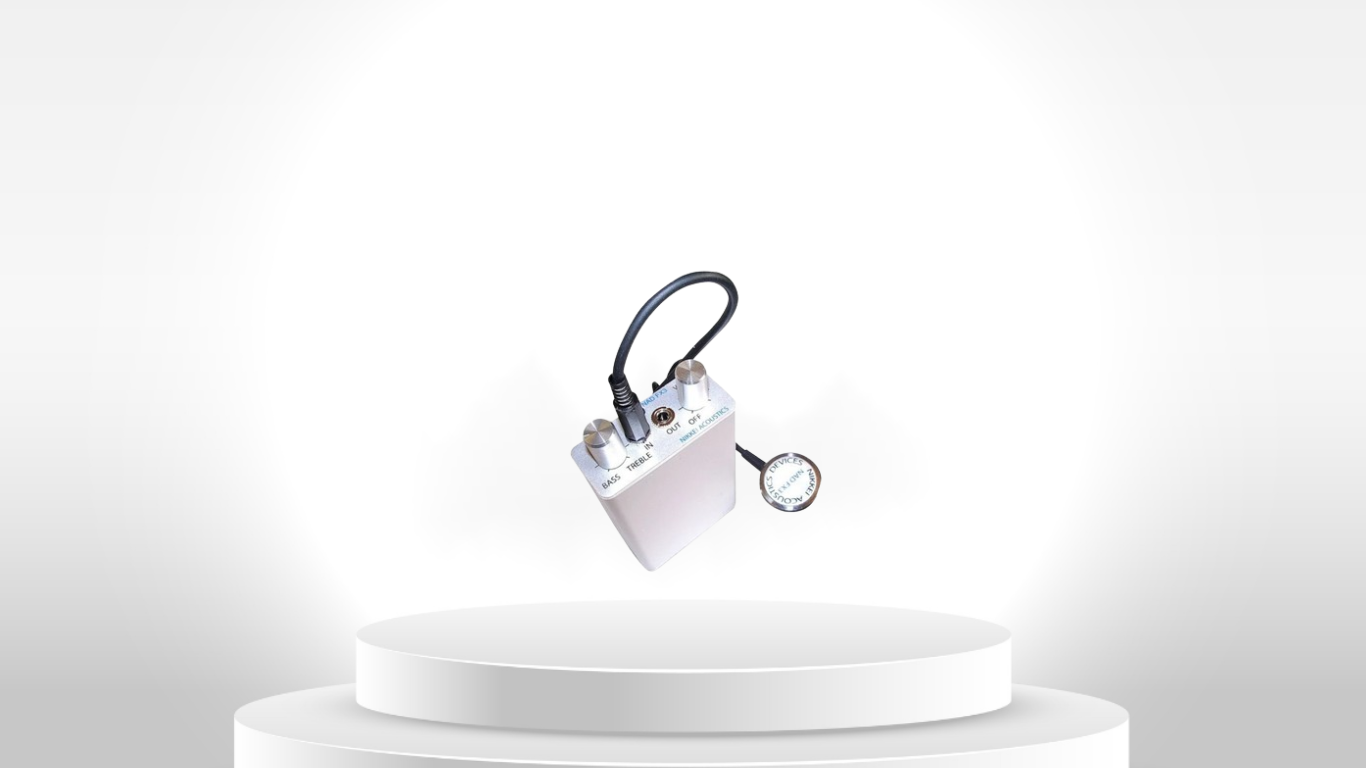
The Professional Listen Through Wall Device is a professional acoustic detection system designed to pick up vibration and sound transmitted through solid surfaces such as walls, floors, ceilings, pipes, doors, panels and machinery.
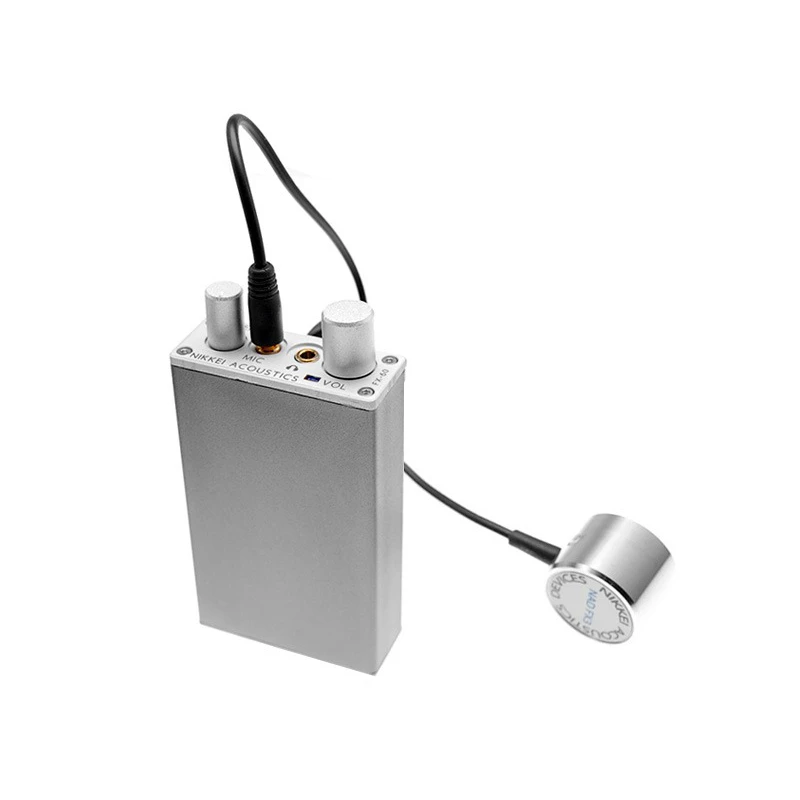
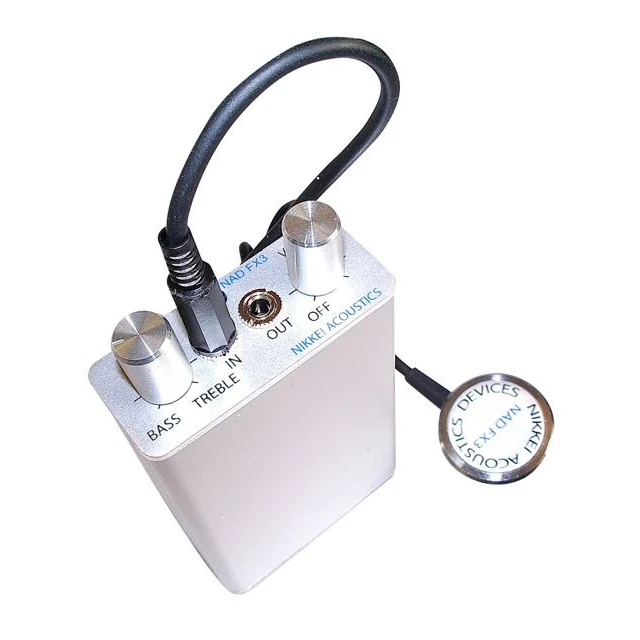
Instead of relying on a conventional airborne microphone, the system uses a ceramic contact microphone to detect vibration through the surface and convert it into audible output for monitoring.
This makes the device relevant to a much wider range of applications than conventional investigative listening, including search and rescue, building inspection, plumbing and leak investigation, mechanical diagnostics, pest detection and authorized security inspection.
What Is the Professional Listen Through Wall Device?
The Professional Listen Through Wall Device is a contact-microphone acoustic listening system designed to detect sounds and vibrations transmitted through solid structures.
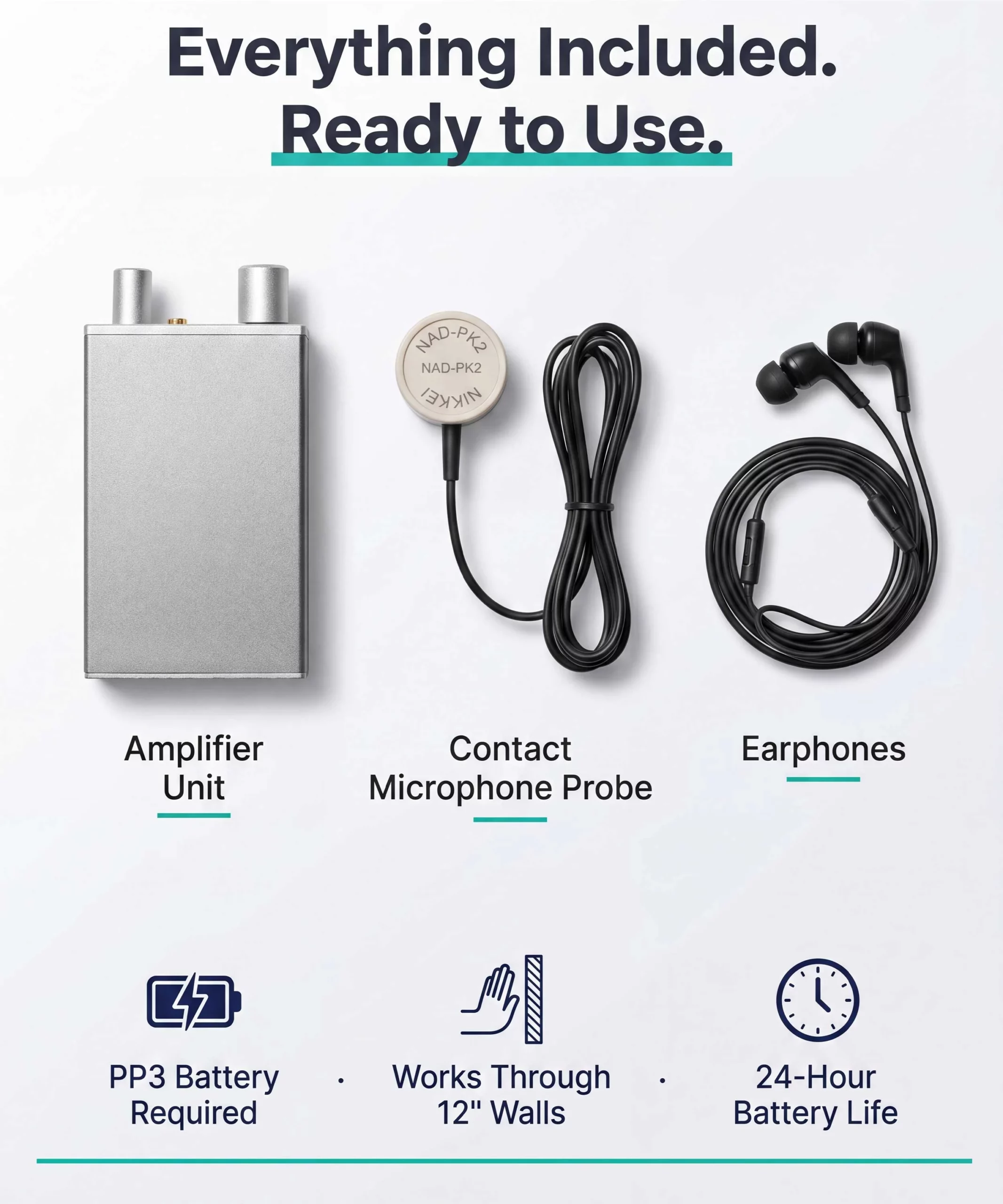
The system combines:
- High-sensitivity ceramic contact microphone
- Acoustic amplification
- Fine-tuning audio filter
- Earphone output
- Recording output
- Portable field construction
- Extended battery operation
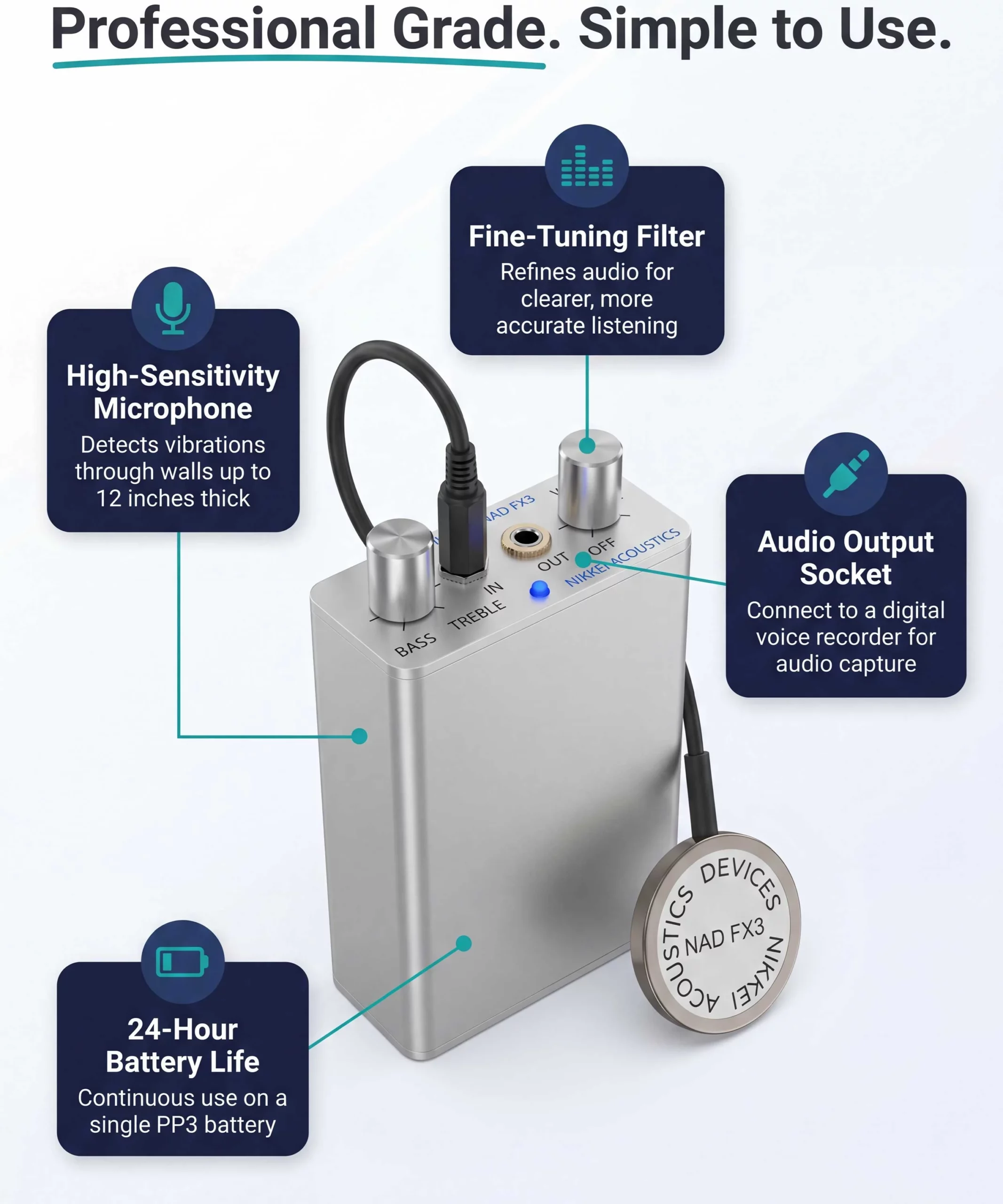
The manufacturer specifies detection through solid walls up to 12 inches / approximately 30 cm, depending on the construction and acoustic conditions.
The core technology is therefore not simply “listening through a wall.”
It is:
Surface Vibration → Contact Microphone → Acoustic Amplification → Audio Monitoring
What Problem Does This Device Solve?
Many sounds cannot be investigated effectively from the open air.
A person may be separated from the operator by:
- A wall
- A floor
- A ceiling
- A door
- A structural panel
- A pipe
- Concrete
- Other solid barriers
Similarly, a mechanical or plumbing problem may produce vibration before the underlying problem is visually accessible.
The Professional Listen Through Wall Device provides a way to investigate these signals through direct contact with the solid surface.
This can help professionals answer questions such as:
Is there movement behind this barrier?
Is there acoustic activity inside this structure?
Is water movement producing a detectable vibration?
Is machinery generating an abnormal mechanical sound?
Could a trapped person be producing sound behind a barrier?
Does this area require closer physical inspection?
Contact Microphone Acoustic Detection
The central technology is the ceramic contact microphone.
Unlike a conventional microphone that primarily captures airborne sound, a contact microphone detects vibration transmitted through the surface to which it is coupled.
The device then amplifies the resulting signal so that the operator can monitor the acoustic information through connected earphones.
This makes contact-microphone technology particularly useful where the sound source is separated from the operator by a solid structure.
Solid Surface → Mechanical Vibration → Contact Sensor → Amplified Audio
The manufacturer describes the device as suitable for walls, floors, ceilings, pipes, panels, doors and machinery.
Real-Time Acoustic Monitoring Through Solid Surfaces
One of the product’s strongest capabilities is real-time acoustic monitoring.
The operator can monitor the acoustic response while investigating a solid surface rather than relying exclusively on visual access.
This can provide immediate information about:
- Movement
- Mechanical vibration
- Water movement
- Pipe noise
- Structural activity
- Human-generated sound
- Other detectable acoustic events
Real-time monitoring is particularly valuable when the objective is to determine whether an area warrants further investigation.
The system should be understood as an acoustic detection and monitoring instrument, not an automatic classification system.
A detected sound does not by itself establish its source.
Professional interpretation remains necessary.
Search & Rescue
Search and rescue is one of the most important non-investigative applications for this technology.
After structural collapse, building damage or access obstruction, conventional visual inspection may not immediately reveal whether a person is present behind a barrier.
The manufacturer specifically identifies applications including people trapped in:
- Basements
- Elevators
- Confined spaces
- Rubble
- Other obstructed environments
A contact microphone can provide an additional acoustic observation channel when direct access or visibility is limited.
Why Acoustic Detection Matters in Rescue Operations
A trapped person may be:
- Behind structural material
- In a confined space
- Visually inaccessible
- Unable to communicate continuously
- Separated from rescuers by debris
Acoustic detection can therefore serve as an additional source of information alongside visual inspection, structural assessment and other rescue technologies.
The device should not be considered a standalone life-detection system.
Rather:
Search → Acoustic Observation → Area Assessment → Rescue Verification
Emergency & Disaster Response
The same principle can apply during emergency response operations where access is restricted.
Potential applications include:
- Structural collapse
- Damaged buildings
- Blocked rooms
- Confined spaces
- Elevator incidents
- Disaster response
- Emergency building assessment
In these situations, the value is not necessarily hearing speech clearly.
The more important question may simply be:
Is there detectable human activity or movement in an otherwise inaccessible area?
That distinction makes the technology relevant to emergency-response workflows rather than limiting it to surveillance.
Building & Property Inspection
The device can also be used as an acoustic inspection tool for buildings and property.
Possible inspection targets include:
- Walls
- Floors
- Ceilings
- Doors
- Structural panels
- Pipes
- Utility areas
Acoustic differences can help identify areas that deserve additional physical inspection before more disruptive investigation begins.
This can be particularly useful when investigating hidden activity inside a structure.
Plumbing & Hidden Leak Detection
Water movement can generate detectable sound and vibration through pipes and surrounding structures.
The manufacturer specifically identifies plumbing and hidden leak investigation as an application.
Potential use cases include:
- Hidden pipe leaks
- Water movement
- Pipe vibration
- Hissing sounds
- Slab leaks
- Concealed plumbing problems
The device does not directly measure water pressure or moisture.
Instead, it provides acoustic information that may help narrow an area for subsequent plumbing inspection.
Mechanical Diagnostics
Mechanical systems generate vibration.
A change in the acoustic signature of machinery may indicate an area requiring closer technical examination.
Potential applications include:
- Engines
- Transmissions
- Machinery
- Mechanical assemblies
- Equipment panels
- Industrial systems
The device can therefore function as a portable contact-acoustic inspection tool rather than being restricted to wall listening.
The manufacturer’s product information explicitly lists engines, transmissions and mechanical apparatus among potential diagnostic applications.
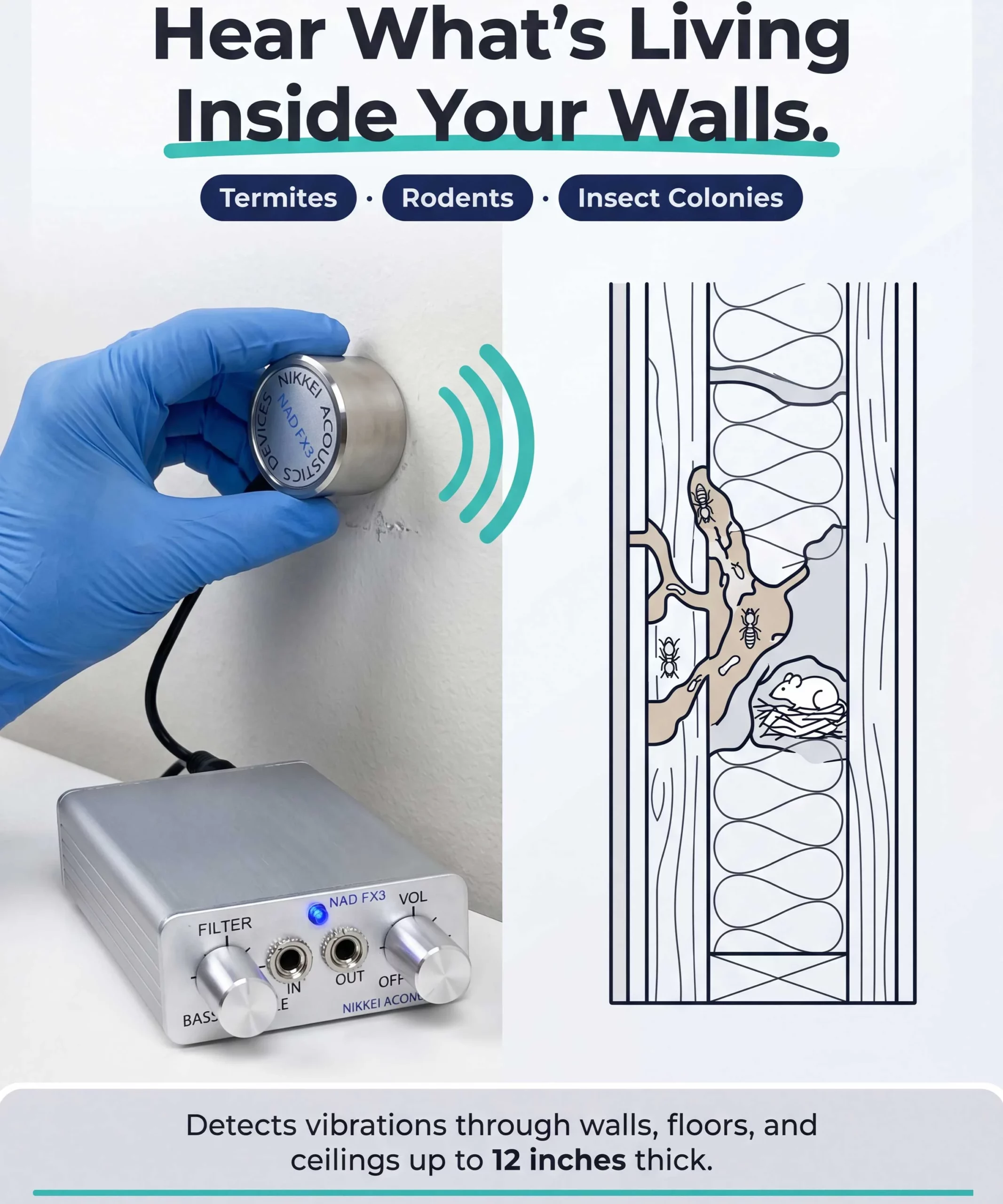
Pest & Structural Activity Detection
Small animals and insects can produce vibration and sound within enclosed structures.
Potential inspection applications include:
- Rodent activity
- Insect activity
- Termite colonies
- Pest movement
- Structural cavities
This can help pest-control professionals narrow an inspection area before opening walls, ceilings or floors.
The manufacturer specifically identifies pest-control applications involving insects, rodents and termites.
Security & Authorized Acoustic Inspection
The device can also support authorized security and investigative inspections where acoustic activity through a solid barrier needs to be assessed.
Possible environments include:
- Sensitive facilities
- Restricted areas
- Controlled-access environments
- Security inspections
- Authorized investigations
- Structural security assessments
For professional security use, the technology should be treated as an acoustic observation tool.
It does not automatically establish:
- Identity
- Intent
- Threat level
- Attribution
- Legality of an activity
Any recording or monitoring should be performed within the applicable legal and organizational authorization framework.
Acoustic Evidence & Recording
The Professional Listen Through Wall Device provides an audio output that can be connected to a compatible digital voice recorder for recording.
This creates a broader workflow:
Detect → Monitor → Record → Review → Document
The manufacturer specifies a dedicated recording output for connection to an external digital recorder.
Recording capability is useful when an acoustic observation needs to be:
- Reviewed later
- Compared with another observation
- Shared with a specialist
- Included in an inspection report
- Preserved for authorized documentation
A recording itself does not automatically establish authenticity, evidentiary integrity or legal admissibility.
Fine-Tuning Audio Control
The system includes a fine-tuning filter designed to refine the monitored audio.
This is important because structural surfaces can transmit many different forms of vibration simultaneously.
The objective is not simply to make the system louder.
It is to make relevant acoustic information easier to distinguish during professional inspection.
The manufacturer identifies the fine-tuning filter as a core feature for refining audio listening.
Multi-Surface Acoustic Inspection
The Professional Listen Through Wall Device is not limited to conventional walls.
The manufacturer identifies applications across:
| Surface / Environment | Potential Inspection Objective |
|---|---|
| Walls | Human activity, structural sound, hidden activity |
| Floors | Movement, water movement, structural vibration |
| Ceilings | Activity, plumbing, structural sound |
| Pipes | Water movement and leakage-related sound |
| Doors | Acoustic activity and vibration |
| Panels | Mechanical or structural inspection |
| Machinery | Mechanical diagnostics |
| Concrete | Acoustic and vibration investigation |
| Solid structural materials | General contact-acoustic assessment |
The key requirement is that the acoustic energy must be capable of propagating through the material to the contact sensor.
Solid Materials vs. Cavity Construction
The device is designed primarily around solid-surface vibration transmission.
The manufacturer specifically notes that wall construction affects performance and that cavity gaps can interfere with vibration transmission.
This is an important purchasing consideration.
A claim such as “works through walls” should not be interpreted as:
Works equally through every wall.
Performance depends on:
- Material
- Thickness
- Structural construction
- Air gaps
- Surface coupling
- Environmental vibration
- Source strength
- Background noise
- Operator technique
12-Inch Wall Capability
The manufacturer specifies detection through solid walls up to 12 inches thick.
This should be understood as a manufacturer specification rather than a universal guarantee for every construction type or acoustic source.
Actual performance can vary significantly depending on:
- Wall material
- Wall thickness
- Internal construction
- Cavity structure
- Source distance
- Vibration transmission
- Background noise
- Contact conditions
The appropriate interpretation is:
Up to 12 inches of solid material under suitable conditions — not a guaranteed result across every wall.
24-Hour Field Operation
The device operates from a PP3 9V battery and the manufacturer specifies up to 24 hours of continuous operation.
This makes the platform suitable for extended inspection periods where professionals may need to remain in the field without frequent battery replacement.
The actual operating duration can vary with battery condition and operating conditions.
Portable Professional Construction
The amplifier uses a brushed aluminum construction designed for professional field use.
The manufacturer lists:
- Amplifier dimensions: approximately 20 × 55 × 70 mm
- Contact microphone dimensions: approximately 26 × 18 mm
- Weight: approximately 157 g
- Power: 9V PP3 battery
These specifications support a compact field-inspection form factor.
Audio Output & Recording Workflow
The system provides separate audio pathways for monitoring and recording.
Audio Monitoring
The earphone output allows real-time listening to the amplified acoustic signal.
Audio Recording
The recording output can be connected to a compatible digital voice recorder.
This creates a simple professional workflow:
Contact Surface → Acoustic Signal → Amplification → Monitoring → Recording → Review
The external recorder is not inherently part of the basic device’s recording architecture and should be confirmed as a separate component unless included in the selected package.
Professional Applications
Search & Rescue
For emergency teams investigating blocked or inaccessible areas where trapped-person sounds may be detectable.
Emergency Response
For assessing damaged or obstructed structures where visual access is limited.
Building Inspection
For investigating acoustic activity, vibration and hidden structural conditions.
Plumbing Inspection
For investigating pipe noise, water movement and suspected hidden leaks.
Mechanical Diagnostics
For investigating vibration and unusual mechanical sounds.
Pest Control
For locating potential insect, rodent or termite activity inside structures.
Property Maintenance
For narrowing inspection areas before opening walls, floors or ceilings.
Security Inspection
For authorized acoustic assessment where solid barriers prevent direct access.
Investigation & Documentation
For professional environments where acoustic observations may need to be monitored, recorded and reviewed.
What the Professional Listen Through Wall Device Does
The system can help professionals:
- Detect acoustic vibration through solid surfaces
- Monitor sound transmitted through walls and structures
- Investigate inaccessible areas
- Identify areas requiring closer inspection
- Support search-and-rescue operations
- Investigate hidden plumbing noise
- Investigate mechanical vibration
- Support pest inspection
- Monitor acoustic activity in authorized security inspections
- Provide an audio output for recording
- Support documented acoustic inspection workflows
What It Does Not Automatically Determine
The device does not automatically determine:
- The exact identity of a sound source
- Whether a sound represents a threat
- Whether a person is present
- Whether a detected vibration is human-generated
- Whether a pipe is definitely leaking
- Whether machinery has a specific mechanical fault
- Whether a detected sound has legal significance
It provides an acoustic observation.
Professional interpretation and, where appropriate, independent verification remain necessary.
Technical Specifications
| Specification | Manufacturer Information |
|---|---|
| Product | Professional Listen Through Wall Device |
| SKU | PBN-LTW |
| Acoustic Principle | Contact microphone / surface vibration detection |
| Sensor | High-sensitivity ceramic contact microphone |
| Wall Capability | Up to 12 inches / approximately 30 cm of solid material |
| Audio Monitoring | Earphone output |
| Recording Output | 3.5 mm mono recording output |
| Audio Control | Fine-tuning filter |
| Battery | PP3 / 9V |
| Battery Life | Up to 24 hours continuous use |
| Amplifier Dimensions | Approx. 20 × 55 × 70 mm |
| Contact Microphone | Approx. 26 × 18 mm |
| Weight | Approx. 157 g |
| Construction | Brushed aluminum |
| Primary Technology | Acoustic / contact vibration detection |
Specifications are based on manufacturer and current product information. Actual acoustic performance depends on material, construction, source characteristics, environmental conditions and operator technique.
How to Evaluate a Listen Through Wall Device
Before purchasing a through-wall acoustic system, professionals should evaluate:
Acoustic Detection Method
Does the system use a contact microphone, acoustic amplifier, vibration sensor or another sensing principle?
Surface Compatibility
What materials can the system realistically inspect?
Structural Thickness
What maximum thickness is specified, and under what conditions?
Cavity Limitations
Does wall construction affect vibration transmission?
Audio Filtering
Can the operator refine or filter the detected acoustic signal?
Monitoring
Can the signal be monitored in real time?
Recording
Does the system provide an appropriate recording output?
Battery Life
How long can it operate continuously in the intended field environment?
Portability
Can the system be carried and deployed as part of a professional inspection kit?
Application Fit
Is the primary requirement rescue, building inspection, plumbing, diagnostics, pest control or authorized security inspection?
Professional Listen Through Wall Device vs. Conventional Microphone
A conventional microphone primarily captures airborne sound.
A contact-microphone system is designed to detect vibration transmitted through the surface.
| Capability | Conventional Air Microphone | Professional Listen Through Wall Device |
|---|---|---|
| Airborne sound capture | Yes | Not the primary principle |
| Surface vibration detection | Limited | Yes |
| Solid-surface inspection | Limited | Yes |
| Wall investigation | Limited | Yes |
| Pipe inspection | Limited | Yes |
| Mechanical contact diagnostics | Limited | Yes |
| Real-time acoustic monitoring | Yes | Yes |
| External recording | Model-dependent | Yes |
| Search & rescue application | Possible | Yes |
| Plumbing inspection | Limited | Yes |
The distinction is therefore not simply “more sensitive microphone.”
It is a different acoustic sensing approach.
Professional Listen Through Wall Device vs. Through-Wall RF Systems
These technologies should not be confused.
A contact-microphone system detects mechanical vibration and acoustic energy transmitted through a structure.
RF or radar-based through-wall systems use electromagnetic sensing principles.
The Professional Listen Through Wall Device is therefore best understood as an acoustic inspection instrument, not a radar-based through-wall imaging system.
Professional Listen Through Wall Device vs. Thermal Imaging
Thermal imaging and acoustic contact sensing provide different information.
Thermal imaging observes temperature patterns.
Contact acoustic sensing observes vibration and sound transmitted through a surface.
In some professional inspection environments, the two technologies can therefore complement one another:
Thermal Information + Acoustic Information + Physical Inspection
Neither technology independently proves the identity or cause of a finding.
Professional Listen Through Wall Device vs. NLJD
NLJD investigates nonlinear responses associated with electronic components.
A contact microphone investigates acoustic vibration.
They therefore answer different questions:
NLJD: Could electronic components be present?
Contact Acoustic Device: Is there detectable sound or vibration through this structure?
For advanced TSCM or security inspection, these technologies can be complementary rather than interchangeable.
Acoustic Inspection Workflow
A professional workflow can be summarized as:
Detect → Monitor → Compare → Localize → Verify → Document
The technology provides the acoustic observation.
The professional determines what the observation means in the context of the inspection.
For rescue operations:
Search → Detect Acoustic Activity → Assess Area → Coordinate Rescue
For plumbing:
Suspected Leak → Acoustic Assessment → Narrow Area → Physical Inspection
For mechanical diagnostics:
Abnormal Noise → Acoustic Assessment → Isolate Area → Mechanical Inspection
For building inspection:
Unexplained Activity → Acoustic Assessment → Compare Areas → Physical Verification
For authorized security work:
Inspection Requirement → Acoustic Detection → Assessment → Verification → Documentation
Evidence & Professional Use
The device can provide an audio output that may be recorded for later review.
However:
A recording is not automatically evidence.
The evidentiary value of an audio recording depends on the circumstances in which it was created, preserved, transferred, authenticated and interpreted.
Similarly, the device does not create legal authority to monitor or record people.
Professional users should operate the technology within applicable laws, regulations, permissions and organizational procedures.
Frequently Asked Questions
What is a listen through wall device?
A listen through wall device is an acoustic inspection system designed to detect sound and vibration transmitted through solid surfaces using a contact microphone and amplifier.
How does a contact microphone work?
A contact microphone detects mechanical vibration transmitted through the surface to which it is coupled and converts that vibration into an electrical audio signal for amplification and monitoring.
Can the Professional Listen Through Wall Device detect sound through walls?
Yes. The manufacturer specifies detection through solid walls up to 12 inches thick under suitable conditions.
Can it work through concrete?
The manufacturer describes the system as suitable for solid surfaces including walls, floors and other structural materials. Actual performance depends on construction, thickness and acoustic transmission conditions.
Can it detect people behind a wall?
It can detect acoustic or vibration activity transmitted through a suitable solid barrier. In search-and-rescue contexts, this may help identify areas requiring further investigation. It should not be treated as an autonomous human-presence detector.
Can it be used for search and rescue?
Yes. Search and rescue is specifically identified by the manufacturer as an application, including situations involving people trapped in basements, elevators or rubble.
Can it be used during disaster response?
It may provide an additional acoustic observation channel where visual or physical access is limited. It should complement, not replace, established rescue and structural-assessment procedures.
Can it detect water leaks?
It can help detect acoustic and vibration signatures associated with hidden water movement and pipe leaks. It does not directly measure water flow or moisture.
Can it be used for plumbing inspection?
Yes. The manufacturer specifically identifies plumbing and hidden leak detection as applications.
Can it be used for mechanical diagnostics?
Yes. The manufacturer identifies engines, transmissions and other mechanical apparatus as potential diagnostic applications.
Can it detect rodents or termites?
It can help professionals investigate sounds and vibration associated with pest activity inside walls, ceilings and floors.
Can the device record audio?
The device provides a recording output that can be connected to a compatible digital audio recorder.
Does it record internally?
The standard PBN-LTW is primarily an acoustic monitoring/amplification device with an external recording output. An external recorder is required for recording unless a different package is selected.
How long does the battery last?
The manufacturer specifies up to 24 hours of continuous operation from a PP3 9V battery.
How thick a wall can it work through?
The manufacturer specifies up to 12 inches of solid wall material. Actual performance depends on the construction and acoustic properties of the barrier.
Does wall construction affect performance?
Yes. Solid construction is important because the system relies on vibration transmission. Cavity gaps and other structural characteristics can reduce the acoustic signal reaching the contact microphone.
Can it monitor sound in real time?
Yes. The amplified acoustic signal can be monitored through connected earphones.
Is this a thermal camera?
No. It detects acoustic vibration rather than temperature.
Is this a radar through-wall device?
No. It is an acoustic contact-microphone system rather than a radar or RF imaging system.
Is this an NLJD?
No. NLJD detects nonlinear electronic responses. This device detects acoustic vibration through contact with a solid surface.
Is this suitable for professional TSCM?
It can be used as a complementary acoustic inspection tool within an authorized TSCM or security assessment, but it does not replace RF detection, NLJD, optical inspection, physical verification or other appropriate TSCM methods.
Is this suitable for private investigators?
It may be relevant to authorized investigative applications, but the technology has a substantially broader professional use case than private investigation alone.
Is this suitable for emergency responders?
Yes. Search and rescue is one of the manufacturer’s explicitly identified applications.
Is this suitable for contractors?
Yes. Its acoustic inspection capabilities may support building, plumbing and mechanical diagnostic work.
Is this suitable for plumbers?
Yes. The manufacturer specifically identifies hidden pipe and leak investigation as an application.
Is this suitable for pest-control professionals?
Yes. The manufacturer identifies insect, rodent and termite investigation as applications.
Is this suitable for industrial inspection?
It may be useful for investigating mechanical vibration and abnormal sounds from equipment, engines and machinery.
Does it identify the exact source of a sound automatically?
No. It provides an acoustic signal for professional interpretation. Localization and identification require assessment and, where appropriate, additional inspection.
Does it prove that someone is behind a wall?
No. An acoustic response may have multiple possible causes. Professional verification is required before concluding that a person or specific source is present.
Does it guarantee clear speech through every wall?
No. The manufacturer specifies performance through solid material up to 12 inches, but actual intelligibility depends on construction, source, vibration transmission, background noise and other conditions.
Can it replace a professional rescue life-detection system?
No. It can serve as an additional acoustic observation tool but should not replace specialized rescue equipment or established emergency procedures.
Can it replace a professional leak detector?
Not necessarily. It is an acoustic inspection tool and may complement dedicated plumbing and leak-detection technologies.
Can it replace a vibration analyzer?
No. It provides amplified acoustic monitoring but is not a substitute for specialized vibration-analysis instrumentation.
What is the biggest advantage of this device?
Its primary advantage is the ability to convert vibration transmitted through solid structures into an audible signal that professionals can monitor and investigate in real time.
Who should consider this device?
Potential users include:
- Search-and-rescue teams
- Emergency responders
- Building inspectors
- Plumbing professionals
- Mechanical technicians
- Pest-control professionals
- Property inspection teams
- Security professionals
- Authorized investigators
- TSCM professionals seeking complementary acoustic inspection capability
Why Choose the Professional Listen Through Wall Device?
The Professional Listen Through Wall Device is best understood as a portable professional acoustic inspection tool.
Its value comes from combining:
High-Sensitivity Contact Microphone
with:
Acoustic Amplification
plus:
Fine-Tuning Control
plus:
Real-Time Monitoring
plus:
Recording Output
plus:
Extended Field Operation
The result is a practical workflow for investigating sounds and vibrations that cannot be easily assessed from the open air.
From search and rescue to plumbing, from mechanical diagnostics to building inspection, and from pest detection to authorized security assessment, the technology provides another way to observe what is happening beyond a solid surface.
Final Takeaway
The Professional Listen Through Wall Device should not be positioned simply as a “spy listening device.”
Its broader and stronger market identity is:
Professional Acoustic Detection Through Solid Surfaces.
The core capability is simple:
Surface Vibration → Acoustic Detection → Real-Time Monitoring → Assessment
That makes the device relevant to multiple professional markets:
Rescue → Inspection → Diagnostics → Maintenance → Security
The technology does not replace professional judgment or specialized equipment for each application.
It gives professionals another information channel when direct visual or physical access is limited.


Reviews
There are no reviews yet.