



Description
ST-402 CAYMAN Non-Linear Junction Detector
Find concealed electronics beyond conventional RF detection. Investigate semiconductor-based devices whether they are transmitting or silent.
The ST-402 CAYMAN is a professional Non-Linear Junction Detector (NLJD) designed to help TSCM specialists investigate concealed electronic devices containing semiconductor components.
Unlike conventional RF detection, an NLJD does not depend on a target actively transmitting a wireless signal.
The ST-402 emits probing signals and analyzes nonlinear responses from electronic components, helping operators investigate concealed electronics that may be:
- Switched on
- Switched off
- Not actively transmitting
- Hard-wired
- Concealed inside structures or objects
The system is designed around professional inspection, target assessment and physical verification—not automatic identification.
Detect → Assess → Localize → Verify
What Is the ST-402 CAYMAN?
The ST-402 CAYMAN is a professional nonlinear junction detector designed to investigate hidden electronic devices containing semiconductor components.
Modern electronic devices commonly contain components such as:
- Diodes
- Transistors
- Integrated circuits
- Microchips
- Other semiconductor junctions
An NLJD actively illuminates the inspected area with a probing signal and analyzes nonlinear harmonic responses produced by compatible electronic structures.
This creates a different inspection methodology from conventional RF detection.
An RF detector primarily investigates:
“Is something transmitting?”
An NLJD investigates:
“Could semiconductor-based electronics be physically concealed here?”
These technologies address different detection problems.
Why NLJD Detection Matters
A surveillance device does not need to be actively transmitting when an inspection takes place.
A device may:
- Be switched off
- Remain inactive
- Transmit only periodically
- Store information locally
- Be connected through a wired circuit
- Remain dormant until activated
In these situations, the absence of RF activity does not necessarily mean that electronic hardware is absent.
The ST-402 provides an additional detection layer focused on nonlinear responses associated with semiconductor-based electronics.
This can support inspections of:
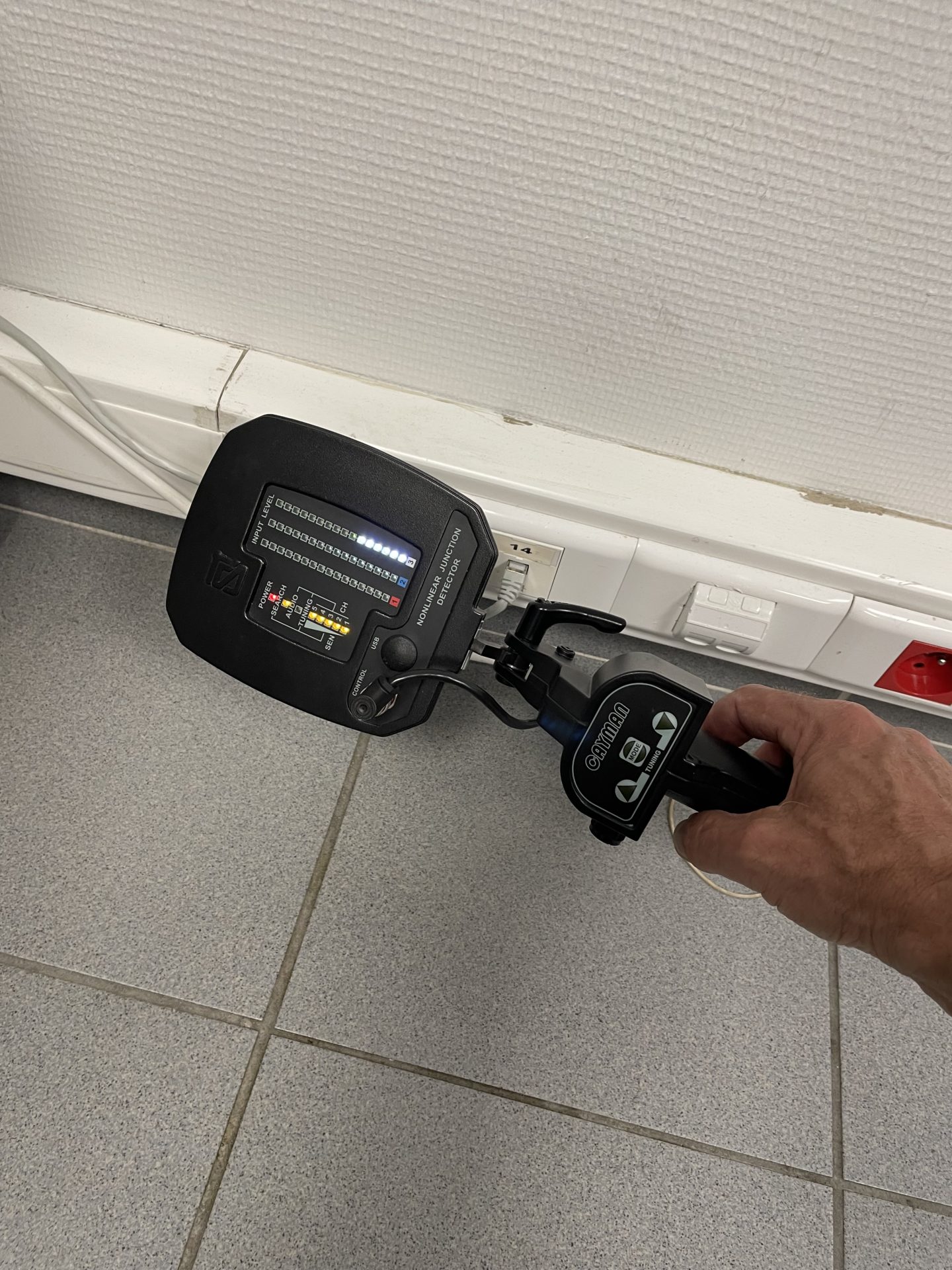
- Walls
- Floors
- Ceilings
- Furniture
- Fixtures
- Containers
- Packages
- Vehicles
- Other enclosed or difficult-to-access locations
How the ST-402 CAYMAN Works
The ST-402 uses active nonlinear junction detection.
The system emits probing signals within the 2–3 GHz frequency range and analyzes the reflected nonlinear response.
Electronic semiconductor junctions can produce harmonic responses when exposed to the probing signal.
The operator evaluates these responses using the ST-402’s detection interface.
The process is not:
Signal Detected = Surveillance Device Confirmed
The correct methodology is:
Nonlinear Response → Assessment → Localization → Physical Verification
A response may originate from legitimate electronic equipment or other nonlinear structures.
Professional interpretation remains essential.
Multiple Probing Frequencies
One of the distinctive characteristics of the ST-402 CAYMAN is its operation across several probing frequencies within the 2–3 GHz range.
The manufacturer describes the device as emitting several frequencies simultaneously while maintaining peak radiated power below 2 W.
Different electromagnetic environments can contain different levels of interference.
The ST-402 therefore provides multiple frequency combinations that can be selected during inspection.
This helps operators adapt the search process to the electromagnetic environment and the observed target response.
SEARCH Mode — Investigate Nonlinear Responses
SEARCH Mode is the primary operating mode of the ST-402.
It is designed to detect nonlinear targets and provide visual information about the observed responses.
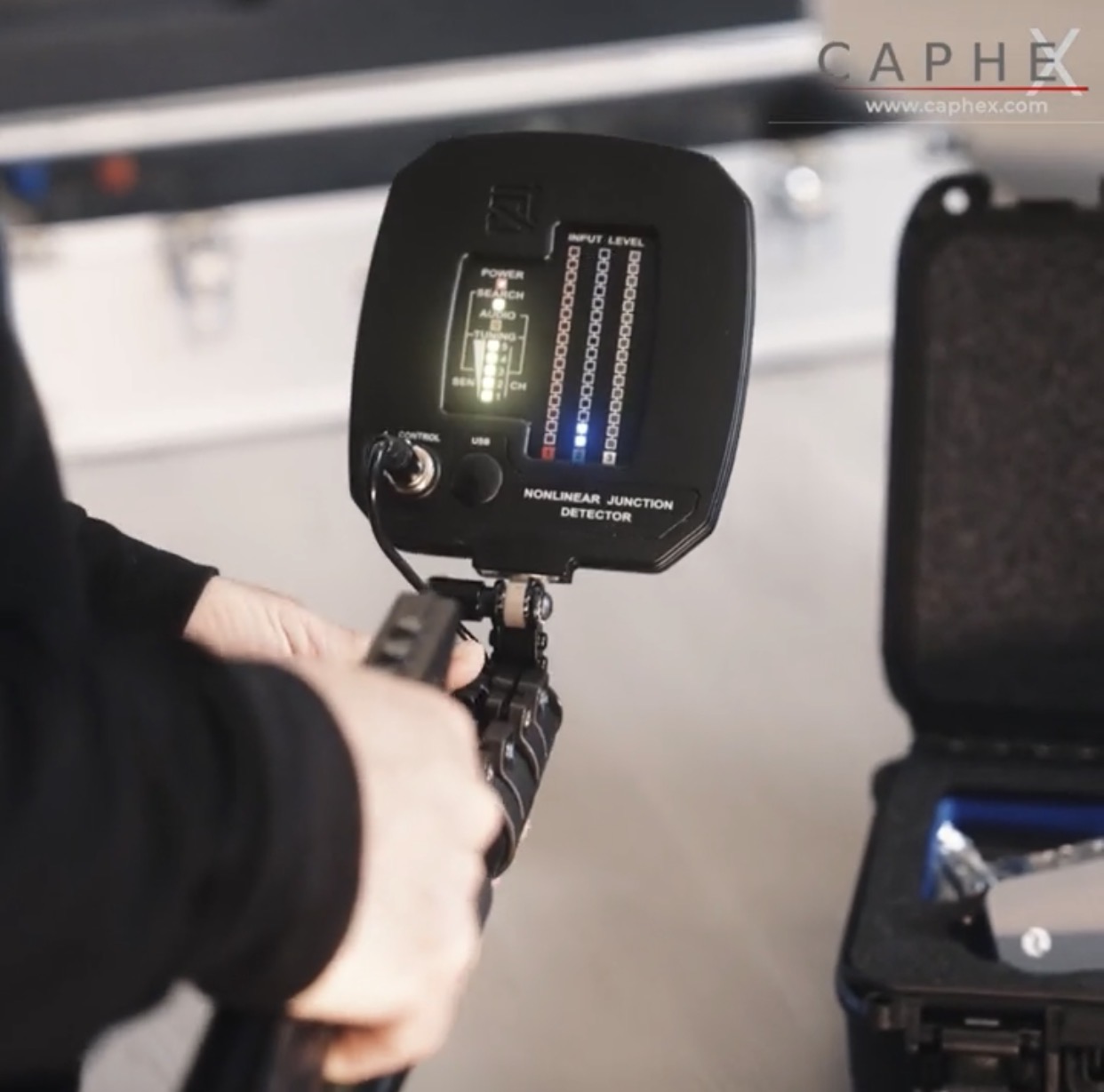
The device uses three visual LED gauge bars to display response information.
The operator can use this information to assess the characteristics of a detected nonlinear response and determine whether further investigation is required.
SEARCH Mode is the starting point for:
Detection → Response Assessment → Localization
A nonlinear response should not automatically be interpreted as proof of a hidden surveillance device.
The physical source must still be identified.
AUDIO Mode — Additional Target Assessment
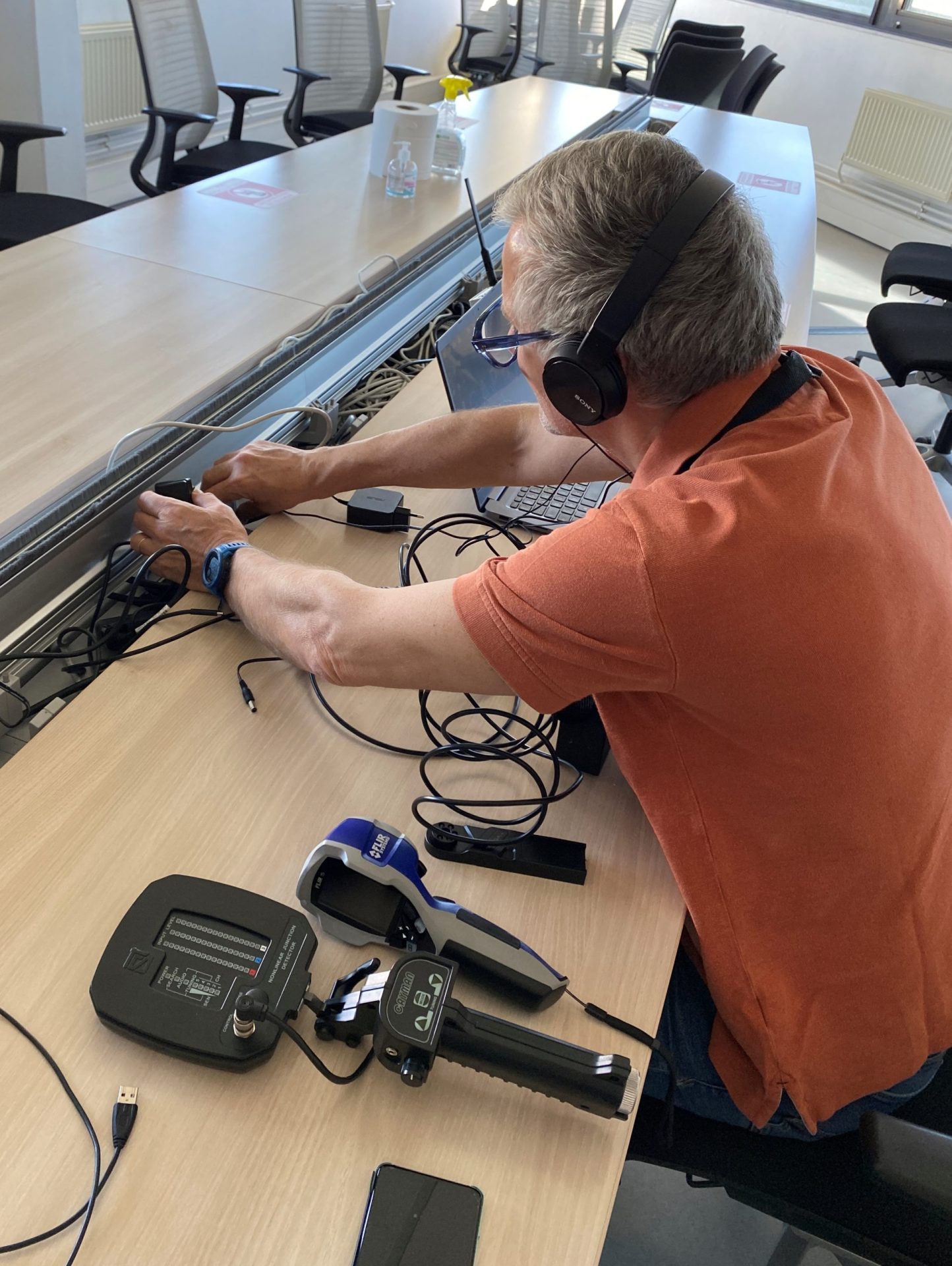
After detecting a nonlinear response, the operator can use AUDIO Mode to demodulate and listen to the target response.
Audio can be monitored through:
- Built-in speaker
- Headphones
This provides an additional source of information during target assessment.
Audio Mode is intended as a supporting investigation function after a response has been identified in SEARCH Mode.
It does not independently classify a target as malicious or legitimate.
ADAPTATION Mode — Prepare for the Environment
The ST-402 includes an ADAPTATION Mode designed to tune the NLJD for efficient operation within the surrounding electromagnetic environment.
The manufacturer recommends using adaptation after powering on the device and periodically during the inspection process.
During adaptation, the antenna should be directed away from:
- Electronic equipment
- Large metal objects
- Potential nonlinear targets
This helps establish suitable operating parameters before continuing the search.
Environmental adaptation is particularly important because real inspection environments can contain:
- Legitimate electronics
- RF infrastructure
- Metallic structures
- Building systems
- Other sources of interference
Low Output Power Architecture
The ST-402 operates with maximum peak radiated power below 2 W.
NLJD technologies use different transmission architectures and power levels depending on their design objectives.
Higher output power is not automatically equivalent to better performance in every inspection environment.
The ST-402’s architecture is designed around sensitivity and controlled professional inspection.
According to manufacturer information, its low output power also allows the device to be used for checking people where appropriate operational procedures are followed.
Equipment selection should therefore be based on the inspection objective—not simply maximum transmitter power.
Detecting Concealed Semiconductor Electronics
The ST-402 is designed to investigate electronic devices containing semiconductor elements.
Potential inspection targets may include concealed:
- Cameras
- Microphones
- Electronic recording devices
- Communication devices
- Mobile phones
- SIM cards
- Tracking electronics
- Other unauthorized electronic equipment
However, these examples should not be interpreted as guaranteed detection of every device.
Actual detection results depend on factors including:
- Semiconductor characteristics
- Target size
- Target orientation
- Distance
- Concealment material
- Surrounding electronics
- Electromagnetic environment
- Operator technique
- Inspection methodology
The instrument identifies nonlinear characteristics.
Physical verification is required to identify the actual source.
Distinguishing Different Nonlinear Responses
One challenge in nonlinear junction detection is that nonlinear responses can originate from more than one type of structure.
Electronic semiconductor junctions may produce responses that differ from nonlinear effects associated with:
- Corrosion
- Oxidized metal contacts
- Metal-oxide-metal structures
- Other passive nonlinear sources
The ST-402 is designed to provide response information that supports professional assessment of the detected target.
This helps the operator move beyond a simple:
“Something responded.”
toward:
“What characteristics does this response have, and does it justify further investigation?”
The final conclusion should always be based on verification of the physical source.
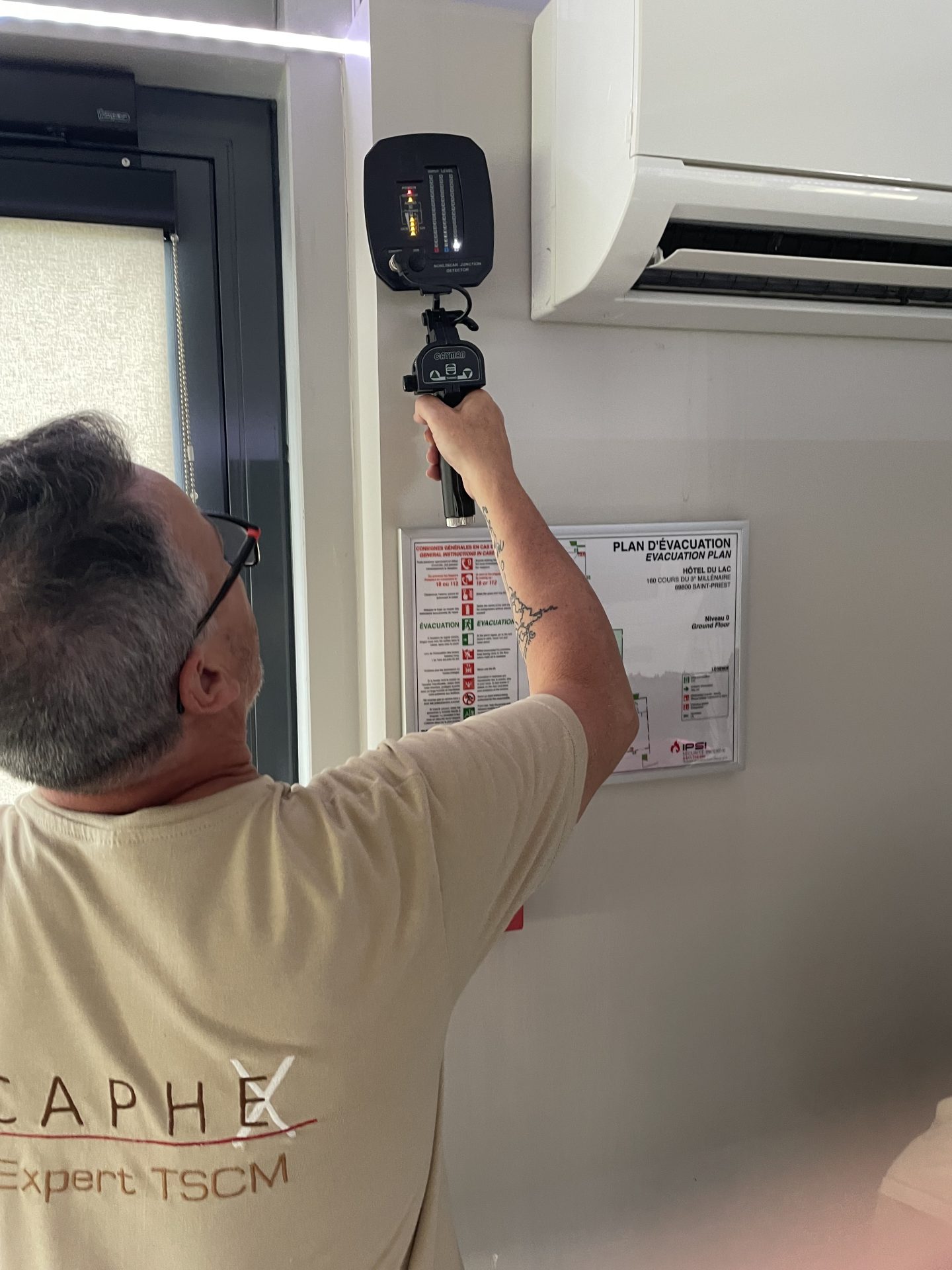
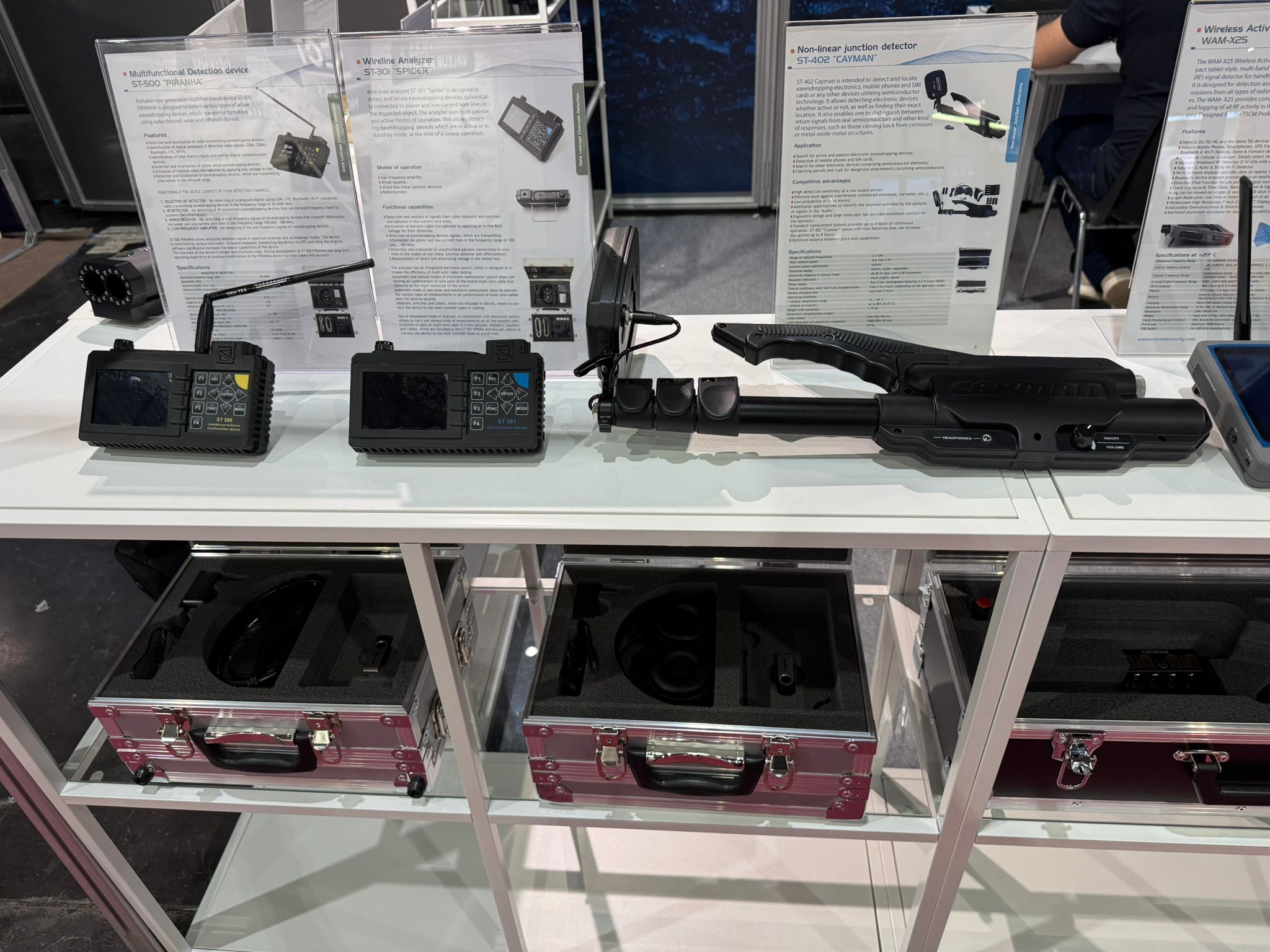
Telescopic Inspection Architecture
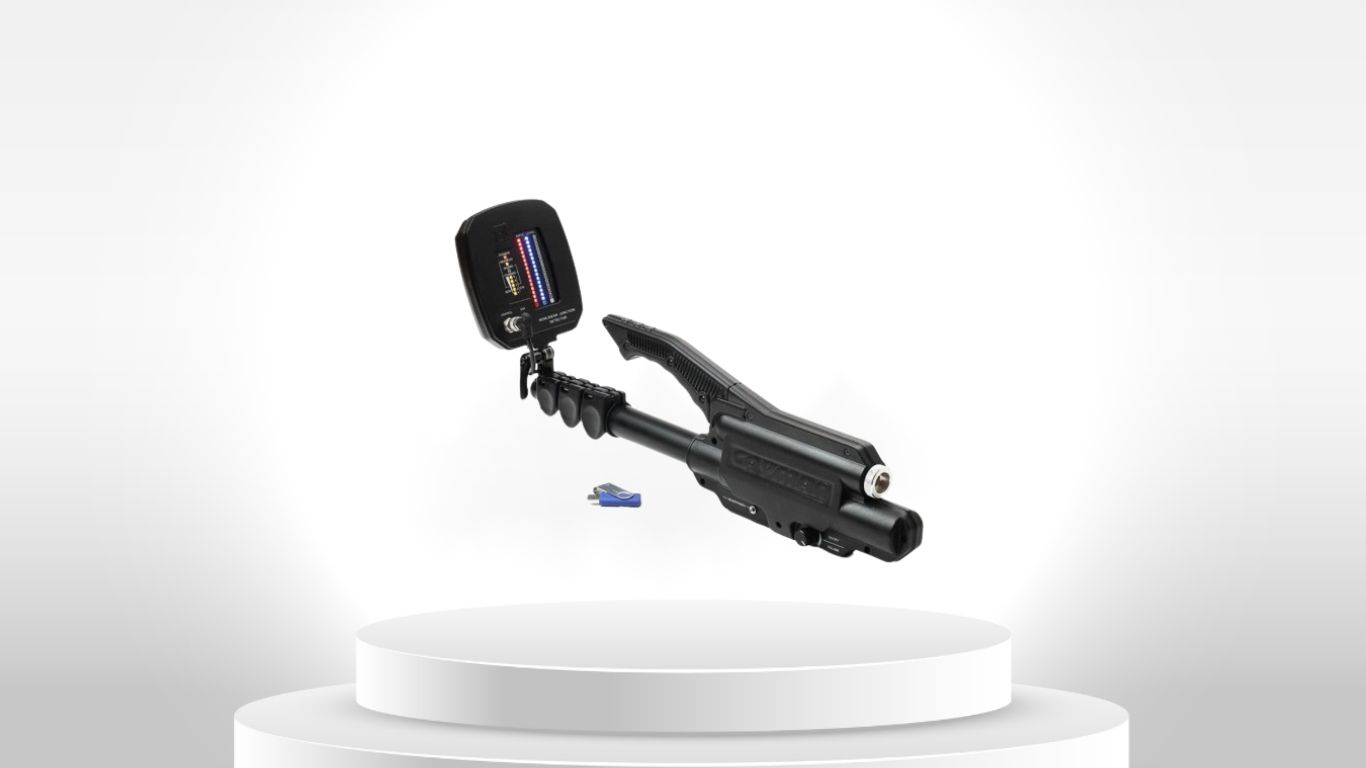
The ST-402 consists of a main unit and antenna module connected through a telescopic arm.
The arm can be extended to approximately 1.5 metres, helping operators inspect areas that may be difficult to reach with a conventional handheld device.
Potential applications include:
- High walls
- Ceilings
- Furniture
- Shelving
- Fixtures
- Structural areas
- Vehicles
- Containers
The antenna angle can also be adjusted to support different inspection positions.
This is particularly relevant during systematic physical sweeps where inspection coverage matters.
ST-402 in a Professional TSCM Workflow
The ST-402 should be used as part of a structured inspection methodology.
1. Prepare
Review the environment and identify known electronic infrastructure where possible.
2. Adapt
Use ADAPTATION Mode to tune the device for the inspection environment.
3. Scan
Systematically inspect surfaces, structures and objects using SEARCH Mode.
4. Observe
Monitor nonlinear response characteristics.
5. Adjust
Change probing frequency combinations where appropriate and continue the inspection.
6. Assess
Evaluate whether the response may originate from semiconductor electronics or another nonlinear source.
7. Analyze
Use AUDIO Mode as an additional source of information where appropriate.
8. Localize
Repeat the inspection around the response area to narrow the likely physical source.
9. Verify
Identify the actual object or component responsible for the response.
10. Document
Record observations, location, inspection conditions and verified findings.
Detect → Assess → Localize → Verify → Document
Designed For & Common Applications
Professional TSCM Inspections
The ST-402 is designed for professional inspections involving the search for concealed semiconductor-based electronics.
Corporate and Executive Security
Sensitive offices, boardrooms and executive environments may require inspection beyond conventional wireless signal detection.
Government and Institutional Facilities
Professional security teams can use NLJD technology as part of broader counter-surveillance procedures.
Vehicle Inspections
Vehicles contain complex structures and concealed compartments where electronic equipment may require physical investigation.
Sensitive Meeting Environments
NLJD inspection can support security procedures before confidential discussions or high-sensitivity meetings.
Infrastructure and Restricted Areas
The telescopic architecture supports inspection of structural locations and areas that may not be immediately accessible.
Packages and Containers
NLJD technology can also be relevant when investigating objects or containers for concealed electronic components.
ST-402 vs Conventional RF Detector
| Inspection Requirement | Conventional RF Detector | ST-402 CAYMAN NLJD |
|---|---|---|
| Detect active RF transmissions | Strong | Not its primary purpose |
| Investigate non-transmitting electronics | Limited | Strong |
| Investigate switched-off electronics | No | Possible through semiconductor response |
| Detect semiconductor-based components | No | Yes |
| Analyze RF spectrum | Model-dependent | No |
| Physical concealed-electronics investigation | Limited | Yes |
| Requires target to actively transmit | Usually yes | No |
| Detect every surveillance device automatically | No | No |
The technologies answer different questions.
RF Detection:
“Is something transmitting?”
NLJD Detection:
“Could semiconductor-based electronics be concealed here?”
For professional TSCM operations, these technologies can complement one another.
ST-402 vs High-Power NLJD Systems
NLJD systems use different probing architectures.
Some models prioritize high-power pulse transmission, while others use lower-power or continuous transmission approaches.
The ST-402 operates with maximum peak radiated power below 2 W and uses multiple probing frequencies within the 2–3 GHz range.
The correct selection depends on:
- Inspection environment
- Target characteristics
- Required operating methodology
- Nearby electronic infrastructure
- Operator preference
- Physical access requirements
The question should not simply be:
“Which NLJD has the highest power?”
It should be:
“Which detection architecture best matches the inspection requirement?”
What ST-402 Can and Cannot Tell You
What It Can Do
The ST-402 can help qualified operators:
- Investigate nonlinear responses
- Search for semiconductor-based electronics
- Investigate devices that may not be transmitting
- Inspect devices that may be switched off
- Search difficult-to-access areas
- Adjust operation for the surrounding environment
- Analyze detected responses
- Listen to demodulated responses
- Support progressive target localization
- Investigate concealed electronic components
What It Cannot Automatically Do
The ST-402 does not automatically:
- Identify every detected object
- Prove that a response is a surveillance device
- Determine hostile intent
- Eliminate all false or ambiguous responses
- Detect every electronic device under every condition
- Replace physical verification
- Replace RF spectrum analysis
- Replace professional TSCM methodology
A legitimate electronic device can produce a nonlinear response.
A non-semiconductor structure may also produce nonlinear characteristics.
The professional process remains:
Detect → Interpret → Locate → Identify → Verify
Professional Selection Considerations
Before purchasing an NLJD, professional users should evaluate:
- Probing frequency architecture
- Output power
- Sensitivity
- Response analysis
- Frequency adjustment options
- Environmental adaptation
- Target localization workflow
- Audio analysis capability
- Ergonomics
- Inspection reach
- Battery operating time
- Operating environment
- Operator training
- Required complementary equipment
An NLJD should not be selected based on one specification alone.
The inspection methodology matters.
Technical Specifications
| Parameter | Specification |
|---|---|
| Product Type | Non-Linear Junction Detector |
| Radiated Frequency Range | 2–3 GHz |
| Maximum Peak Radiated Power | <2 W |
| Antenna Polarization | Elliptic |
| Operation Modes | SEARCH / AUDIO / ADAPTATION |
| Manual Sensitivity Range | 40 dB |
| Sensitivity Adjustment | 5 values with 8 dB increments |
| Response Indication | Visual LED gauge bars and audio |
| Battery Type | Li-ion rechargeable, 3.7 V, 18650 |
| Battery Sets Included | Two sets |
| Continuous Operation | Approx. 3–4 hours per battery charge, depending on operating mode |
| Total Available Operation | Up to approximately 8 hours with supplied battery sets |
| Battery Charging Time | <3 hours |
| Operating Temperature | +5°C to +40°C |
| Relative Humidity | Up to 85% at +25°C |
| Device Weight | 1.75 kg with batteries |
| Folded Dimensions | 510 × 145 × 130 mm |
| Extended Dimensions | 1500 × 250 × 130 mm |
| Complete Set Weight | 5.8 kg |
Specifications should be confirmed against the current manufacturer documentation and supplied configuration before procurement.
Included Equipment
The ST-402 CAYMAN is supplied as a professional inspection system with:
- ST-402 CAYMAN main unit
- Antenna module
- Telescopic arm
- Rechargeable battery sets
- Battery charging equipment
- Headphones
- Test targets
- Protective transport case
- Operating documentation
Included configuration should be confirmed before procurement.
Frequently Asked Questions
What is the ST-402 CAYMAN?
The ST-402 CAYMAN is a professional Non-Linear Junction Detector designed to investigate concealed electronic devices containing semiconductor components.
What does ST-402 CAYMAN detect?
It detects nonlinear responses associated with semiconductor-based electronic components.
This can support investigation of concealed electronics including cameras, microphones, mobile devices, SIM cards and other electronic equipment.
The result should not be interpreted as automatic identification of a specific device.
Can ST-402 detect switched-off devices?
The NLJD is designed to investigate semiconductor-based electronics without relying on active wireless transmission.
This makes it relevant to devices that may be switched off or not actively transmitting.
Actual detection depends on the target and inspection conditions.
Can ST-402 detect non-transmitting surveillance devices?
It can help investigate concealed semiconductor electronics even when no active RF transmission is present.
Physical verification remains necessary to determine whether the detected electronics are surveillance equipment.
Can ST-402 detect mobile phones?
Mobile phones contain semiconductor electronics and are among the types of targets referenced in manufacturer application information.
Detection performance depends on inspection conditions and should not be treated as a guaranteed result at every distance or orientation.
Can ST-402 detect SIM cards?
The manufacturer identifies SIM cards among potential semiconductor-containing targets.
Actual detection depends on size, orientation, distance and environmental conditions.
Does ST-402 detect hidden cameras?
It can investigate semiconductor-based electronic components associated with cameras.
However, an NLJD response does not automatically prove that the detected object is a hidden camera.
Does ST-402 require a device to transmit?
No.
This is one of the main differences between NLJD and conventional RF detection.
An NLJD investigates nonlinear electronic characteristics rather than relying exclusively on an active wireless transmission.
What frequency does ST-402 use?
The manufacturer specifies a radiated frequency range of 2–3 GHz.
The device operates using multiple probing frequencies within this range.
What is the output power of ST-402?
The specified maximum peak radiated power is less than 2 W.
Why does ST-402 use multiple probing frequencies?
Different electromagnetic environments may contain different levels of interference.
Multiple probing frequencies provide flexibility when conducting professional inspections.
What is SEARCH Mode?
SEARCH Mode is the main operating mode used to detect and assess nonlinear responses from potential targets.
What is AUDIO Mode?
AUDIO Mode allows the operator to demodulate and listen to a detected target response using the built-in speaker or headphones.
What is ADAPTATION Mode?
ADAPTATION Mode helps tune the device for efficient operation within the surrounding electromagnetic environment.
The manufacturer recommends using adaptation after powering on and periodically during the search process.
Can ST-402 distinguish electronics from corrosion?
The device provides response information intended to support professional assessment of nonlinear targets.
However, interpretation requires operator expertise and physical verification.
A response should never automatically be treated as confirmed evidence of a surveillance device.
Does ST-402 eliminate false positives?
No professional detection system should be described as automatically eliminating all ambiguous responses.
The ST-402 provides response analysis and operating modes that support professional interpretation, but physical verification remains necessary.
Can ST-402 inspect walls and ceilings?
Yes.
The telescopic arm supports inspection of difficult-to-access locations including walls, ceilings and other structural areas.
How long can ST-402 operate?
The manufacturer specifies approximately 3–4 hours of continuous operation per fully charged battery, depending on the operating mode.
Two battery sets provide extended field operation.
Is ST-402 suitable for professional TSCM?
Yes.
The ST-402 is designed as professional NLJD equipment for investigating concealed semiconductor-based electronics as part of a structured TSCM inspection.
Does ST-402 replace an RF detector?
No.
The technologies address different detection problems.
RF detection investigates active transmissions.
NLJD investigates semiconductor-based electronics that may not be actively transmitting.
Does ST-402 replace a spectrum analyzer?
No.
A spectrum analyzer is designed for detailed RF measurement and signal analysis.
The ST-402 is designed specifically for nonlinear junction detection.
What equipment complements an NLJD?
Depending on the inspection requirement, complementary equipment may include:
- RF detectors
- Spectrum analyzers
- Wireline analyzers
- Hidden-camera detectors
- Optical lens finders
- Thermal imaging systems
- Physical inspection tools
A professional TSCM inspection often combines multiple detection methodologies.
Why Professional TSCM Teams Use Multiple Detection Methods
No single instrument can answer every surveillance detection question.
Different technologies investigate different threat characteristics.
| Detection Question | Relevant Technology |
|---|---|
| Is something actively transmitting? | RF Detector / Spectrum Analyzer |
| Could silent electronics be concealed here? | NLJD |
| Is there a signal on a wired circuit? | Wireline Analyzer |
| Is a camera lens visually present? | Optical Lens Detector |
| Can a concealed area be physically inspected? | Endoscope / Inspection Tools |
| Can a wireless source be localized? | Directional RF Detection |
The value of the ST-402 is therefore not that it replaces every TSCM technology.
Its role is specific:
Investigating concealed semiconductor electronics that may not reveal themselves through active RF transmission.
Global Procurement Through Archthetic
Archthetic connects professional buyers with specialized TSCM technologies designed for different inspection requirements.
For the ST-402 CAYMAN, professional evaluation should begin with the actual detection problem:
Do you need to investigate concealed electronics that may not be transmitting?
If the answer is yes, nonlinear junction detection may be an important part of the inspection architecture.
The procurement process is designed around:
Discover → Evaluate → Confirm Requirements → Procure → Deploy
The objective is not simply to buy a detector.
It is to select the right detection methodology for the environment being protected.
Focused Conclusion
The ST-402 CAYMAN is a professional Non-Linear Junction Detector designed for systematic investigation of concealed semiconductor-based electronics.
Its multi-frequency 2–3 GHz probing architecture, SEARCH, AUDIO and ADAPTATION modes, telescopic inspection design and portable field configuration support professional TSCM workflows.
Its core value is simple:
RF detection tells you whether something may be transmitting.
ST-402 helps investigate whether electronics may be physically concealed—even when they are silent.
The device does not automatically identify every nonlinear response as a surveillance device.
Its purpose is to help qualified operators move from:
Possible concealed electronics → Response assessment → Localization → Physical verification
Detect what is hidden. Assess what responded. Verify what is actually there.


Reviews
There are no reviews yet.