


Description
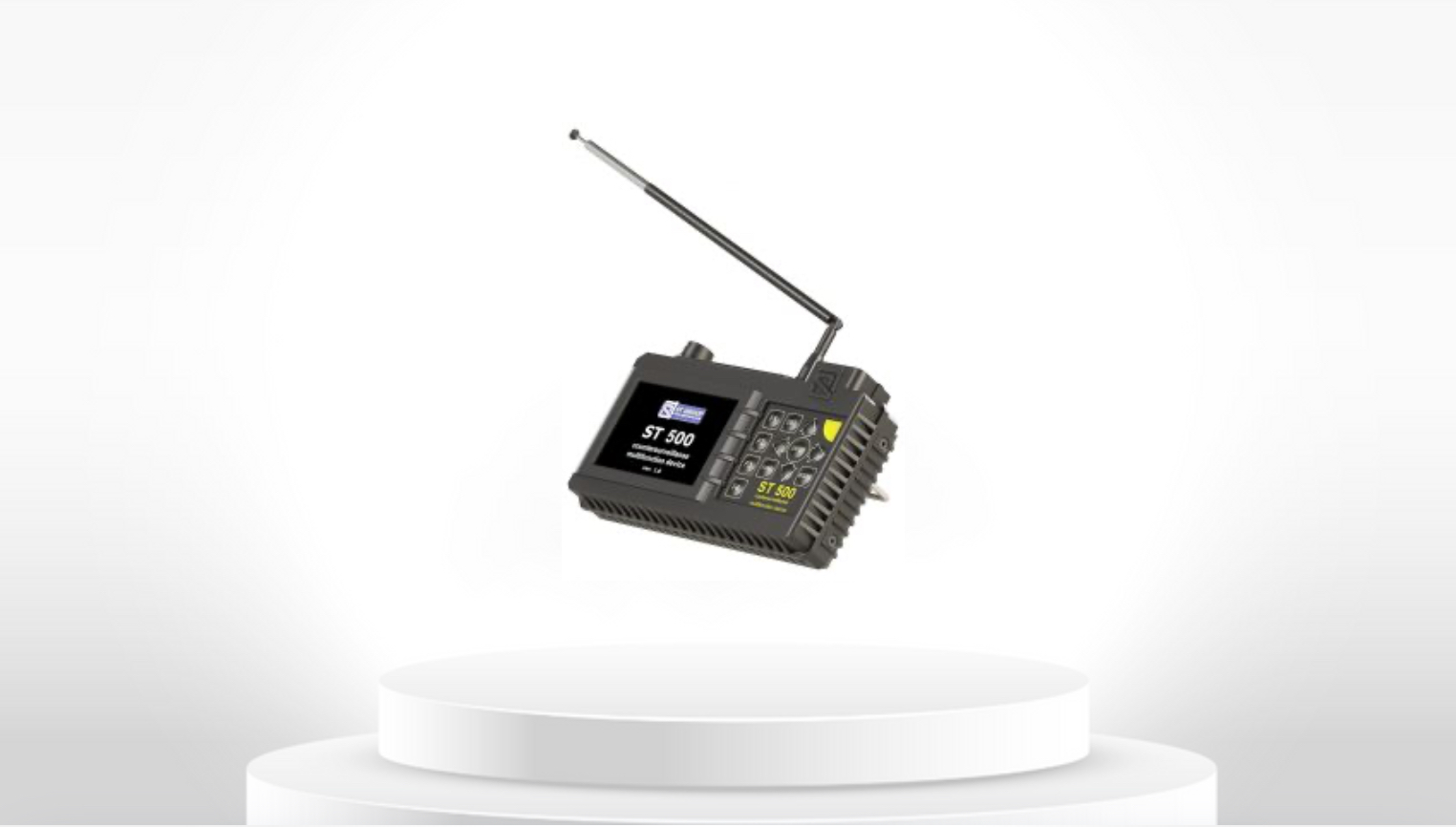
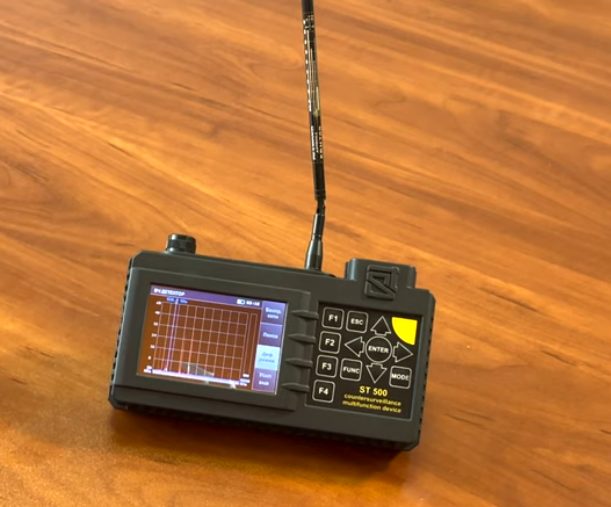
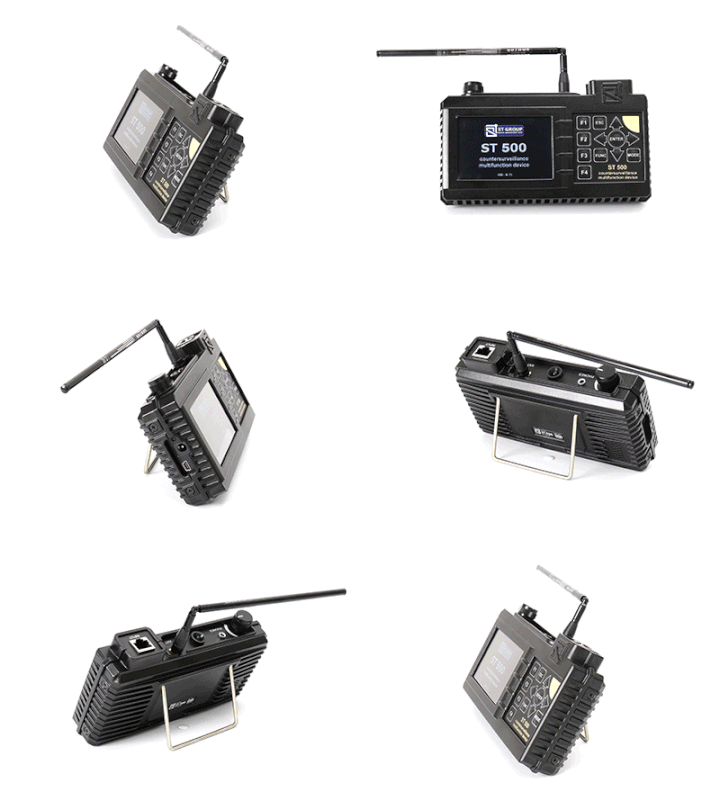
ST-500 PIRANHA Multifunctional TSCM Detection Device
Four detection channels. Wireless and wired inspection. One professional platform for investigating electronic surveillance and data leakage channels.
The ST-500 PIRANHA is a multifunctional TSCM detection device designed to detect, analyze and help localize electronic surveillance transmission channels across wireless, infrared and wired environments.
Instead of focusing on a single detection method, the ST-500 combines four dedicated inspection channels:
Selective HF Detection → IR Detection → Wired Receiver → Low Frequency Amplification
This architecture allows qualified TSCM professionals to investigate different types of potential electronic surveillance and data leakage channels using one portable instrument.
What Is the ST-500 PIRANHA?
The ST-500 PIRANHA is a multifunctional detection device for TSCM and electronic surveillance inspection.
It is designed around the principle that electronic surveillance can communicate through different transmission paths.
A potential surveillance device may transmit:
- Through radio frequencies
- Through infrared
- Through electrical mains
- Through telephone or other low-current lines
- Through other wired communication paths
A single RF detector cannot address all of these possibilities.
The ST-500 therefore combines multiple detection channels within one instrument.
The objective is not simply to detect “a signal.”
It is to help the operator determine:
What type of transmission may be present?
Where is it appearing?
Is it new or already present in the environment?
Can the signal be analyzed further?
Does the finding justify physical verification?
Four Detection Channels in One Platform
1. Selective HF Detector
The Selective HF Detector covers 20 MHz–6000 MHz.
It is designed to investigate analog and digital radio transmissions associated with active electronic surveillance devices.
Supported signal categories include:
- GSM
- CDMA
- LTE
- Bluetooth
- WiFi
The RF channel provides several analysis modes, including:
- Panorama
- Differential
- Automated
- Wireless Communication
- Fixed-frequency analysis
- Oscilloscope analysis
- Audio analysis
This allows an operator to move from broad spectrum observation toward more focused analysis of a detected signal.
2. Infrared Detector
The dedicated IR Detector is designed to detect infrared transmitters.
Its purpose is different from thermal imaging or passive infrared motion detection.
The channel investigates infrared transmission used by electronic surveillance equipment to transmit information.
The IR channel can display detected signal information graphically and acoustically, while its differential mode can assist with locating the source of an observed IR signal.
This makes the IR channel a complementary TSCM capability rather than a general-purpose infrared camera.
3. Wired Receiver
The Wired Receiver investigates high-frequency signals carried through:
- Electrical mains
- Telephone lines
- LAN and low-current cabling
- Other low-current circuits
The specified operating range is:
100 kHz–180 MHz
The channel supports:
- Panorama analysis
- Differential analysis
- Automated search
- Fixed-frequency analysis
- AM/FM demodulation
- Oscilloscope analysis
This provides a dedicated method for investigating potential surveillance transmission channels that do not rely on conventional wireless RF radiation.
4. Low Frequency Amplifier
The Low Frequency Amplifier covers:
20 Hz–25 kHz
It is designed to investigate low-frequency signals that may be present on wired circuits.
The gain can be selected across multiple amplification levels:
1× / 2× / 5× / 10× / 20× / 50× / 100×
The channel can therefore be used as part of a broader investigation of low-frequency wired transmission paths.
RF Spectrum Detection and Analysis
The ST-500 does more than display that RF energy exists.
The Selective HF Detector can scan the 20 MHz–6 GHz range and present detected activity through graphical and analytical interfaces.
Operators can examine:
- Signal frequency
- Signal level
- Continuous signals
- Pulse signals
- Spectrum activity
- Demodulated information
- Oscilloscope response
- Previously observed signals
The device also supports fine frequency tuning and selectable analysis bandwidth.
This provides a more structured workflow than simply moving around a room while watching a single signal-strength meter.
Differential Detection
One of the useful functions of the ST-500 is Differential Mode.
An operator can first establish the RF environment at one location and then compare subsequent measurements against that baseline.
New or changing signals can therefore receive additional attention.
This is particularly useful in environments with substantial legitimate wireless activity.
For example, an inspection may begin with:
Baseline Environment → Differential Measurement → New Signal → Signal Analysis → Localization → Verification
The purpose is to help reduce unnecessary attention to signals that are already known to be present.
Differential detection does not automatically determine that a newly detected signal is a surveillance device.
It identifies a change that requires interpretation.
Automated Signal Detection
The Automated Mode is designed to register signals exceeding an adaptive detection threshold within the selected frequency limits.
Detected signals can be categorized within the system according to configured signal classifications.
The manufacturer documentation describes categories including:
- Threat
- Non-Threat
- Unknown
These classifications are based on configured frequency-band information and should be treated as an analytical aid rather than an independent determination of hostile intent.
A “threat” classification does not by itself prove that a physical surveillance device is present.
Professional verification remains necessary.
Wireless Communication Analysis
The ST-500 includes a Wireless Communication mode for monitoring frequency bands associated with digital communication standards.
This supports investigation of signals associated with:
- GSM
- CDMA
- Bluetooth
- LTE
- WiFi
Regional and user-defined frequency-band information can also be configured through the associated software environment.
This is particularly relevant when the RF environment contains many legitimate communication systems and the operator needs to focus the inspection on particular bands.
Base Station and Mobile Communication Monitoring
The ST-500 can distinguish and monitor signal activity associated with mobile communication infrastructure and mobile digital communication devices.
This provides additional context when analyzing cellular RF environments.
The important distinction is:
Signal classification is not the same as device identification.
A detected GSM, LTE or other mobile signal does not automatically identify a specific handset, tracker or surveillance device.
The result must be interpreted within the physical inspection environment.
Signal Localization
Detection is only the first stage of a TSCM investigation.
Once a potentially relevant signal has been identified, the operator can use signal level, frequency analysis, audio analysis and repeatable movement through the inspected area to help localize the source.
The manufacturer describes a workflow based around:
Detection → Identification → Localization
The actual localization result depends on:
- Transmitter output power
- Distance
- Environmental RF conditions
- Interference
- Building construction
- Antenna position
- Signal behavior
- Operator technique
The ST-500 therefore provides localization assistance rather than an automatic exact-position determination.
Infrared Signal Localization
The IR channel includes a Differential Mode that establishes a reference level and displays changes from that baseline.
This can help the operator investigate the direction or location of an observed infrared transmission.
As with RF detection, the result should be physically verified before concluding that an identified signal belongs to a surveillance device.
Wired Surveillance Detection
Not every electronic surveillance system needs to radiate a conventional wireless signal.
Some systems may transfer information through:
- Power lines
- Telephone circuits
- Low-current wiring
- Other conductive communication paths
The ST-500’s Wired Receiver is designed specifically for this inspection problem.
It can investigate signals from 100 kHz to 180 MHz on connected circuits.
The instrument provides multiple analysis modes so the operator can move from broad line inspection toward more detailed signal analysis.
Low-Current and Telephone Line Inspection
The ST-500 can be connected to appropriate low-current circuits and telephone lines using the supplied connection accessories.
Depending on the circuit under investigation, the operator can:
Scan → Identify an abnormal signal → Select the affected line → Analyze → Apply appropriate test conditions → Localize → Verify
The equipment should be used according to the circuit type, applicable electrical safety procedures and the manufacturer’s operating instructions.
Wired Electret Microphone Investigation
The ST-500 includes bias-voltage functionality for investigating certain wired microphone configurations.
Applying an appropriate bias voltage can assist in testing wired electret microphones connected to compatible circuits.
This is an investigative function—not a guarantee that every wired microphone will respond.
Actual results depend on:
- Microphone configuration
- Circuit design
- Wiring
- Existing voltage
- Transmission method
- Circuit condition
Spectrum Analyzer and Oscilloscope Functions
The ST-500 provides additional signal-analysis functions beyond basic detection.
Spectrum Analysis
Spectrum analysis helps the operator examine the distribution of signal energy across frequency.
This can help answer:
Where is the signal located in frequency?
Oscilloscope Analysis
Oscilloscope functionality provides time-domain information about the detected or demodulated signal.
This can help answer:
What does the signal behavior look like over time?
Audio Analysis
Where appropriate, demodulated signals can also be monitored through headphones or the built-in speaker.
Audio analysis may provide another layer of information when investigating analog or otherwise demodulatable transmissions.
These analytical functions should be interpreted by trained operators rather than treated as automatic device identification.
ST-500 in a Professional TSCM Workflow
The ST-500 is best understood as part of a structured inspection process.
1. Establish the Environment
Identify legitimate wireless infrastructure and known communication sources.
2. Scan
Use the Selective HF Detector to examine the relevant RF spectrum.
3. Compare
Use Differential Mode to identify signals that differ from the established environment.
4. Analyze
Examine suspicious signals through frequency, spectrum, oscilloscope or audio functions.
5. Classify
Use the device’s configured signal classifications and professional judgment to determine which findings require additional attention.
6. Localize
Use repeatable measurements and signal-level changes to narrow the likely source area.
7. Inspect Wired Paths
Where appropriate, examine mains and low-current circuits using the Wired Receiver and LFA channels.
8. Investigate Infrared
Use the dedicated IR channel where an infrared transmission is a relevant possibility.
9. Physically Verify
Identify the actual source, device, component or legitimate infrastructure responsible for the observed response.
10. Document
Record the detection, conditions, analysis, localization process and final finding.
Detect → Analyze → Localize → Verify → Document
Designed For & Common Applications
Professional TSCM Sweeps
The ST-500 is designed for technical surveillance countermeasure inspections where multiple transmission paths need to be investigated.
Corporate Security
Security teams can use qualified TSCM specialists to investigate sensitive offices, meeting rooms and executive environments.
Government and Institutional Security
The combination of wireless, infrared and wired inspection channels can support security assessments in sensitive facilities.
Executive and Boardroom Inspections
The RF and wired channels can be used to investigate communication paths within areas where confidential discussions take place.
High-Sensitivity Information Environments
Facilities handling confidential information may require investigation of both wireless and conductive data leakage channels.
Professional Investigation
The device can support specialist investigators examining suspected electronic surveillance equipment and transmission paths.
Telecommunications and Low-Current Infrastructure
The Wired Receiver and LFA provide dedicated capabilities for examining signals present on selected conductive circuits.
What ST-500 Can and Cannot Do
What It Can Do
The ST-500 can help qualified operators:
- Scan RF activity from 20 MHz to 6 GHz
- Analyze supported wireless communication signals
- Identify configured digital signal categories
- Compare current RF activity with an established baseline
- Analyze selected signals through spectrum and oscilloscope functions
- Perform audio analysis where applicable
- Detect infrared transmissions
- Investigate wired high-frequency signals from 100 kHz to 180 MHz
- Analyze low-frequency wired signals from 20 Hz to 25 kHz
- Investigate certain wired electret microphone configurations
- Support localization of detected transmission sources
- Connect to a PC for additional software-supported analysis
What It Cannot Automatically Do
The ST-500 does not automatically:
- Prove that every detected signal is a surveillance device
- Identify the exact physical device responsible for every signal
- Determine hostile intent
- Distinguish every legitimate wireless device from every surveillance device
- Detect every camera
- Detect every GPS tracker
- Detect passive infrared cameras
- Detect laser microphones as a dedicated laser detector
- Read communications content
- Provide universal identification of a Flipper Zero or other multifunction device
- Replace physical inspection or professional TSCM methodology
The correct professional interpretation is:
Detection ≠ Identification ≠ Attribution ≠ Threat Assessment
ST-500 vs Conventional RF Detector
| Capability | Conventional RF Detector | ST-500 PIRANHA |
|---|---|---|
| RF detection | Yes | Yes |
| RF range to 6 GHz | Model-dependent | Yes |
| Differential RF analysis | Model-dependent | Yes |
| Automated RF search | Model-dependent | Yes |
| Spectrum analysis | Model-dependent | Yes |
| Oscilloscope analysis | Usually limited | Yes |
| Audio analysis | Model-dependent | Yes |
| IR transmission detection | Usually no | Yes |
| Wired high-frequency detection | No | Yes |
| Low-frequency wired analysis | No | Yes |
| Wired microphone investigation | No | Yes |
| Multi-channel TSCM workflow | Limited | Yes |
The difference is not simply frequency range.
A conventional RF detector may answer:
“Is RF activity present?”
The ST-500 is designed to support a broader investigation:
“What transmission channels are present, what changed, how can the signal be analyzed, and where should the operator investigate next?”
ST-500 vs Spectrum Analyzer
A spectrum analyzer is optimized for detailed RF measurement and signal characterization.
The ST-500 is optimized around a broader TSCM inspection workflow.
| Requirement | Spectrum Analyzer | ST-500 PIRANHA |
|---|---|---|
| Detailed RF measurement | Strong | Supported |
| RF spectrum inspection | Yes | Yes |
| TSCM-oriented automated search | Model-dependent | Yes |
| Differential search | Model-dependent | Yes |
| IR transmission detection | No | Yes |
| Wired signal inspection | No | Yes |
| Low-frequency wired analysis | No | Yes |
| Wired microphone investigation | No | Yes |
| Multi-channel TSCM platform | No | Yes |
The two technologies can therefore serve different purposes and may complement one another in a professional inspection environment.
Professional Selection: What Should Buyers Evaluate?
Before procurement, professional users should consider:
- Required RF frequency range
- Types of wireless technologies present at the inspection sites
- Need for differential detection
- Need for automated signal search
- Requirement for spectrum analysis
- Requirement for oscilloscope analysis
- Requirement for audio analysis
- IR transmission detection requirements
- Power-line inspection requirements
- Low-current line inspection requirements
- Telephone-line inspection requirements
- Need for wired microphone investigation
- PC/software workflow
- Operator training
- Electrical safety requirements
- Regional RF environment
- Documentation and reporting requirements
- Manufacturer or specialist technical support
The most important question is not:
“How many frequencies can it detect?”
It is:
“Does the detection architecture match the transmission paths I actually need to investigate?”
Technical Specifications
| Parameter | Specification |
|---|---|
| Product Type | Multifunctional TSCM Detection Device |
| Selective HF Detector | 20–6000 MHz |
| HF Passband | 1 MHz / 20 MHz |
| HF Input Impedance | 50 Ω |
| HF Scanning Speed | 18 GHz/s |
| HF Minimum Detection Level | −70 dB |
| HF Dynamic Range | 50 dB |
| IR Spectral Range | 0.75–1.1 µm |
| IR Detection Passband | 5 MHz |
| IR Field of View | ±20° |
| IR Minimum Detectable Power | 10⁻¹³ W/Hz½ |
| Wired Receiver | 0.1–180 MHz |
| Wired Receiver Scan Time | Approx. 2 seconds for full range |
| Wired Receiver Minimum Detection Level | −50 to −75 dBm |
| Wired Receiver Dynamic Range | 50 dB |
| Wired Receiver Input Impedance | 100 Ω |
| Wired Receiver Demodulation | AM / FM |
| Wired Receiver Input Filter | 180 kHz |
| Low Frequency Amplifier | 20–25,000 Hz |
| LFA Input Impedance | 200 kΩ |
| LFA Gain | 1× / 2× / 5× / 10× / 20× / 50× / 100× |
| LFA Maximum Input | ±60 V DC / ±1 V AC |
| LFA Noise Spectral Density | 3 nV/Hz |
| Bias Voltage | +30 V / −30 V |
| Battery | Built-in 3.7 V lithium-polymer battery |
| Power Consumption | <1 W |
| Operating Time | >4 hours at maximum power |
| Recharge Time | Approx. 7 hours |
| Main Unit Dimensions | 165 × 100 × 40 mm |
| Main Unit Weight | 470 g |
Specifications should be confirmed against the current manufacturer documentation and supplied configuration before procurement.
Included Equipment
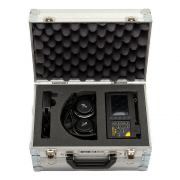
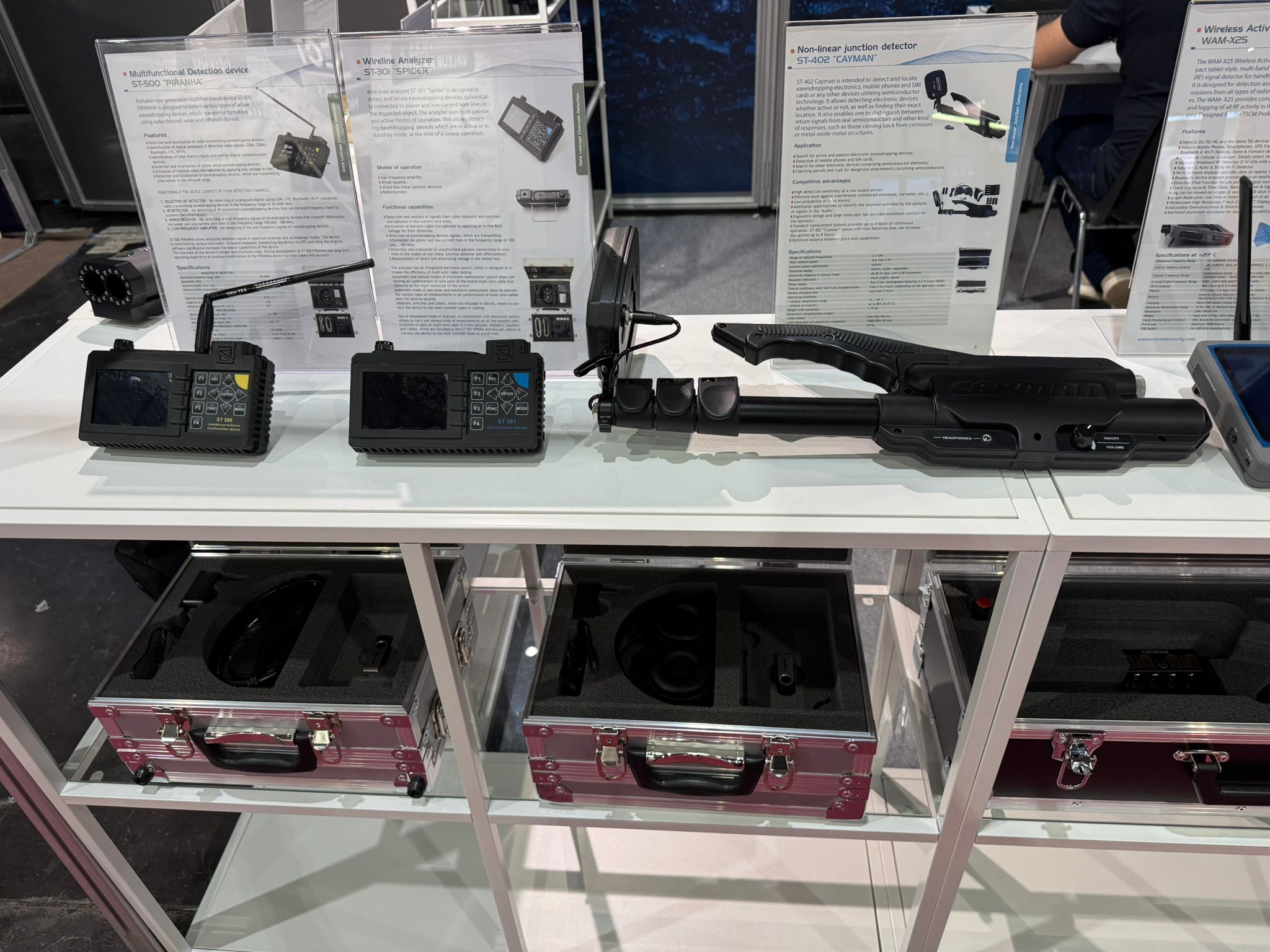
The standard ST-500 configuration documented by the manufacturer includes the main unit and accessories for wireless and wired inspection, including:
- ST-500 main unit
- Telescopic HF antenna
- Charger
- Headphones
- PC connection cable
- USB flash drive with software/manual
- Telephone-line connection accessories
- Low-current line connection cable
- RJ11/RJ45 couplers and splitters
- Multicore cable connection adapter
- Transportation case
Important: The manufacturer documentation states that the test sound source is not included in the package and can instead be provided by a suitable portable device such as a smartphone, tablet or voice recorder.
The current manufacturer information also states that an induction/magnetic sensor is not included in the ST-500 kit and is associated with the separately purchased ST-600.
Accessory configurations should therefore be confirmed before purchase.
Frequently Asked Questions
What is the ST-500 PIRANHA?
The ST-500 PIRANHA is a multifunctional TSCM detection device designed to investigate wireless, infrared and wired electronic surveillance transmission channels.
What does ST-500 detect?
Its four detection channels cover:
- RF signals from 20 MHz to 6 GHz
- Infrared transmissions
- Wired high-frequency signals from 100 kHz to 180 MHz
- Low-frequency wired signals from 20 Hz to 25 kHz
Is ST-500 an RF detector?
Yes, but it is more than a conventional RF detector. It combines selective HF detection with IR, wired receiver and low-frequency amplification channels.
What RF frequency range does ST-500 cover?
The Selective HF Detector operates from 20 MHz to 6000 MHz.
Can ST-500 detect GSM and LTE?
Yes. The manufacturer documentation identifies GSM and LTE among the supported digital communication signal categories.
Can ST-500 detect Bluetooth and WiFi?
Yes. Bluetooth and WiFi are among the supported wireless signal categories.
Does ST-500 identify a specific phone?
Not automatically. It can identify or classify detected signal characteristics and communication categories, but signal classification should not be interpreted as unique physical-device identification.
Can ST-500 detect GPS trackers?
It may detect radio transmissions from tracking devices when their transmission falls within the detector’s capabilities and operating conditions. It should not be presented as a universal GPS-tracker detector.
Can ST-500 detect a switched-off surveillance device?
The ST-500’s RF and IR channels are primarily concerned with transmission signals. A switched-off device that produces no relevant transmission cannot be assumed to be detectable through those channels.
Other TSCM technologies, such as nonlinear junction detection, may be appropriate for investigating non-transmitting electronics.
Does ST-500 detect hidden cameras?
It can detect relevant radio or infrared transmissions from electronic surveillance devices where the transmission falls within its detection capabilities.
It is not a dedicated optical hidden-camera lens detector and should not be marketed as detecting every hidden camera.
Does ST-500 detect passive infrared cameras?
No. The IR channel is designed for detecting infrared transmissions, not passive infrared motion sensing.
Can ST-500 detect laser microphones?
ST-500 does not provide a dedicated laser microphone detection channel. Laser-based surveillance requires appropriate specialist detection methodology.
Does ST-500 detect Flipper Zero?
The ST-500 detects RF activity within its supported frequency range, but it should not be marketed as a dedicated Flipper Zero detector or as automatically identifying the device.
What is the Wired Receiver used for?
The Wired Receiver investigates high-frequency signals present on power and low-current lines from approximately 100 kHz to 180 MHz.
Can ST-500 inspect telephone lines?
Yes. The supplied configuration includes telephone-line connection accessories and the manufacturer documents telephone-line inspection procedures.
Can ST-500 investigate wired microphones?
Yes, within applicable configurations. The device provides bias-voltage functionality that can assist in investigating certain wired electret microphone arrangements.
What is Differential Mode?
Differential Mode establishes a reference and helps identify changes in the detected environment. In RF inspection, this can help highlight newly appearing or changing signals.
Does ST-500 eliminate false alarms?
No detection system should be presented as eliminating false alarms automatically.
Differential analysis, signal classification and further signal analysis can help operators distinguish findings that require attention, but professional interpretation remains necessary.
Does ST-500 provide spectrum analysis?
Yes. The device supports spectrum-analysis functionality for examining detected signals.
Does ST-500 provide oscilloscope analysis?
Yes. Oscilloscope functionality is available for additional signal analysis.
Can ST-500 analyze audio?
Yes, where the detected signal can be appropriately demodulated. Audio can be monitored through headphones or the built-in speaker.
Is ST-500 suitable for professional TSCM?
Yes. Its architecture is specifically designed around the detection and localization of wireless, infrared and wired surveillance transmission channels.
Is ST-500 suitable for beginners?
The device provides multiple professional analysis modes and is best used by operators who understand RF, wired-line inspection and TSCM procedures.
Does ST-500 replace a nonlinear junction detector?
No.
An NLJD addresses a different detection problem: investigating electronic components that may be present even when they are not actively transmitting.
The ST-500 primarily investigates transmission channels.
For comprehensive TSCM work, the two technologies can be complementary.
Does ST-500 replace a spectrum analyzer?
Not necessarily.
The ST-500 provides spectrum-analysis functionality within a broader TSCM platform, while a dedicated spectrum analyzer may provide deeper RF measurement and characterization capabilities depending on the model.
What is the biggest advantage of ST-500?
Its primary advantage is multi-channel TSCM coverage.
Instead of relying only on conventional RF detection, the ST-500 combines:
RF → IR → Wired HF → Low Frequency
within one inspection platform.
Professional TSCM Equipment vs Single-Purpose Detectors
Single-purpose detectors can be useful when the inspection requirement is narrow.
A professional TSCM investigation, however, may require examination of several potential transmission paths.
The difference is therefore not simply whether one device is “better.”
It is whether the equipment supports the investigation methodology required by the environment.
A single RF detector may answer:
“Is there RF activity?”
The ST-500 can extend the investigation toward:
“What RF activity is present?”
“What changed?”
“Can the signal be analyzed?”
“Is there an infrared transmission?”
“Is there a signal on a wired line?”
“Is there low-frequency activity?”
“Where should the operator investigate next?”
That broader architecture is the reason the ST-500 belongs in the professional TSCM equipment category.
Procurement & Deployment Considerations
Before deployment, professional buyers should confirm:
- Current hardware revision
- Current firmware/software version
- Regional RF requirements
- Required frequency-band configuration
- Included accessories
- Electrical connection requirements
- Operator training
- Site safety procedures
- Applicable legal requirements
- Technical support availability
When inspecting electrical circuits, operators should follow the manufacturer’s procedures and the electrical safety requirements applicable to the installation.
The ST-500 should be treated as professional inspection equipment—not as an automatic surveillance-device classifier.
Global Procurement Through Archthetic
Archthetic connects professional buyers with specialized TSCM technologies from international technology ecosystems.
For the ST-500 PIRANHA, the procurement process is designed around:
Discover → Evaluate → Confirm Configuration → Procure → Deploy
Before purchase, professional buyers can evaluate the detection architecture, technical specifications, intended inspection environment and required accessories.
The objective is not simply to purchase another detector.
It is to select a detection platform that matches the transmission paths, operational requirements and professional TSCM methodology of the organization.
Focused Conclusion
The ST-500 PIRANHA is a multifunctional TSCM detection platform built around four complementary inspection channels:
Selective HF Detection
Infrared Transmission Detection
Wired High-Frequency Detection
Low-Frequency Analysis
Its value comes from bringing these capabilities together with differential search, automated detection, signal classification, spectrum analysis, oscilloscope analysis and audio analysis.
It does not automatically identify every electronic device or establish hostile intent.
Its role is more practical:
Detect → Analyze → Localize → Verify → Document
For professional TSCM teams investigating wireless, infrared and wired data leakage channels, the ST-500 provides a broader inspection architecture than a single-purpose RF detector.
Four channels. Multiple transmission paths. One professional TSCM investigation platform.


Reviews
There are no reviews yet.